Your Ultimate 10-Point Real Estate Due Diligence Checklist for 2025
Don't buy blind. Our comprehensive real estate due diligence checklist covers the 10 critical checks you must make before closing to protect your investment.
Investing in real estate is one of the most significant financial decisions you'll ever make. The difference between a profitable asset and a costly mistake often comes down to one critical process: due diligence. This isn't just about a standard home inspection; it's a comprehensive investigation into every aspect of the property's legal, physical, and financial health. A thorough real estate due diligence checklist acts as your roadmap, guiding you through every essential verification step from pre-offer analysis to post-closing confirmation.
Neglecting this process can lead to unforeseen expenses, legal entanglements, and significant buyer's remorse. A poorly executed deal can trap capital in an underperforming asset or, worse, become a liability that drains your resources for years. A systematic approach, however, transforms a potentially risky purchase into a calculated and secure investment. To kickstart your due diligence process and gain a comprehensive initial understanding of a property, consider leveraging an AI-powered real estate property analyzer. These tools can quickly process financial data to give you a clear picture of potential returns before you commit significant time and capital.
This guide breaks down the 10 most critical components of a robust due diligence strategy, organized by the stages of your transaction. We'll provide actionable steps, red flags to watch for, and insights on when to call in professionals. By following this structured checklist, you can move forward with the clarity and confidence needed to build a successful real estate portfolio, ensuring that your next purchase is a strategic win, not a hidden disaster.
1. Property Title Search & Examination
A property title search is the cornerstone of any real estate due diligence checklist. This critical investigation verifies that the seller has the legal right to transfer ownership and uncovers any claims, liens, or restrictions tied to the property. It’s a historical deep-dive into public records to ensure you receive a "clean" or "clear" title, free from future legal challenges from other parties.
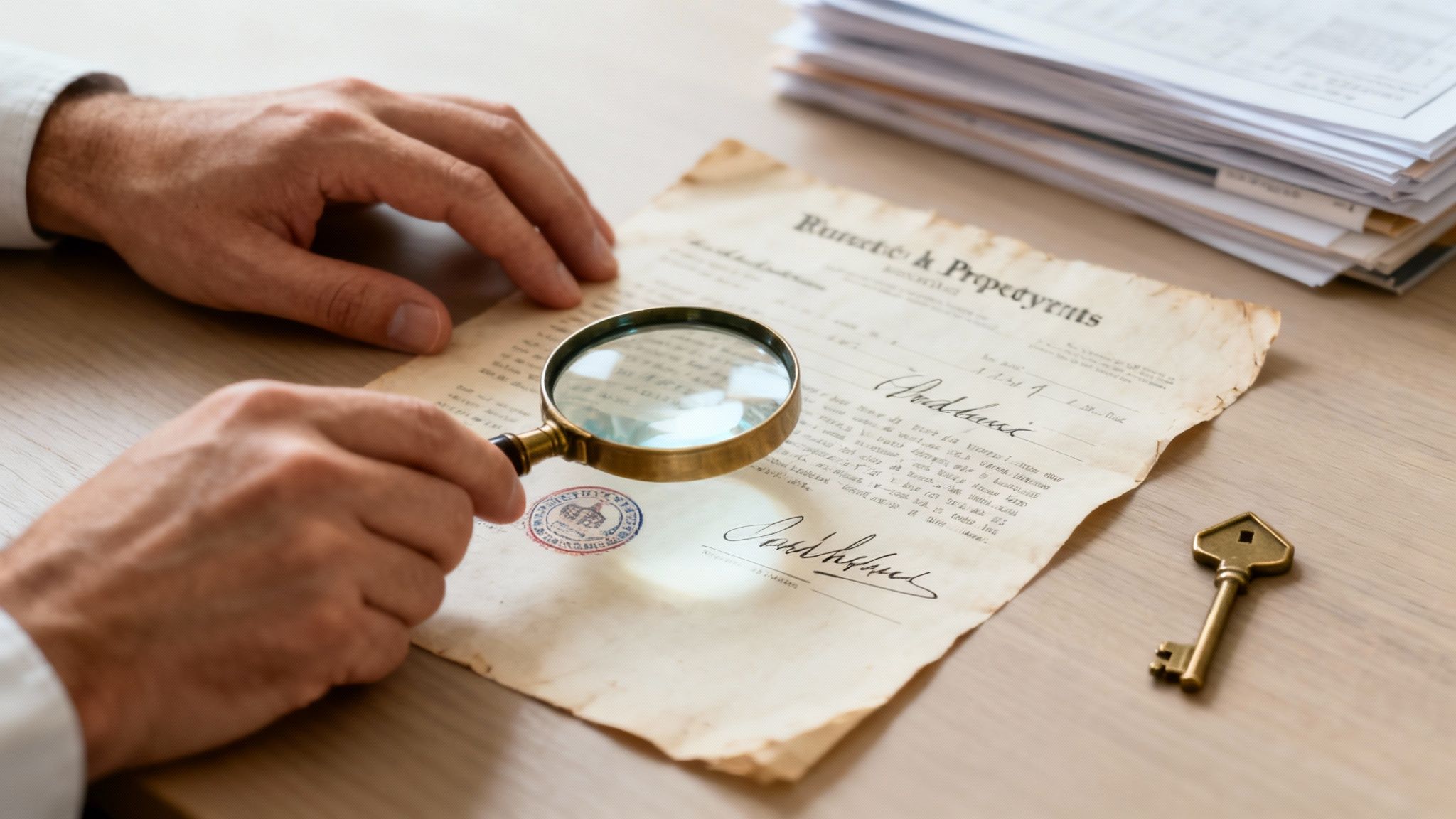
Without this step, you could inherit costly problems. Imagine discovering after closing that the seller’s ex-spouse has a claim from a divorce settlement or that the local utility company has a wide, restrictive easement running right through your planned building site. A thorough title search identifies these issues upfront, allowing you to address them before they derail your investment.
Key Actions and What to Look For
Engage a reputable title company or real estate attorney early in the post-offer phase. They will conduct the search and produce a title commitment, a document outlining their findings and the conditions required to issue a title insurance policy.
When reviewing the commitment, pay close attention to the "Schedule B-II" section, which lists exceptions to coverage. Common red flags include:
- Financial Liens: Unpaid property taxes, mechanic's liens from contractors, or outstanding mortgages.
- Easements and Encroachments: Rights granted to others to use a portion of your property (e.g., for utility lines) or a neighbor’s fence extending onto your land.
- Restrictive Covenants: Rules and restrictions from a homeowner's association (HOA) or a previous owner that limit how you can use the property.
- Chain of Title Issues: Gaps or errors in the historical record of ownership that could create legal ambiguity.
Obtaining both an Owner's Title Insurance Policy and a Lender's Title Insurance Policy is non-negotiable. The lender's policy protects their loan, while the owner's policy protects your equity from any title defects missed during the search.
2. Property Inspection & Condition Assessment
While a title search secures your legal ownership, a physical property inspection protects your financial investment by revealing the true condition of the asset. This detailed examination, performed by a licensed professional, scrutinizes everything from the foundation to the roof, identifying defects, safety hazards, and necessary repairs. It’s a crucial step in any real estate due diligence checklist, translating the physical state of the property into a clear financial picture.

This step prevents you from unknowingly acquiring a "money pit." Imagine discovering after closing that the HVAC system is on its last legs or that faulty wiring requires a complete and costly overhaul. A comprehensive inspection report provides the leverage to negotiate repairs with the seller, request a price reduction, or walk away from a deal that no longer makes financial sense, potentially saving you tens of thousands of dollars.
Key Actions and What to Look For
Hire a certified inspector, preferably one accredited by a major organization like the American Society of Home Inspectors (ASHI) or InterNACHI. It is highly recommended that you attend the inspection to ask questions and see potential issues firsthand. The inspector will provide a detailed report, often with photos, documenting their findings.
Pay special attention to big-ticket items that can severely impact your budget:
- Structural and Foundation Issues: Cracks in the foundation, signs of water intrusion in the basement, or uneven floors.
- Major Systems: The age and condition of the roof, HVAC system, plumbing, and electrical panels (e.g., outdated knob-and-tube wiring).
- Environmental Hazards: Evidence of mold, asbestos-containing materials, lead paint, or high radon levels.
- Safety and Code Violations: Improperly wired outlets, lack of GFCI protection, or unsafe stair railings.
If the general inspection uncovers potential problems in specific areas, do not hesitate to schedule specialized inspections for things like the foundation, sewer line, or pest activity. This thorough assessment ensures you fully understand the property’s liabilities before closing the deal.
3. Survey & Boundary Verification
While the title search confirms who owns the property, a professional land survey confirms what you actually own. This critical step establishes and documents the exact property boundaries, easements, encroachments, and the physical location of structures relative to those lines. It provides a visual and legal map of your ownership, preventing costly disputes and ensuring you get precisely the land you are paying for.

Without a current survey, you're relying on potentially outdated records and assumptions. Imagine discovering post-closing that a neighbor’s driveway encroaches two feet onto your lot, that the property is 0.3 acres smaller than advertised, or that an unrecorded utility easement prevents you from building a planned addition. A survey is a fundamental part of any comprehensive real estate due diligence checklist, identifying these physical and legal discrepancies before they become your problem.
Key Actions and What to Look For
Hire a state-licensed surveyor to perform a new survey, especially if the existing one is more than a decade old or if you plan any construction. For commercial or complex properties, requesting an ALTA/NSPS Land Title Survey provides a more detailed report that meets specific lender and title company requirements.
When reviewing the survey plat map, cross-reference it with the legal description in the title commitment and look for:
- Encroachments: Structures like fences, sheds, or driveways from neighboring properties that cross over onto your land (or vice versa).
- Easements: Recorded rights of way for utilities, access, or drainage that could restrict your use of the property. The survey will show their exact location.
- Setbacks: The survey will clearly mark building setback lines dictated by local zoning ordinances, showing you where you can and cannot build.
- Boundary Discrepancies: Differences between the surveyed property lines and existing fences or perceived boundaries. This could indicate a potential dispute with a neighbor.
If the survey reveals any encroachments or boundary issues, it is essential to resolve them through written agreements or legal action before closing. This step protects your property rights and prevents future conflicts that could impact your investment’s value and usability.
4. Environmental Assessment & Phase I ESA
An environmental assessment is a crucial step in a real estate due diligence checklist, particularly for commercial, industrial, or older properties. This investigation, formally known as a Phase I Environmental Site Assessment (ESA), identifies potential or existing environmental contamination liabilities. Its goal is to protect you, the buyer, from inheriting costly cleanup responsibilities and legal issues related to hazardous substances or pollutants.
Failing to conduct an ESA can lead to catastrophic financial consequences. For instance, you could purchase a property that was once a gas station and later discover a leaking underground storage tank (UST). The remediation costs for soil and groundwater contamination can easily exceed hundreds of thousands of dollars, turning a promising investment into a financial disaster. A Phase I ESA is your first line of defense against such hidden environmental risks.
Key Actions and What to Look For
Hire a certified environmental professional to conduct a Phase I ESA in accordance with ASTM International standards. This process is non-invasive and involves reviewing historical records, government databases, and conducting a site inspection to identify any "Recognized Environmental Conditions" (RECs). The final report will detail these findings and recommend a course of action.
During your review of the Phase I report, look for specific red flags:
- Historical Industrial Use: Evidence of past operations like dry cleaning, manufacturing, or auto repair that commonly used hazardous chemicals.
- Underground Storage Tanks (USTs): Presence of current or former USTs used for storing petroleum or other chemicals.
- Hazardous Materials: Identification of asbestos-containing materials (ACMs), lead-based paint, or radon gas.
- Nearby Contamination: Proximity to other contaminated sites that could have impacted your property’s soil or groundwater.
If the Phase I report identifies RECs, a Phase II ESA may be necessary. This next step involves invasive testing, such as soil and groundwater sampling, to confirm the presence and extent of contamination. These findings are critical for negotiating remediation costs with the seller or deciding if the property's environmental liability is too great to assume.
5. Zoning Compliance & Land Use Verification
Zoning and land use verification confirms that a property's current and intended use is legally permitted by the local municipality. This step is a crucial part of any real estate due diligence checklist, as it ensures your investment plans align with government regulations. It protects you from buying a property you cannot legally use as intended, whether for a specific business, a multi-family conversion, or a home expansion.
Without this verification, you could face significant financial and legal setbacks. Imagine purchasing a charming old house to operate a bed and breakfast, only to discover it’s in a single-family residential zone where such businesses are prohibited. Or finding that your plan to add a second story to a retail building violates a 35-foot height limit. Verifying zoning upfront prevents these costly surprises and ensures your project is viable from the start.
Key Actions and What to Look For
Start by contacting the local municipal planning or zoning department. Request an official zoning verification letter, which provides a formal statement of the property's zoning classification and its compliance status. This document is your foundational proof of the property's legal standing.
As you review the local zoning ordinance, search for these potential red flags:
- Nonconforming Use: The property's current use may have been "grandfathered in" but doesn't meet current zoning rules. This can limit your ability to expand, rebuild after damage, or even change the use.
- Parking and Setback Requirements: Insufficient parking spaces or structures built too close to property lines can trigger violations and expensive remedies.
- Future Land Use Map (FLUM) Conflicts: The city’s long-term plan may designate the area for a different use in the future, potentially leading to rezoning that conflicts with your plans.
- Conditional Use Permits (CUPs) or Variances: If your intended use is not automatically permitted, you may need to go through a lengthy and uncertain public hearing process to get special approval.
For any complex zoning issues, consulting a land use attorney is a wise investment. They can interpret dense code, assess the feasibility of obtaining a variance or rezoning, and guide you through the municipal approval process, protecting your investment from regulatory roadblocks.
6. Financial Review & Seller Disclosure Analysis
While inspections reveal a property's physical health, a deep dive into the seller's disclosures and financial records uncovers its operational and financial history. This step in your real estate due diligence checklist involves scrutinizing documents provided by the seller to understand past issues, ongoing costs, and potential liabilities that aren't visible during a walk-through. It’s about verifying what the seller claims and discovering what they might not.
Neglecting this review is like buying a business without looking at its books. For instance, a seller's disclosure might reveal the property flooded three times in the last five years, a critical fact that drastically impacts insurance costs and future risk. Similarly, reviewing three years of utility bills might show electricity costs tripling in the summer, strongly suggesting an inefficient or failing HVAC system that will soon need a costly replacement.
Key Actions and What to Look For
Request and meticulously review all seller-provided documents as soon as your offer is accepted. Your goal is to cross-reference these records with your own findings from inspections and public record searches. A real estate attorney can be invaluable in interpreting the legal implications of these documents.
Pay special attention to these potential red flags in the seller's packet:
- Seller Disclosure Inconsistencies: Does the seller claim "no known leaks" while your inspector found evidence of water damage in the attic? Document all discrepancies.
- HOA Financial Instability: Review all HOA documents, especially the budget and reserve study. Insufficient reserves (e.g., $50,000 in reserves when a study indicates $500,000 is needed for upcoming roof replacements) signal a high likelihood of a large special assessment.
- Utility Bill Anomalies: Sudden spikes or consistently high utility costs can indicate problems with insulation, appliances, or major systems.
- Undisclosed Violations: The seller may fail to mention open permits or code violations. Always verify this information with the local building department.
Thoroughly analyzing these documents provides leverage for negotiation and helps you create an accurate long-term budget for the property. Any significant discrepancy or undisclosed issue is a valid reason to renegotiate the price, request credits for repairs, or even walk away from the deal.
7. HOA & Condo Association Review
Purchasing a property within a Homeowners Association (HOA) or Condominium Association means you're not just buying real estate; you're buying into a governing entity with its own rules, finances, and politics. This part of your real estate due diligence checklist is crucial for understanding the community's health and the long-term obligations you will be responsible for, protecting you from surprise fees and restrictive limitations.
Neglecting this review can lead to disastrous financial consequences. Imagine discovering after closing that the HOA has only 10% of its recommended reserve funds and is planning a $2 million roof replacement. This scenario often triggers a large, mandatory special assessment, potentially costing you thousands of dollars out-of-pocket shortly after your purchase. A thorough review uncovers these hidden liabilities before you commit.
Key Actions and What to Look For
Your first step is to request the complete HOA or condo association document package from the seller. This should include bylaws, covenants, conditions, and restrictions (CC&Rs), financial statements, meeting minutes, and the reserve study. A real estate attorney specializing in community associations can be invaluable in deciphering these documents.
When reviewing the package, be vigilant for these red flags:
- Underfunded Reserves: The reserve study is a critical report detailing the lifespan of major shared components (roofs, elevators, pools) and the funds saved for their replacement. A severely underfunded reserve is a strong indicator of future special assessments.
- Pending Litigation: Lawsuits against the association, or by the association, can be costly and impact the community's financial stability and insurability.
- Restrictive Covenants: The CC&Rs may prohibit activities essential to your plans, such as renting out the property, certain types of renovations, or even parking a work vehicle in your driveway.
- Dysfunctional Governance: Reviewing several years of meeting minutes can reveal ongoing disputes between residents, high board turnover, or poor management, all of which can affect property values and quality of life.
Always obtain a resale certificate or estoppel letter directly from the association. This legally binding document confirms the current owner's account status, monthly dues, and any pending assessments tied to the specific unit, ensuring you don't inherit the seller's unpaid debts.
8. Financing & Appraisal Review
Even if you have pre-approval, this part of your real estate due diligence checklist is where financing meets the specific property. The lender's appraisal is an independent, professional assessment of the property's market value, and it's a critical step that protects both you and the lender from overpaying. It confirms that the asset is worth the loan amount and meets the lender’s minimum condition standards.
An appraisal that comes in below the contract price creates an "appraisal gap," which can be a major hurdle. For instance, if you offer $375,000 but the property appraises for only $350,000, the lender will only finance based on the lower value. This leaves you to either cover the $25,000 difference in cash, renegotiate the price with the seller, or walk away from the deal if you have an appraisal contingency in place.
Key Actions and What to Look For
Your lender will order the appraisal from a licensed professional. Your main task is to ensure your purchase agreement includes an appraisal contingency, giving you an exit if the value is too low. Once the appraisal report is complete, review it carefully with your real estate agent and lender.
Pay close attention to these common red flags and key details:
- Valuation vs. Purchase Price: The most obvious checkpoint. Does the appraised value meet or exceed the agreed-upon price?
- "Subject To" Conditions: The appraiser may flag necessary repairs before the lender will fund the loan, such as a damaged roof, non-operational HVAC system, or safety issues like missing handrails.
- Comparable Sales (Comps): Analyze the properties the appraiser used for comparison. Are they truly similar in size, condition, and location? If not, you may have grounds to challenge the appraisal.
- Inaccurate Property Details: Verify that the report correctly lists the property’s square footage, number of bedrooms and bathrooms, and notable features. Errors here can significantly impact the valuation.
Proactively provide the appraiser with a list of recent upgrades or improvements and a copy of the inspection report to ensure they have a complete picture of the property's condition. A low appraisal isn't a deal-killer, but it's a critical financial check that forces a realistic conversation about the property's true market worth.
9. Insurance & Risk Assessment
A crucial, yet often overlooked, part of any real estate due diligence checklist is a thorough insurance and risk assessment. This step goes beyond simply confirming the property is insurable; it involves evaluating the availability, cost, and adequacy of coverage for potential hazards. It's an essential financial projection that identifies risks and ensures you can secure affordable, comprehensive protection for your investment.
Neglecting this can lead to devastating financial surprises. Imagine discovering after closing that your new coastal property is in a high-risk flood zone, requiring an additional $3,000 in annual flood insurance premiums. Or finding out a history of water damage claims has rendered the home uninsurable by standard carriers, forcing you into a specialty policy at double the cost. Assessing insurance early prevents these budget-busting scenarios from jeopardizing your deal.
Key Actions and What to Look For
Contact an insurance agent immediately after your offer is accepted to get quotes and discuss potential issues. Provide them with the property address and any details from the seller’s disclosure. This proactive step helps you understand the full cost of ownership and underwriting requirements before you are financially committed.
When investigating insurance, be vigilant for these red flags:
- High-Risk Hazard Zones: Check official FEMA flood maps or local wildfire hazard maps. A property's location can mandate expensive, specialized policies.
- Claims History (CLUE Report): Request a Comprehensive Loss Underwriting Exchange (CLUE) report from the seller. A history of frequent claims, especially for water or mold, can dramatically increase premiums or lead to denial of coverage.
- Outdated Systems: Insurers may charge higher rates or deny coverage for properties with old electrical systems (like knob-and-tube wiring), aging roofs, or galvanized plumbing.
- Uninsurable Features: Certain features, such as pools without fences, specific dog breeds, or trampolines, can create liability issues that make standard insurance difficult to obtain.
Factoring a realistic insurance estimate into your holding cost analysis is critical. It ensures your projected cash flow or profit margin accounts for this significant and recurring expense, protecting the long-term viability of your investment.
10. Legal Review & Title Attorney Consultation
While a title search provides the raw data, a legal review by a qualified real estate attorney provides the expert interpretation and strategic guidance necessary to navigate it. This step involves a comprehensive legal examination of all transaction documents, including the purchase agreement, title commitment, and property disclosures. An attorney acts as your advocate, ensuring you understand your legal obligations, liabilities, and protections before closing.
Without professional legal counsel, you might misinterpret complex contract clauses or overlook subtle but significant title issues. For example, an attorney might discover that your purchase agreement lacks a crucial financing contingency, exposing you to legal action if your loan falls through. Their role is to transform legal jargon into clear risks and actionable advice, safeguarding your investment from preventable legal pitfalls. For any property transaction, a robust legal review is crucial, and understanding the nuances of real estate law is foundational to uncovering potential liabilities.
Key Actions and What to Look For
Engage a real estate attorney who has specific experience with your type of transaction (e.g., commercial, residential, land). Provide them with all documents as soon as you receive them, including the purchase contract, inspection reports, and title commitment. Their review is a critical part of any comprehensive real estate due diligence checklist.
Your attorney's review should scrutinize every detail for potential red flags:
- Contractual Weaknesses: Identifying missing contingencies, ambiguous clauses, or unfavorable terms that could put you at a disadvantage.
- Title and Survey Defects: Analyzing easements, encroachments, or boundary disputes discovered in the title search and survey to determine their impact on your intended property use.
- Zoning and Land Use Compliance: Confirming that the property's current and planned use complies with local ordinances and restrictions.
- Entity Structuring: Advising on the best way to hold title (e.g., LLC, trust) for liability protection and tax optimization.
Request that your attorney provide a written summary of their findings and recommendations. This documentation is invaluable for negotiating with the seller to resolve issues and provides a clear record of the legal due diligence performed before you commit to the purchase.
10-Point Real Estate Due Diligence Comparison
| Item | Implementation complexity 🔄 | Resource requirements ⚡ | Expected outcomes 📊 | Ideal use cases 💡 | Key advantages ⭐ |
|---|---|---|---|---|---|
| Property Title Search & Examination | Moderate–High: extensive records review; possible legal follow-up | Title company/attorney time; moderate cost; days–weeks | Verifies ownership; identifies liens, easements; title insurance commitment | All purchases, high-value or older properties, lender-required closings | Protects buyer from hidden ownership claims and liens |
| Property Inspection & Condition Assessment | Moderate: physical inspection by licensed pro; may need specialists | Inspector fee ($300–$800+); possible specialist follow-ups; 1 day–1 week | Detailed defect list, safety issues, repair estimates; photos/report | Residential purchases, fixer-uppers, buyers needing repair clarity | Reveals costly repairs and negotiation leverage before purchase |
| Survey & Boundary Verification | Moderate: fieldwork and legal description comparison | Licensed surveyor cost ($300–$1,500+); scheduling/site access | Accurate boundaries, encroachments, easements documented | Properties with boundary questions, construction/development sites | Prevents neighbor disputes and clarifies usable land area |
| Environmental Assessment & Phase I ESA | High: records research + site visit; technical reporting | Environmental consultant ($1,000–$3,000+); potential Phase II costs | Identifies contamination risks and regulatory liabilities | Commercial/industrial sites; properties with industrial history | Detects environmental liabilities that affect value and liability |
| Zoning Compliance & Land Use Verification | Moderate: regulatory review and department inquiries | Planner/attorney time; municipal records; minor fees | Confirms permitted uses, restrictions, and permit needs | Development projects, change-of-use plans, commercial buys | Ensures legal use and identifies zoning constraints early |
| Financial Review & Seller Disclosure Analysis | Moderate: document-heavy review | Accountant/attorney time; access to HOA/utility/rental records | Reveals operating costs, undisclosed issues, financial patterns | Investment properties, HOA units, income-producing assets | Exposes recurring costs and undisclosed liabilities |
| HOA & Condo Association Review | Moderate–High: documents + financial analysis | HOA package fees; attorney/accountant review; meeting attendance | Assesses rules, reserves, pending assessments, litigation risk | Condos, planned communities, properties with shared governance | Identifies financial risk and restrictive covenants impacting use |
| Financing & Appraisal Review | Moderate: appraisal + lender underwriting | Appraisal fee ($400–$600+); lender conditions; timing constraints | Confirms market value and lender eligibility; may require repairs | Any purchase relying on mortgage financing | Protects against overpaying and ensures lender approval |
| Insurance & Risk Assessment | Low–Moderate: quotes and hazard review | Insurance agent time; multiple quotes; FEMA/map checks | Determines insurability, premium estimates, coverage gaps | Properties in flood/wildfire/quake zones or high-claim histories | Prevents surprise premiums/exclusions and informs total cost |
| Legal Review & Title Attorney Consultation | High: contract and legal risk analysis | Real estate attorney fees ($1,000–$3,000+); document review time | Legal risk mitigation, contract revisions, closing representation | Complex transactions, title defects, entity purchases | Protects legal interests, negotiates terms, and resolves title issues |
Turning Your Checklist into a Successful Investment
The journey from identifying a potential property to closing the deal is filled with complexities and potential pitfalls. This is where a comprehensive real estate due diligence checklist transforms from a simple guide into your most critical strategic asset. It's not about mindlessly ticking boxes; it's about systematically de-risking your investment, uncovering hidden opportunities, and arming yourself with the empirical data needed to make confident, profitable decisions.
By progressing through the pre-offer, post-offer, and post-close stages outlined in this guide, you build a complete, 360-degree view of the asset. You move beyond the seller’s marketing materials and into the factual reality of the property’s condition, legal standing, and financial viability. This structured investigation is what separates savvy, successful investors from those who leave their returns to chance.
Key Takeaways: From Checklist to Confidence
Let's distill the most powerful principles from our deep dive into due diligence:
- Due Diligence is Scalable: A single-family home purchase won't require a Phase I Environmental Site Assessment, but a commercial warehouse near an industrial zone absolutely will. Your checklist must be adapted to the specific risk profile, value, and complexity of each deal. One size does not fit all.
- Time is Your Most Valuable Resource: The due diligence period is a finite window of opportunity. Prioritizing long-lead-time items like surveys, environmental assessments, and detailed HOA document reviews is crucial. Procrastination can lead to rushed decisions or, worse, a forfeiture of your earnest money deposit.
- Your Professional Team is a Force Multiplier: No investor is an expert in all ten areas we covered. Trying to be one is a recipe for disaster. Leveraging the specialized knowledge of home inspectors, title attorneys, surveyors, and environmental consultants isn't just a cost; it’s an investment in risk mitigation that can save you multiples of their fees down the line.
Core Insight: Successful real estate due diligence is an active, investigative process, not a passive review of documents. It's about asking the right questions, challenging assumptions, and knowing when to bring in an expert to uncover what lies beneath the surface.
Actionable Next Steps: Putting Your Knowledge to Work
Reading about due diligence is one thing; executing it is another. To translate this checklist into tangible results on your next deal, focus on these immediate actions:
- Build Your Due Diligence "Go-Bag": Don't wait until you're under contract to find your team. Start today by vetting and building a contact list of trusted professionals: a go-to home inspector, a responsive title attorney, and a reliable surveyor. When a deal comes across your desk, you can deploy them immediately.
- Create a Digital Document Repository: Use a cloud-based service like Google Drive or Dropbox to create a standardized folder structure for every potential deal. Have subfolders ready for
Inspections,Title Work,Financials,Zoning, andLegal. This organization system will save you precious time and prevent critical documents from getting lost in the shuffle. - Practice on a "Ghost" Deal: Find a property currently for sale and run through the initial, low-cost due diligence steps. Pull the tax records, check the online zoning maps, and analyze the seller’s disclosures. This no-risk practice will build your analytical muscle and make the process second nature when your own capital is on the line.
Ultimately, mastering the real estate due diligence checklist is about more than just avoiding bad deals. It’s about cultivating the discipline and analytical rigor required to build a resilient, high-performing real estate portfolio. It empowers you to negotiate from a position of strength, forecast capital expenditures accurately, and confidently project your long-term returns. This methodical approach is the bedrock of sustainable wealth creation in real estate.
Ready to streamline the most time-consuming parts of your initial deal analysis? While this checklist helps you manage the hands-on investigation, Property Scout 360 automates the critical upfront financial modeling, market analysis, and comp selection, allowing you to vet more deals and focus your energy on the deep-dive due diligence that truly matters. Explore how our tools can give you a competitive edge at Property Scout 360.
About the Author
Related Articles
2026 Investor's Guide: Cost of Installing a Sewer Clean Out
Understand the cost of installing a sewer clean out for investment properties in 2026. Get expert advice on prices, ROI, & budgeting for flips. Plan smart!
15 Year vs 30 Year Mortgage: The Investor's Choice
Deciding between a 15 year vs 30 year mortgage for a rental property? Our guide analyzes cash flow, ROI, and equity to help you pick the best loan.
Real Estate Appraisal Software: Features & Limits
Discover what real estate appraisal software is, its core features, and limits. See how it differs from investment tools for profitable deals.
