What Is a Good Cash on Cash Return for Investors?
Discover what is a good cash on cash return in real estate. Learn how to calculate it, explore benchmarks, and find proven strategies to boost your returns.
So, what's a "good" cash-on-cash return? Let's get right to it. For most residential real estate deals, you’re aiming for a sweet spot between 8% and 12%.
Think of it this way: for every dollar you personally put into the deal, you want to get 8 to 12 cents back in your pocket each year, before taxes. It's a simple, powerful way to measure how hard your money is working for you.
Your Real Estate Paycheck, Explained
Let's use a simple analogy. Imagine you buy a rental property. The cash you put in for the down payment and closing costs is your initial investment. The money left over each year after paying the mortgage, taxes, insurance, and all other expenses is your annual cash flow.
Your cash-on-cash (CoC) return is simply that annual cash flow divided by your initial cash investment. It answers the most important question an investor can ask: "For the money I took out of my bank account, what am I getting back each year?"
Why This Number Cuts Through the Noise
It's easy to get sidetracked by a property's high purchase price or the potential for appreciation down the road. But your cash-on-cash return brings the focus back to what matters most for many investors: the immediate performance of your actual cash. It’s the clearest measure of how efficiently your capital is generating income right now.
Think of positive cash flow as the lifeblood of your rental portfolio. Your cash-on-cash return is the pulse—it tells you exactly how strong that blood flow is.
Time and again, seasoned investors point to this metric as a key indicator of a solid deal. For standard single-family rentals or small multifamily buildings, that 8% to 12% range is the widely accepted benchmark for a healthy, income-producing asset. Hitting this target usually means you've found a property that generates a strong income relative to the cash you had to put in.
You can dig deeper into real estate return benchmarks to see how this fits into the bigger picture. Understanding this range is crucial; it helps you quickly filter out the duds from the deals that will actually build wealth.
How to Confidently Calculate Your Return
Figuring out your cash-on-cash return might sound intimidating, but the actual formula is surprisingly straightforward. At its heart, it answers a very simple question: for every dollar I put into this deal, how many cents did I get back this year?
Cash-on-Cash Return = Annual Pre-Tax Cash Flow ÷ Total Cash Invested
The real work isn't in the division. It's in making sure you've nailed down the two numbers that go into that formula. Get those right, and you'll have a crystal-clear picture of how your investment is truly performing.
Step 1: Pinpoint Your Total Cash Invested
Your Total Cash Invested is the sum of every single dollar that left your bank account to get the property up and running. It's so much more than just the down payment. Missing even a few of these initial costs will skew your numbers and make your return look better than it actually is.
To get the real number, you have to add up everything:
- Down Payment: This is usually the biggest chunk of cash you'll put in.
- Closing Costs: Don't forget these! They include lender fees, title insurance, and appraisal costs, which can easily add up to 2% to 5% of the purchase price.
- Initial Repairs: What did you have to spend to get the place rent-ready? This includes everything from a new coat of paint to a full kitchen remodel.
- Inspection Fees: The money you spent on professional home and pest inspections before you closed.
Tallying these up gives you the true "cash in" part of the equation. For instance, a $50,000 down payment plus $8,000 in closing costs and another $7,000 for immediate repairs means your Total Cash Invested is actually $65,000.
Step 2: Calculate Your Annual Pre-Tax Cash Flow
Now for the other side of the coin: your Annual Pre-Tax Cash Flow. This is the cash profit your property spits out over the course of a year before the tax man gets his share. It’s what’s left over after you've collected all the rent and paid all the bills.
Start with your Gross Rental Income for the year. From there, you subtract all the expenses that come with owning and operating the property:
- Mortgage Payments (principal and interest)
- Property Taxes
- Homeowners Insurance
- Ongoing Maintenance and Repairs
- Property Management Fees
- Utilities (any that you cover for the tenant)
- Vacancy Costs (always a smart move to budget for some downtime between tenants)
The number you're left with is your annual cash flow. For a deeper dive and an easier way to crunch these numbers, take a look at our guide on using a cash-on-cash return calculator.
This infographic gives a great visual for what different return levels feel like as an investor.
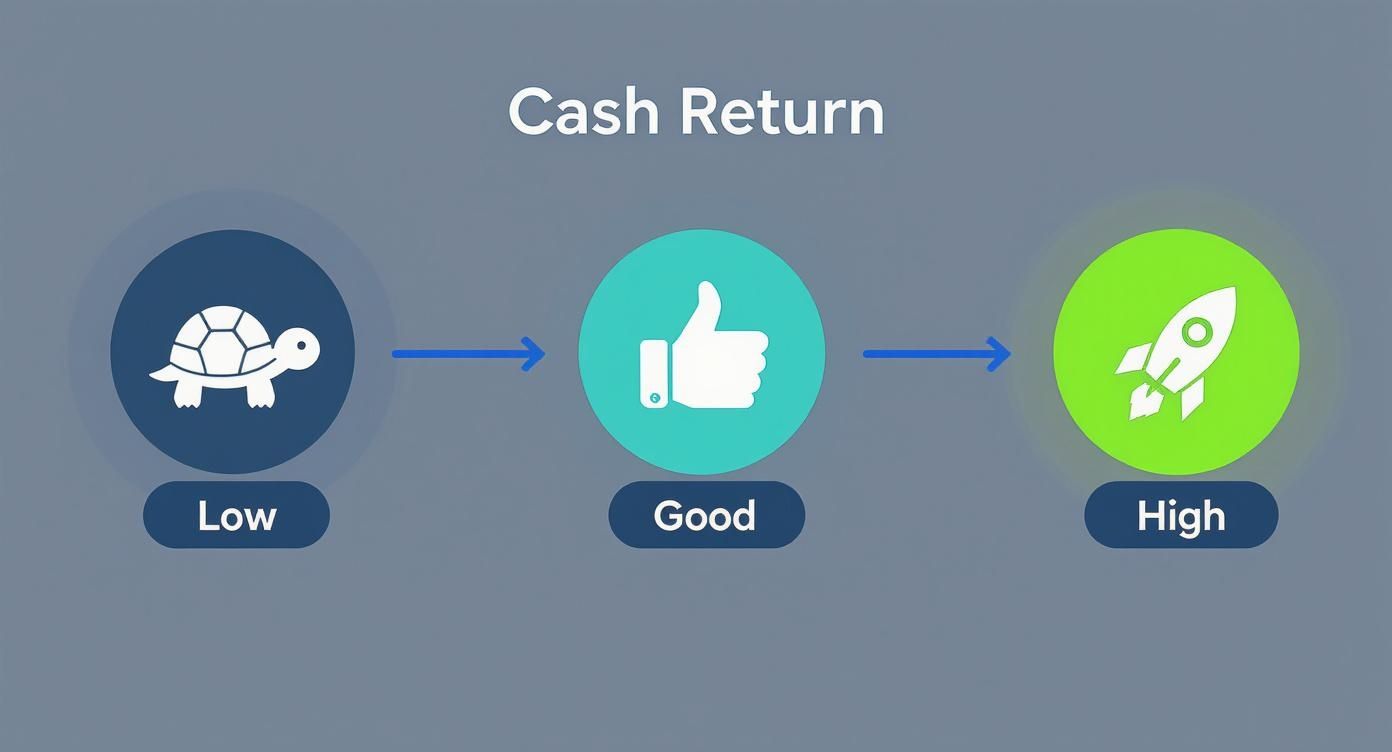
It’s a simple way to frame performance, showing how an investment can go from a slow and steady earner to a real high-flyer.
What’s a Good Cash on Cash Return? Setting Realistic Benchmarks
That 8% to 12% range is a solid rule of thumb for cash on cash return, but it's far from a universal law. The truth is, a "good" return depends entirely on the property itself. A fantastic return for a sleepy suburban single-family home would look downright dismal for a value-add commercial strip mall.
Applying a one-size-fits-all number to every deal is a rookie mistake. It can cause you to pass on a perfectly stable, low-risk investment or, even worse, jump into a risky deal that isn't offering nearly enough reward.
Think of it like comparing vehicles. You wouldn't judge a reliable family sedan by the same horsepower standards as a heavy-duty freight truck. Both get you from A to B, but they're built for completely different jobs and have entirely different performance metrics. Real estate works the same way.
Every property type, or asset class, comes with its own unique blend of risk, management headaches, and potential for growth. These factors directly shape what you should expect as a fair return. A stable, lower-risk property will naturally offer a more modest return, while a hands-on, higher-risk project needs to dangle a much bigger carrot to be worth your time and money.
Typical Cash on Cash Return Ranges by Real Estate Asset Class
To give you a clearer picture, let's break down what you can generally expect from different corners of the real estate market. The table below outlines typical CoC return ranges and the key factors that drive those numbers for each asset class.
| Property Type | Average CoC Return Range | Key Influencing Factors |
|---|---|---|
| Single-Family Homes | 8% - 12% | High demand from long-term tenants, relatively straightforward management, and strong appreciation potential in good markets. |
| Small Multifamily (2-4 Units) | 10% - 15% | Multiple income streams under one roof improve efficiency and cash flow. Often owner-occupied options can reduce vacancy risk. |
| Large Multifamily (Apartments) | 5% - 10% | Lower perceived risk due to tenant diversification. Professional management is common, and there's strong potential for long-term rent growth and economies of scale. |
| Commercial (Retail, Office) | 4% - 8% | Long-term leases (3-10+ years) offer incredible stability. Triple-net (NNN) leases can make them almost passive, justifying a lower initial cash-on-cash return. |
Remember, these are just starting points. A run-down property you plan to renovate (a "value-add" play) should promise a much higher return to compensate for the extra work and risk involved.
A Closer Look at Residential Real Estate
For most of us, residential property is the gateway into real estate investing. But even here, the numbers can vary quite a bit.
- Single-Family Homes (SFH): The classic rental. These properties are known for attracting stable, long-term tenants and are generally easy to manage, making returns in the 8% to 12% range very common and achievable.
- Small Multifamily (2-4 Units): Think duplexes, triplexes, and fourplexes. These are cash flow machines. With multiple rent checks coming from a single property, they are incredibly efficient and can often push returns into the 10% to 15% range.
What about bigger apartment buildings? They operate on a slightly different logic. While the scale is incredible, their initial cash on cash returns are often a bit lower, typically landing between 5% and 10%, with many seasoned investors targeting 8%. Why? Because the risk is spread across many tenants, and the long-term potential for rent increases makes them a blue-chip asset. For a deeper dive, Plante Moran offers great insights on multifamily returns.
How Commercial Real Estate Stacks Up
When you step into the commercial world, the benchmarks shift entirely. These deals often involve locking in businesses on long-term leases, which creates fantastic stability but can mean lower initial cash flow.
A stable commercial building with a tenant on a triple-net lease might only generate a 4% to 8% cash on cash return. But for the right investor, it’s a phenomenal deal. The real prize is the predictable, hands-off income stream.
This is where another metric, the capitalization rate (cap rate), becomes absolutely vital. Cap rate helps you compare properties based on their income potential, completely separate from financing. To get the full picture, you really need both. You can learn all about it in our guide that explains how to calculate cap rate.
The main takeaway here is simple: context is king. Setting your expectations based on the specific type of property you're analyzing is the only way to make smart, confident investment decisions.
The Hidden Factors That Shape Your Return

It’s a classic mistake I see new investors make all the time. You find two houses that look almost identical, maybe even on the same street, and figure they’ll perform the same. You pick one, only to find out later that the other property would have been a cash-flow machine, while yours is just scraping by. What gives?
The truth is, the listing price and what you think you can get for rent are just the tip of the iceberg. A property's real performance is buried in the details—a few powerful factors that can completely change your cash-on-cash return.
Learning to spot these variables is what separates a smart investment from a costly lesson. It’s all about looking past the obvious numbers to see how a deal really works.
The Power of Financing
Your loan is, without a doubt, the biggest lever you have for manipulating your cash-on-cash return. Think about it: financing directly impacts both your initial cash investment and your monthly cash flow. A tiny adjustment to your loan terms can make your returns skyrocket—or completely crater.
Let’s break down the moving parts:
- Down Payment: Putting less money down means less cash out of your pocket, which can make your CoC percentage look fantastic. But the trade-off is a bigger monthly mortgage payment, which puts a squeeze on your cash flow.
- Interest Rate: You'd be surprised how much a half-point difference on your interest rate matters. Over the life of the loan, it can easily add or subtract thousands from your annual cash flow.
- Loan Term: Choosing between a 15-year and a 30-year loan is a strategic decision. A 15-year mortgage builds equity like crazy but comes with a punishing monthly payment that often kills your cash flow. A 30-year loan, on the other hand, is designed to maximize that monthly cash flow, giving your immediate CoC return a serious boost.
The way you finance a deal doesn't just affect the numbers—it defines the investment strategy. Aggressive leverage can amplify returns, while a conservative loan creates a safer, more stable asset.
Market, Condition, and Management
After you sort out financing, three other big-picture factors will make or break your return. These are the things that control both your income and your expenses, ultimately shaping the cash flow that is the lifeblood of your investment.
Location, Location, Location: This isn't just a cliché; it's everything. A property in a booming market with rising rents and high demand is set up for success. On the flip side, an investment in a declining area can be a nightmare of high vacancy and mounting costs that torpedo your returns.
Property Condition: Are you buying a pristine, turnkey rental or a fixer-upper? A turnkey property keeps your initial cash investment low since there are few immediate repairs. A value-add property requires a lot more cash upfront for renovations, but if you play your cards right, the resulting higher rents could lead to a much stronger CoC return down the road.
Management Efficiency: Who's running the show? If you're managing it yourself, you save on fees, but it costs you time. A great property manager can be worth their weight in gold, keeping vacancies low and maintenance costs in check. Bad management, however, will bleed you dry, letting small issues fester into expensive disasters. This is especially true in commercial real estate (CRE), where management is more complex, contributing to typical returns between 4% and 8%. You can discover more insights about commercial real estate returns from J.P. Morgan.
Looking Beyond Your Cash on Cash Return
Relying solely on your cash-on-cash return is like trying to drive a car by only looking at the speedometer. Sure, you know how fast you're going right now, but you have no clue what’s coming up on the road ahead. This metric is a superstar for measuring immediate cash flow, but it's blind to the other powerful ways real estate builds long-term wealth.
Think of it this way: your CoC return is your property’s weekly paycheck. It's crucial for paying the bills and keeping the lights on. But what about your retirement account? Your cash-on-cash return tells you nothing about the wealth you’re quietly building through property appreciation, loan paydown, and significant tax advantages.
Chasing the highest possible cash-on-cash return can sometimes lead you to high-risk deals in less-than-ideal areas. You might even pass on a fantastic long-term investment just because it's a slower starter. To build a truly resilient portfolio, you need a more complete view of a property's financial performance.
Essential Partners for Your Analysis
To get that complete picture, you need to bring in a couple of other key metrics: Capitalization Rate (Cap Rate) and Total Return on Investment (ROI). They work together with your cash-on-cash return to give you a 360-degree understanding of any potential deal.
Cap Rate: This metric is all about making apples-to-apples comparisons. It measures a property's income potential relative to its price, completely ignoring any financing. This is how you can fairly judge two different properties without loan terms clouding your judgment.
Total ROI: This is the long-game metric. It looks beyond simple cash flow and accounts for the equity you build as your tenant pays down your mortgage and the property (hopefully) appreciates in value over time.
A savvy investor uses cash-on-cash return to screen for immediate viability, cap rate to compare against the market, and total ROI to project long-term wealth creation.
Seeing the Whole Financial Story
Let's look at two hypothetical properties. Property A boasts a 12% cash-on-cash return but is located in a stagnant market. Property B, on the other hand, only offers an 8% return but is in a neighborhood with strong job growth and home appreciation.
If you only look at CoC return, Property A seems like the obvious winner. But what happens when you factor in appreciation and loan paydown over five or ten years? Property B might generate far more total wealth. Its Total ROI could easily dwarf the other property's performance.
This is why a balanced approach is so critical. By using these three metrics together, you stop gambling on a single number and start making truly strategic investment decisions. You ensure the property not only pays you well today but also builds significant equity for your future. It's the key to not passing up a great long-term deal for a short-term cash cow.
Actionable Strategies to Boost Your Returns

Knowing your cash on cash return is great, but improving it is how you actually make money. The good news is that you have more control than you think. You can directly influence the key drivers of your returns by focusing on three areas: income, expenses, and financing.
These aren't complicated, secret formulas—just smart, proactive management. Even small tweaks in these areas can add up to big gains in your annual cash flow, turning a decent investment into a fantastic one. Let's dig into a few practical ways savvy investors get their properties to perform.
Increase Income Through Smart Upgrades
The most direct way to bump up your cash flow is to increase the rent. But that doesn't have to mean gutting the place. The trick is to focus on targeted, cost-effective upgrades that tenants are happy to pay a premium for.
- Cosmetic Touch-Ups: You'd be amazed what a fresh coat of paint, new light fixtures, or modern hardware on the cabinets can do. These small changes make a unit feel new and can justify a rent increase for a very small upfront cost.
- Add In-Demand Amenities: Think about what makes a renter's life easier. Can you squeeze in a stackable washer and dryer? Or maybe a slimline dishwasher? These are game-changers for tenants and can command significantly higher rent.
- Utility Billing Systems: If you own a multifamily property, look into a Ratio Utility Billing System (RUBS). This lets you pass a portion of the property's utility costs on to the tenants, which directly boosts your net income without touching the base rent.
A landlord I know spent $3,000 to add a washer and dryer to a unit and immediately increased the monthly rent by $100. That's an extra $1,200 in income each year, giving them a 40% cash on cash return on that one upgrade alone.
Slash Expenses With Systematic Audits
Cutting your operating costs is just as powerful as raising the rent—every dollar you save falls straight to your bottom line. The key is to be relentless and review every single line item in your budget.
Don't just set it and forget it. Shop your insurance policy every year to see if you can get a better rate. Appeal your property taxes if you think the assessment is out of whack. And get ahead of problems with a preventative maintenance schedule to avoid those budget-killing emergency repair calls. Every little bit helps push that return percentage higher.
Frequently Asked Questions
Once you get the hang of the basics, you'll find that real-world deals bring up a whole new set of questions. Let's tackle some of the most common ones that pop up for investors.
Is a Higher Cash on Cash Return Always Better?
Not necessarily. While a big number looks fantastic on paper, it often signals a bigger risk. It’s all about the trade-off.
For instance, you might find a property in a less desirable neighborhood promising a 15% cash on cash return. That sounds great, but it might come with the headache of frequent vacancies or zero appreciation potential. On the flip side, a stable property in a booming, sought-after area might only offer a 6% return. The immediate cash flow is lower, but you're buying into a safer asset with a much brighter future for long-term growth.
A savvy investor knows how to balance their portfolio. Some properties pay the bills today with strong cash flow, while others are slow-burners that build serious wealth over time.
How Does Financing Change My Calculation?
Financing is the single biggest factor you can control, and it completely changes the game. When you use more leverage (a smaller down payment), you’re putting less of your own money into the deal. This shrinks the "Total Cash Invested" denominator and can send your cash on cash return percentage soaring.
But here's the catch: more leverage means a bigger mortgage payment. That bigger payment cranks up your monthly risk. If the property sits empty for a month, that payment is still due.
- Less Cash Down: This gives you a higher CoC return but also brings on more risk.
- More Cash Down: You'll see a lower CoC return, but you’ll sleep better at night with less risk.
There's no magic formula here—it all comes down to your personal comfort level with risk and what you're trying to achieve with your investments.
Should I Use Pre-Tax or After-Tax Numbers?
When you’re comparing one property against another, always use pre-tax cash flow. It's the industry standard for a reason.
Every investor's tax situation is completely different. Using pre-tax numbers creates a level playing field, allowing for a true apples-to-apples comparison. You should absolutely run the after-tax numbers for your own personal planning, but for evaluating a potential deal? Stick to pre-tax.
Tired of getting lost in spreadsheets? Stop guessing and start making confident investment decisions. Property Scout 360 handles all your cash on cash return calculations automatically, lets you compare different financing scenarios, and helps you find profitable deals in minutes. Find your next winning investment today.
About the Author
Related Articles
2026 Investor's Guide: Cost of Installing a Sewer Clean Out
Understand the cost of installing a sewer clean out for investment properties in 2026. Get expert advice on prices, ROI, & budgeting for flips. Plan smart!
15 Year vs 30 Year Mortgage: The Investor's Choice
Deciding between a 15 year vs 30 year mortgage for a rental property? Our guide analyzes cash flow, ROI, and equity to help you pick the best loan.
Real Estate Appraisal Software: Features & Limits
Discover what real estate appraisal software is, its core features, and limits. See how it differs from investment tools for profitable deals.
