Top Real Estate Books for Beginners in 2024
Discover the best real estate books for beginners. This guide provides a clear roadmap with proven reads to build your investing knowledge from the ground up.
The best real estate books for beginners don't just throw complex jargon at you; they give you a solid blueprint for building real wealth. Think of classics like Rich Dad Poor Dad or The Millionaire Real Estate Investor. They’re packed with the right mindset, practical strategies, and clear steps to get you started. This guide is your roadmap to actually understanding and using what’s in those pages.
Your Starting Point in Real Estate Investing

Before you ever invest a dollar into a property, you have to invest in your education. One of the biggest myths in real estate is that you need a mountain of cash to get started. The truth? You need a solid strategy first. The money will follow a good plan.
Without that proven plan, even a huge pile of cash can disappear into a bad deal in the blink of an eye. This is where the right books make all the difference.
Think of building a real estate portfolio the same way you’d build a house. You wouldn’t just start digging or ordering materials without a detailed blueprint, would you? The best real estate books for beginners are that blueprint. They hand you the frameworks, models, and hard-won lessons from successful investors before you put your own money on the line.
Adopting a Knowledge-First Approach
A "knowledge-first" mindset simply means you prioritize learning the core principles of smart investing before you even think about looking at properties. This approach is all about building competence and confidence—your two most valuable assets. By studying what already works, you learn how to:
- Spot profitable markets without having to guess.
- Analyze deals the right way to see the real cash flow and potential return.
- Get creative with financing, even if you don't have a lot of capital.
- Dodge the common rookie mistakes that trip up so many new investors.
The goal isn't just to passively read a book; it's to absorb the strategies that will become your guideposts for every decision you make. This article isn't just a book list—it's a complete reading roadmap designed to take you from core concepts all the way to execution.
From Theory to Practice
Reading is where it starts, but taking action is what actually builds wealth. As you go through the books we recommend, you’ll get the theory behind analyzing a deal down cold. The next logical step is to apply it.
This is where tools become so important, helping you translate what you've learned into something tangible. Once you have the fundamentals, check out our Property Scout 360 Getting Started guide. It's designed to help you turn that book knowledge into real-world numbers and confident decisions, bridging that critical gap between the page and your first property.
The Foundational Four: Books Every Beginner Must Read
Think of your real estate education like building a house. You can't put up the walls or the roof until you've poured a solid, unshakeable foundation. These first four books are that concrete slab. They give you the mindset, the systems, and the street smarts you need to build a portfolio that lasts.
Each one has a specific job to do, and together, they’re the perfect launchpad. Let's break down why each of these is a must-read for anyone serious about building real wealth through property.
1. Rich Dad Poor Dad by Robert T. Kiyosaki
Before you even think about analyzing a property, you have to get your head right. Rich Dad Poor Dad isn't a technical manual full of formulas; it's a story that completely rewires how you think about money, work, and building wealth.
Robert Kiyosaki frames his lessons through the story of his two "dads"—his own, a highly educated government employee who struggled financially (Poor Dad), and his best friend's father, an eighth-grade dropout who became a millionaire (Rich Dad). The whole book boils down to one powerful idea: the poor and middle class work for money, but the rich make their money work for them by buying assets.
This book hammers home one concept so effectively you'll never forget it.
An asset is something that puts money in your pocket. A liability is something that takes money out of your pocket.
For a beginner, this changes everything. In Kiyosaki's world, your family home isn't an asset—it's a liability that costs you money every month. A rental property that pays you every month? Now that's a true asset. Getting this straight is the first real step toward financial independence.
The book’s impact is undeniable, having sold over 40 million copies around the globe. It's become a rite of passage for new investors. In fact, some informal industry polls suggest a staggering 85% of beginners have read it before buying their first property. You can explore more about these trends and other popular book choices on Mashvisor.
2. The Millionaire Real Estate Investor by Gary Keller
So, Rich Dad Poor Dad gives you the "why." Gary Keller’s The Millionaire Real Estate Investor gives you the "how." As the founder of Keller Williams Realty, Keller has seen what works, and he distilled the wisdom of over 100 millionaire investors into a practical playbook.
Keller’s big argument is that building wealth isn't about luck; it’s about following proven models, step-by-step. He demystifies the entire process, turning what seems like an impossible goal into a clear, actionable roadmap.
Key Models You Will Learn:
- The Net Worth Model: How to actually track your financial health and see it grow.
- The Financial Model: Simple rules for using debt smartly without getting in over your head.
- The Network Model: The art of building your team of experts (your agent, lender, inspector, etc.).
- The Lead Generation Model: How to consistently find great deals when everyone else says there are none.
What makes this one of the absolute best real estate books for beginners is how it pushes you to think big while starting small. Keller teaches you to set a massive goal and then work backward to figure out the exact number of doors you need to hit it. It transforms the vague dream of "getting rich" into a simple math problem.
3. The Book on Rental Property Investing by Brandon Turner
You’ve got the mindset and the high-level strategy. Now it’s time to get your hands dirty. Brandon Turner, one of the most recognized voices from BiggerPockets, wrote the ultimate field guide for today's rental property investor. This book is all about the nuts and bolts—the real-world grind of buying and managing properties that generate income.
Turner walks you through the entire lifecycle of a deal, from finding it and funding it to managing it for steady, long-term cash flow. It’s incredibly practical and packed with real stories, answering all the nagging questions that keep new investors up at night.
You'll gain practical skills in:
- Deal Analysis: How to run the numbers on a property in minutes to know if it's a winner or a dud.
- Financing Strategies: Creative ways to get the money for your deals, going way beyond just walking into a bank.
- Property Management: The pros and cons of self-managing versus hiring a pro, plus the systems you need for either path.
- Finding Deals: Techniques for uncovering those off-market gems that most people never see.
This book is the perfect link between theory and action. It’s the one that will finally give you the confidence to analyze your first property, write that first offer, and officially become a landlord.
4. Real Estate Investing QuickStart Guide by Symon He
The last piece of your foundational library is your go-to reference manual. Think of the Real Estate Investing QuickStart Guide as the encyclopedia you'll keep on your desk and flip through constantly. While the other books focus on specific strategies or mindsets, this guide gives you a 30,000-foot view of the entire real estate investing world.
It was written specifically for absolute beginners, using simple language and clear illustrations to break down complex ideas. It covers everything from residential and commercial properties to wholesaling, flipping, and more.
The book’s real power is in its structure. It builds your knowledge logically, making sure you understand the basics—like market cycles, valuation, and due diligence—before you jump into more advanced stuff. If you ever feel lost in a sea of industry jargon, this book is your lifeline.
To help you keep it all straight, here is a quick summary of your new foundational reading list.
Your Foundational Reading List Quick Guide
| Book Title | Author | Core Focus | Key Skill You Will Learn |
|---|---|---|---|
| Rich Dad Poor Dad | Robert Kiyosaki | Shifting your mindset about money and wealth. | Differentiating an asset from a liability |
| The Millionaire Real Estate Investor | Gary Keller | Building systems and models for scalable growth. | Creating a long-term strategic plan |
| The Book on Rental Property Investing | Brandon Turner | The practical, step-by-step process of buying rentals. | Analyzing and managing rental properties |
| Real Estate Investing QuickStart Guide | Symon He | A comprehensive A-to-Z reference guide. | Understanding core real estate terminology |
With these four books under your belt, you'll have a stronger knowledge base than 90% of the people who say they want to get into real estate. You'll be ready to move from reading to doing.
Building Your Knowledge From Mindset to Execution
Jumping into a random pile of real estate books can feel like trying to drink from a firehose. You get drenched in information but don't actually absorb much. A much smarter approach is to follow a roadmap that builds your knowledge piece by piece, making sure you really get one concept before tackling the next.
It's like learning to cook. You wouldn't start with a complex French sauce before you know how to properly chop an onion. Your real estate education should follow that same logic, moving from the "why" to the "how." This journey really breaks down into three key stages.
The image below gives you a great visual of how Mindset, Systems, and Cash Flow all connect to power your success.
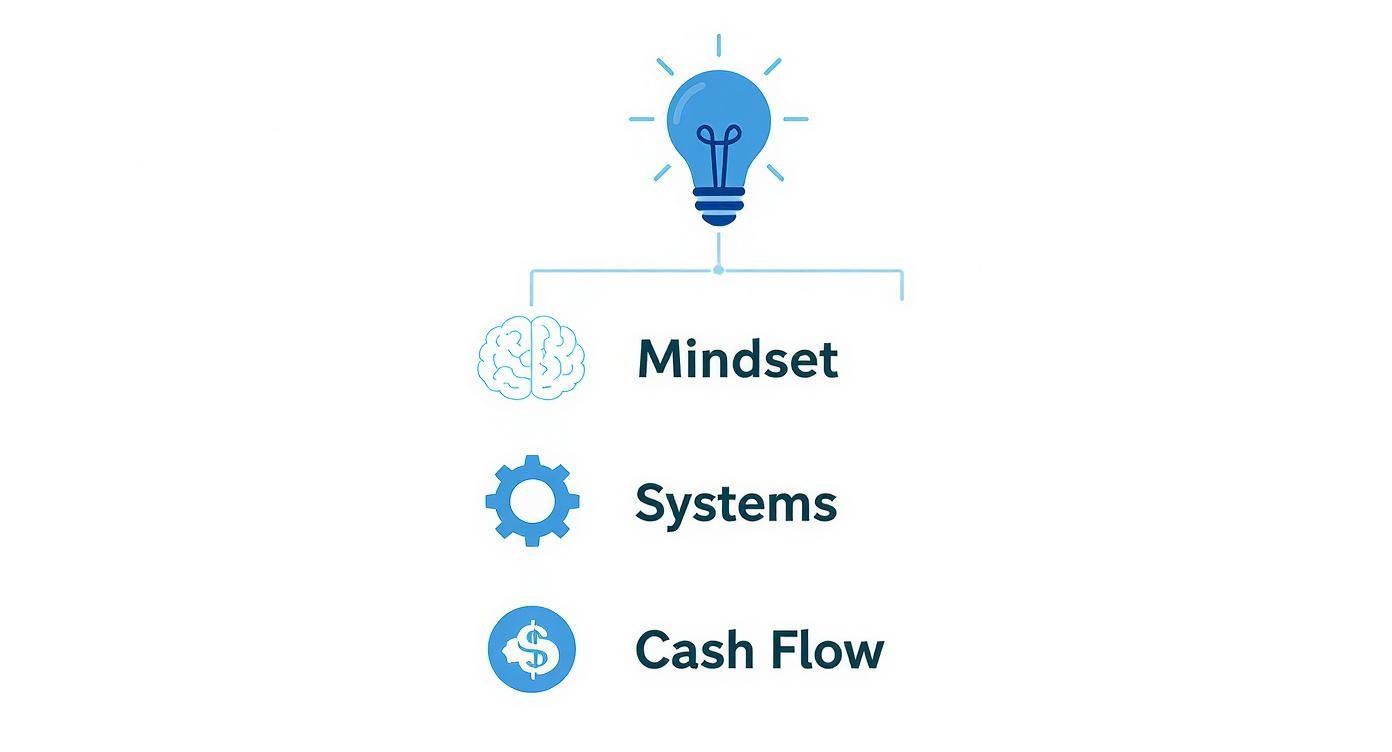
As you can see, everything starts with the right mindset. Without that solid base, the systems and cash flow strategies just won't hold up.
Stage 1: Build the Investor Mindset
Your journey doesn't begin with spreadsheets or property listings—it starts inside your head. This is the philosophical bedrock of your entire investing career. Before you can build a portfolio, you first have to understand the core principles of wealth creation and how assets actually work.
The goal here is simple but profound: learn to see money and investments in a completely different way than most people. It's about making the critical shift from an employee mindset (trading your time for money) to an investor mindset (making your money work for you).
- Key Book for This Stage: Rich Dad Poor Dad by Robert Kiyosaki
- Core Lesson: You must internalize the difference between an asset (something that puts money in your pocket) and a liability (something that takes money out). This one idea is the key that unlocks everything else.
This isn't just motivational fluff; it’s about rewiring your financial DNA. Without this mental shift, even the best strategies will probably fail because your core decision-making will be off-kilter.
Stage 2: Learn the Nuts and Bolts
Once you've got your head in the right space, it's time to get your hands dirty. This is where you move from philosophy to practical, real-world application. Here, you'll learn the actual mechanics of how to find, finance, and manage investment properties.
Think of this as the "how-to" phase. You'll start speaking the language of real estate investing, throwing around terms like cash flow, cap rate, and cash-on-cash return. More importantly, you'll learn the systems for analyzing a deal to know if it's a winner before you ever risk a dime.
- Key Book for This Stage: The Book on Rental Property Investing by Brandon Turner
- Core Lesson: Master the art and science of deal analysis. Learn to run the numbers quickly and confidently to spot profitable rentals and, just as crucial, to steer clear of the money pits.
Stage 3: Scale Your Portfolio
With the right mindset and a solid grasp of the mechanics, the final stage is all about growth. One rental property is fantastic, but true financial freedom often comes from building a portfolio. This requires you to stop thinking deal-by-deal and start creating repeatable systems that let you expand without burning out.
This is where you graduate from being a landlord to becoming a business owner. It means building a team, creating ways to generate leads, and setting up financial systems that can handle a growing empire. The numbers back this up: analysis of best-selling real estate books for beginners shows a massive preference for titles that provide these scalable blueprints.
Take The Millionaire Real Estate Investor by Gary Keller—it has sold over 1.5 million copies worldwide by teaching investors these exact models. Industry surveys even show that about 65% of beginner investors call it their most influential read. That's a huge testament to the demand for systematic guidance, which you can read more about in this breakdown of top real estate books from SmartAsset.com.
- Key Book for This Stage: The Millionaire Real Estate Investor by Gary Keller
- Core Lesson: Lasting success isn't about luck; it’s about following proven models. This book teaches you how to implement the systems used by hundreds of millionaires to build your own scalable real estate business.
Expanding Your Expertise with Specialized Topics
Once you have the fundamentals down, it's time to start exploring the more exciting niches within real estate. Think of it like finishing your core classes and finally getting to pick a major. The essentials of analyzing deals and having the right mindset will always apply, but digging into a specialized strategy can put your wealth-building on the fast track. It's all about aligning your approach with your personal goals, risk tolerance, and the kind of life you want to live.
This is where you graduate from the one-size-fits-all advice and really start customizing your education. The market for real estate books for beginners has exploded, which is great news because it means there's a ton of high-quality information on these specific topics. Just look at the Amazon sales charts—Brandon Turner's The Book on Rental Property Investing has been a runaway bestseller for years, with over 7,700 verified reviews and a solid 4.7-star rating. It’s clear that people are hungry for actionable guides, and seeing what other investors are reading can give you a clue as to what works.
Mastering House Hacking
For most people starting out, the biggest obstacle is scraping together a down payment for their first property. House hacking smashes right through that barrier by turning your own home into an income-generating machine. The idea is brilliant in its simplicity: you buy a small multi-family property (like a duplex or a triplex), live in one of the units yourself, and rent out the others. The rent checks from your tenants go directly toward your mortgage, often covering most—or even all—of your monthly payment.
- Top Book Recommendation: The House Hacking Strategy by Craig Curelop
- Who It's For: This is the perfect play for first-time homebuyers, especially those with a lower income. It's also great for anyone who doesn't mind living next door to their tenants and is serious about wiping out their own housing costs while building equity.
- Key Insights: Curelop lays out the entire process, step-by-step. He shows you how to find the right property, lock in fantastic owner-occupant financing (often with just 3.5% down), and manage your tenants like a pro. It’s the ultimate guide to living for free while your first investment pays for itself.
Scaling with the BRRRR Method
Okay, so you've got your first property or two. Now what? The big question becomes, "How do I keep growing without waiting years to save up another down payment?" The BRRRR method is the answer. It’s a powerful strategy designed to let you recycle your capital and scale your portfolio quickly. BRRRR stands for Buy, Rehab, Rent, Refinance, Repeat.
It works like this: you find an undervalued property that needs some love, fix it up to increase its value (this is called "forced appreciation"), and then place a tenant in it. With a rent-paying tenant in place, you go to a bank for a "cash-out" refinance based on the property's new, higher value. This pulls your original investment right back out, and you can take that same pot of money and go do it all over again.
The BRRRR method is a system for creating infinite returns. By repeatedly pulling your initial capital out of deals, you can use the same pot of money over and over again to acquire more properties.
- Top Book Recommendation: Buy, Rehab, Rent, Refinance, Repeat by David Greene
- Who It's For: This is for investors who aren't afraid to get their hands dirty with renovations and have an ambitious goal to grow their portfolio without being held back by their savings account.
- Key Insights: Greene, another heavy-hitter from BiggerPockets, breaks down every single stage with incredible detail. You'll learn how to accurately estimate rehab costs, how to build a team of reliable contractors you can trust, and how to find lenders who actually understand and support this strategy.
Diving into Commercial Real Estate
While single-family homes and small multi-families are the standard entry point, commercial real estate is a whole different ballgame with its own set of massive opportunities. We're talking about everything from apartment buildings and office spaces to retail centers and industrial warehouses.
One of the biggest differences is how these properties are valued. Unlike a house, a commercial building's worth isn't based on what the property next door sold for. Instead, its value is tied directly to the income it produces. This is where the numbers really matter, and getting comfortable with the metrics is non-negotiable. To get a head start on one of the most vital calculations in the commercial world, you can learn more about what is a good cap rate in our detailed guide.
- Top Book Recommendation: The Real Estate Game by William J. Poorvu
- Who It's For: This book is for investors who have a solid grasp of residential investing and are ready to level up to bigger, more complex deals that offer much higher potential returns.
- Key Insights: Don't let the publication date fool you; the wisdom from this Harvard Business School professor is timeless. Poorvu teaches you to think about commercial deals like a game of chess, understanding all the players—from lenders and partners to tenants—and the market dynamics that drive value. It’s a masterclass in strategic thinking for anyone serious about making it big in real estate.
Time to Put Your Knowledge Into Action

Reading the best real estate books for beginners is a solid first step. But let's be honest—knowledge without action is just trivia. The real magic happens when you close the book and start applying what you've learned. This is where abstract ideas turn into real skills and you start building the confidence to actually pull the trigger on a deal.
The best part? You don't need a single dollar to get started. You can begin honing your skills and gaining practical experience right from your kitchen table. Let's walk through three powerful, no-risk exercises that will put your new education to the test.
Analyze Fifty Deals on Paper
Think of this as your flight simulator. A pilot spends hundreds of hours practicing before ever stepping into a real cockpit, and you should too. Your mission is to find and analyze 50 potential investment properties online. Don't worry about buying them—the goal here is pure practice.
This exercise trains your "deal analysis muscle." It gets you lightning-fast at separating the winners from the duds.
Drawing on what you learned in a book like The Book on Rental Property Investing, you'll start looking at listings differently. You'll instinctively ask the right questions: What are the property taxes? How much will insurance cost? What are other units renting for in this exact neighborhood?
This process forces you to get comfortable with the numbers that truly matter. You can use a tool like Property Scout 360 to help, plugging in a property's details for quick projections. By the time you hit deal #50, you’ll have a gut feeling for what a good investment looks like in your area. To make sure you're running the numbers correctly, check out our guide on how to calculate cash flow on a rental property—it's the perfect companion for this exercise.
Nail Down Your Personal Investment Criteria
After you've analyzed a few dozen properties, patterns will start to emerge. You'll notice that certain neighborhoods, price points, or property types consistently hit your financial targets. Now it's time to get specific and build your personal investment "buy box," a core concept from The Millionaire Real Estate Investor.
Your buy box is just a simple set of rules that defines exactly what you’re looking for. It's your filter, designed to keep you focused and save you from wasting time.
Your investment criteria are your personal investing blueprint. It prevents you from chasing shiny objects and ensures every property you consider is a deliberate step toward your specific long-term goals.
A solid buy box should clearly outline:
- Geographic Area: Which specific zip codes or neighborhoods are you targeting?
- Property Type: Are you hunting for single-family homes, duplexes, or small multi-family buildings?
- Price Range: What is your minimum and maximum purchase price?
- Financial Metrics: What are your non-negotiable minimums for cash flow, cash-on-cash return, and cap rate?
Start Building Your Team
Ask any seasoned real estate investor, and they'll all tell you the same thing: this is a team sport. You can't, and shouldn't, try to do it all alone. Your final step is to start identifying the key players for your A-team before you ever need their help.
Begin by interviewing real estate agents who specialize in working with investors—they think very differently than agents who only work with homebuyers. Find a few lenders who understand the nuances of investment property financing. Reach out to other local investors for coffee and advice. A good mentor can help you sidestep rookie mistakes that could cost you thousands.
By networking proactively, you build credibility and relationships. Then, when the perfect deal finally pops up, your team is already in place and ready to go.
From Reading to Real-World Investing: Your Next Steps
The single most important investment you'll ever make in real estate isn't a down payment—it's your education. The books we've covered lay out the blueprint, but now it’s your turn to pick up the tools and start building.
This whole process is a marathon, not a sprint. Real, lasting confidence doesn't come from just reading another chapter; it comes from getting your hands dirty and engaging with the material.
Your main goal right now is to close the gap between knowing what to do and actually doing it. Knowledge only turns into power when you put it to work, day in and day out.
Stop being a passive reader and start actively participating in your own learning. This is how abstract ideas become concrete skills you can lean on when a real-world deal is on the table.
Your Immediate Action Plan
To make the jump from learner to investor, you need to take small, tangible steps forward. Don't fall into the trap of "analysis paralysis," where you're always researching but never doing. Here’s how to start right now:
- Take Active Notes: Forget highlighting. After each chapter, write a quick summary of the main ideas and, more importantly, the actionable advice you can use.
- Apply What You Learn: Put the strategies into practice immediately. If you just read about analyzing deals, find a live listing on the market and run the numbers yourself. A tool like Property Scout 360 makes this easy.
- Start Your Journey: Look back at the foundational book list and just pick one. Your only goal this week is to read the first chapter. That's it.
Success in real estate doesn't happen overnight. It’s built on the small, consistent actions you take every single day. Your education has officially begun—now go apply it and start building the future you want.
Common Questions About Real Estate Books
Diving into the world of real estate books can feel a bit overwhelming, so let's tackle some of the most common questions that pop up. Getting these answers straight will help you build a reading plan that actually gets you closer to your first deal.
Do I Really Need to Read All These Books Before I Start?
Absolutely not. The goal is to become a confident investor, not to build a library. Your first priority should be to truly grasp the core ideas from the first few foundational books.
Once you know the difference between an asset and a liability and can run a basic cash flow analysis in your sleep, it's time to start applying that knowledge. Think of it as a simple cycle: read, apply, learn, then read more. Real progress happens when learning is paired with action.
What About Audiobooks? Are They a Good Option?
Yes, they're a fantastic way to learn, especially when you're busy. Nearly all of the popular real estate books for beginners we've covered are available in audio format. This is perfect for soaking up knowledge during your commute, at the gym, or even while doing yard work.
A lot of seasoned investors I know listen to the classics over and over again. You'd be surprised what new insights you pick up on the second or third listen—repetition really helps lock in those complex ideas.
The core principles of real estate—analyzing cash flow, finding good deals, and structuring financing—are timeless. A book from ten years ago that teaches these fundamentals is often more valuable than a new book focused on temporary market trends.
How Can I Tell if a Real Estate Book Is Out of Date?
This is a great question. While specific tactics for a hot market can definitely become dated, the fundamental principles of smart investing almost never do. The best books are built on these timeless concepts, not short-term tricks.
When you pick up a book, ask yourself: Is this teaching me a durable skill or just a temporary market hack? Focus on mastering the evergreen abilities, like finding hidden value and managing risk. Those are the skills that will serve you well in any market, no matter when the book was written.
Ready to turn all that reading into real-world numbers? Property Scout 360 is designed to help you analyze potential deals in minutes, crunching everything from cash flow to ROI. Stop the guesswork and start making decisions with confidence. Take a look at our tools and see how it works.
About the Author
Related Articles
2026 Investor's Guide: Cost of Installing a Sewer Clean Out
Understand the cost of installing a sewer clean out for investment properties in 2026. Get expert advice on prices, ROI, & budgeting for flips. Plan smart!
15 Year vs 30 Year Mortgage: The Investor's Choice
Deciding between a 15 year vs 30 year mortgage for a rental property? Our guide analyzes cash flow, ROI, and equity to help you pick the best loan.
Real Estate Appraisal Software: Features & Limits
Discover what real estate appraisal software is, its core features, and limits. See how it differs from investment tools for profitable deals.
