What Is a Good Cap Rate for Real Estate Investing?
Discover what is a good cap rate in real estate. Learn how to calculate it, what factors define a good rate, and how to analyze deals like a pro.
So, what's a "good" cap rate, really? If you're looking for a quick, one-size-fits-all answer, most real estate investors will tell you to aim for something between 5% and 10%.
But the real answer—the one that experienced investors use—is that it depends. A truly "good" cap rate is a moving target, shaped by your specific goals, how much risk you're willing to take on, and the unique details of the property you're sizing up.
The True Meaning of a Good Cap Rate
Think of a cap rate like a car's miles-per-gallon (MPG) rating. A high MPG might catch your eye, but it tells you nothing about the engine's health, the ride quality, or the kind of terrain you’ll be driving on. In the same way, a cap rate gives you a quick snapshot of a property’s potential return, but it never tells the whole story.
At its heart, the cap rate is the unleveraged annual return you can expect from an investment property. It's a fundamental tool for comparing different deals on an apples-to-apples basis because it completely ignores financing. This lets you quickly see how efficiently a property turns its purchase price into income.
Setting a Practical Benchmark
While a "good" cap rate can feel subjective, establishing a baseline is essential. The right number for any given deal is influenced by a few powerful factors:
- Location: A property in a booming, high-demand city will almost always have a lower cap rate than one in a less stable or slower-growing market.
- Property Type: The risk profile of a multifamily apartment complex is vastly different from a single-tenant retail store, and their cap rates will reflect that.
- Market Dynamics: Big-picture economic trends like interest rates and local job growth constantly move the goalposts for what qualifies as a strong return.
Looking at historical data, that 5% to 10% range for commercial real estate holds up. In fact, deep analysis from CBRE covering more than two decades found the average cap rate across major property types was 6.29%, with a surprisingly low standard deviation of just 1.12%. This stability shows how the market prices risk and return over the long haul. You can dive deeper into these trends and learn how cap rates connect to market conditions from CBRE's analysis.
To give you a practical starting point, the table below breaks down the typical cap rate ranges you'll see for different commercial properties.
Quick Guide to Typical Cap Rate Ranges
This table provides a summary of generally accepted 'good' cap rate ranges. Think of it as an initial benchmark to help you understand where a potential investment sits within the broader market landscape.
| Property Type | Typical Cap Rate Range | General Risk Profile |
|---|---|---|
| Multifamily Apartments | 4% - 7% | Low to Moderate |
| Office Buildings | 5% - 8% | Moderate |
| Retail Centers | 5% - 9% | Moderate to High |
| Industrial/Warehouse | 4% - 8% | Low to Moderate |
| Hotels/Hospitality | 7% - 10%+ | High |
Remember, these are just general guidelines. A property with a cap rate outside these ranges isn't automatically a bad (or good) deal. It just means you need to dig deeper to understand why.
How to Calculate Cap Rate: The Essential Formula
Before we can really dig into what makes a "good" cap rate, you have to get your hands dirty with the simple but powerful formula behind it. Don't sweat the math—it's incredibly straightforward. Once you understand the two main ingredients, you'll be able to run the numbers on any deal that crosses your desk.
The formula for cap rate is:
Cap Rate = Net Operating Income (NOI) / Current Market Value
Let's break down what each of those pieces actually means in the real world.
Unpacking Net Operating Income (NOI)
Think of Net Operating Income (NOI) as the property's annual profit before you've paid the bank. It’s the single best measure of a property's raw earning power, showing you what the asset itself generates after paying all the bills necessary to keep it running.
Finding the NOI is a simple two-step dance:
- Start with Gross Income: Add up all the potential rent you could collect if the property was 100% full all year.
- Subtract Operating Expenses: From that total, subtract every cost required to keep the lights on and the tenants happy.
So, what counts as an operating expense? It’s the usual suspects:
- Property Taxes
- Insurance
- Utilities (the ones you, the owner, cover)
- Property Management Fees
- General Maintenance and Repairs
- Landscaping or Snow Removal
- Vacancy Allowance (a crucial buffer for when units are empty)
Notice what’s missing? The mortgage payment. That's on purpose. NOI ignores your loan (principal and interest) because the cap rate is designed to judge the property on its own merits, completely separate from your financing. This is what lets you compare an apartment building in Austin to a duplex in Detroit on an apples-to-apples basis.
For a more detailed breakdown, our guide explains exactly how to calculate cap rate with more examples.
Determining the Current Market Value
The other half of the equation, Current Market Value, is just what it sounds like: what the property is worth today. If you're looking at a property listed for sale, the asking price is your starting point for this number.
If you already own the building and want to see how it's performing, you'd use its estimated current value. You can get a solid idea of this by looking at what similar, nearby properties have sold for recently (we call these "comps") or by getting a formal appraisal.
Putting It All Together: A Quick Example
Let’s run through a real-world scenario to make this stick. Imagine you’re analyzing a small four-unit apartment building with a $1,000,000 price tag.
1. Find the Gross Potential Income:
- Each of the 4 units rents for $1,500/month.
- Monthly Income: 4 units x $1,500 = $6,000
- Annual Gross Income: $6,000 x 12 months = $72,000
2. Tally Up the Operating Expenses:
- Property Taxes: $10,000/year
- Insurance: $2,500/year
- Maintenance & Repairs (a realistic estimate): $5,000/year
- Vacancy Allowance (5% of gross income): $3,600/year
- Property Management (8% of gross income): $5,760/year
- Total Annual Expenses: $26,860
3. Calculate the Net Operating Income (NOI):
- NOI = Gross Income - Operating Expenses
- NOI = $72,000 - $26,860 = $45,140
4. And Finally, Calculate the Cap Rate:
- Cap Rate = NOI / Market Value
- Cap Rate = $45,140 / $1,000,000 = 0.04514
Just move the decimal over two spots to get the percentage. The cap rate for this deal is 4.51%. Now you have a clean, standardized number you can use to compare this investment to any other property on your list.
What Factors Influence a Good Cap Rate
A cap rate isn't just a number on a spreadsheet; it’s a story about risk, opportunity, and potential. One investor might get excited about a property with an 8% cap rate, while another might prefer the stability of a 4% cap rate. Neither is wrong. The difference comes down to understanding the powerful forces that shape what makes a cap rate truly "good."
Thinking of a cap rate in isolation is like judging a book by its cover. A high number could signal high risk, just as a low number might point to stability and long-term growth. To read the full story, you have to look at the context behind the percentage. Let's dig into the critical drivers that really determine the quality of a cap rate.
Location: The Undeniable Driver of Value
In real estate, the old saying is gospel: location, location, location. Where a property is located is arguably the single most important factor influencing its cap rate. The market's perception of risk and growth potential is baked right into this metric.
Imagine two identical apartment buildings. One is in a bustling, high-growth urban center with a booming job market. The other is in a quiet, stagnant suburban town with limited economic prospects.
- The Urban Property (Class A Market): Investors will compete fiercely for this asset, driving the price up relative to its income. This results in a lower cap rate, maybe around 4-5%. The trade-off for a lower immediate return is perceived safety, high tenant demand, and strong potential for the property’s value to grow.
- The Suburban Property (Class C Market): With less investor demand and higher perceived risk (like potential vacancies or flat rent growth), the price will be lower for the same amount of income. This creates a higher cap rate, perhaps in the 8-10% range. Here, investors are compensated for taking on more risk with a higher initial cash flow.
A lower cap rate often signals a more desirable, stable market where investors are willing to pay a premium for safety and future growth. A higher cap rate signals a market where investors demand a bigger reward to compensate for taking on more risk.
Property Type and Condition
Not all real estate is created equal. The type of property and its physical condition create very different risk profiles, which in turn affect the cap rate investors are willing to accept. A brand-new, fully leased apartment complex is a world away from an aging industrial warehouse with a single, short-term tenant.
For instance, a modern multifamily building often commands a lower cap rate because housing is a fundamental need, providing a consistent stream of income. In contrast, a hotel's income can fluctuate wildly with tourism trends and economic downturns, justifying a higher cap rate to account for that volatility.
Similarly, a pristine Class A building will have a lower cap rate than a Class C "value-add" property that needs significant cash for renovations.
Economic Climate and Market Trends
The broader economic environment casts a long shadow over real estate values and cap rates. Factors like interest rates, inflation, and job growth can shift investor sentiment and alter the definition of a good return almost overnight.
This infographic shows how a property's income and its market value come together to produce the final cap rate.
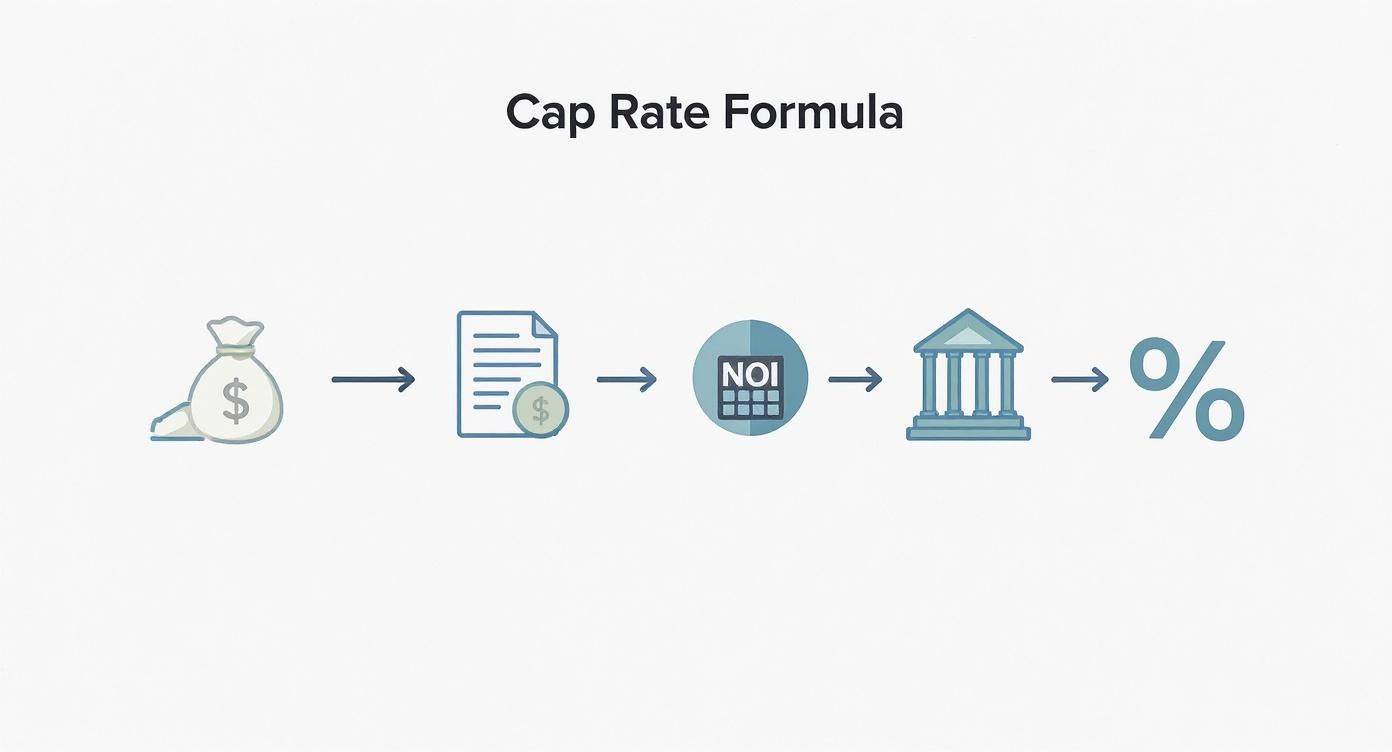
As you can see, the cap rate is a direct relationship between a property's income-generating power (NOI) and what someone is willing to pay for it.
When interest rates rise, the cost of borrowing money increases. Suddenly, investors demand higher returns from real estate to justify choosing it over safer, simpler investments like bonds. This pressure pushes property prices down for a given income level, causing cap rates to expand (go up).
Historical data makes this crystal clear. Over the past two decades, a period largely defined by falling interest rates, cap rates generally compressed. From 2001 to 2022, the average cap rate for major commercial properties in the U.S. fell from around 8% to below 6%. This pattern proves that a "good" cap rate isn't a fixed number but something that evolves with the macroeconomic tide. You can explore more about these historical commercial real estate trends and their drivers to see how these forces play out.
By analyzing these three core factors—location, property characteristics, and economic conditions—you can move beyond a surface-level number and begin to understand the real story behind any investment opportunity.
Putting Cap Rate to Work in Investment Scenarios

Knowing the formula is one thing, but using it to make smart decisions in the real world is what really matters. So, let's move past the theory and see how cap rates play out in two very different investment opportunities. Think of cap rate as a compass—it doesn't tell you the whole story of the terrain, but it points you in the right direction.
Imagine you're evaluating two properties. Each one has a unique story to tell through its numbers.
Scenario 1: Property A – The Stable Urban Core
First on your list is Property A, a modern 10-unit apartment building right in the heart of a thriving city. This area has it all: a hot job market, tons of tenant demand, and a history of steady appreciation. It's what we'd call a classic "core" investment—safe, stable, and predictable.
Here's the breakdown:
- Property Type: Class A Multifamily
- Purchase Price: $2,500,000
- Net Operating Income (NOI): $112,500 annually
- Calculated Cap Rate: 4.5% ($112,500 / $2,500,000)
That 4.5% cap rate might seem a little underwhelming at first glance. But what it really signals is confidence. The market is so sure about this property's future—its low vacancy risk and high likelihood of appreciation—that investors are willing to pay a premium for it. This isn't a get-rich-quick play; it's about long-term wealth preservation and steady, reliable growth.
Scenario 2: Property B – The High-Yield Opportunity
Next up is Property B, an older 20-unit office building in a quiet suburban market. The local economy is chugging along but not exactly booming, and the building could definitely use a facelift to attract better tenants. This is a "value-add" opportunity, where the potential for higher returns comes with a bit more hands-on work.
Let's run the numbers:
- Property Type: Class C Office Building
- Purchase Price: $1,500,000
- Net Operating Income (NOI): $120,000 annually
- Calculated Cap Rate: 8.0% ($120,000 / $1,500,000)
Now, an 8.0% cap rate—that gets your attention. From a pure income standpoint, this property is a powerhouse, generating more cash on a smaller investment. The catch? You're being compensated for taking on more risk. The secondary market, the building's age, and less certain tenant demand all contribute to that higher, more attractive cap rate.
The core difference is crystal clear: Property A offers safety and future appreciation, which is why it has a low cap rate. Property B offers higher immediate income as a reward for taking on greater risk, hence the high cap rate.
Making the Strategic Decision
So, which one is the "better" deal? That's the million-dollar question, and the answer comes down to your personal strategy.
An investor nearing retirement might sleep a lot better at night with the predictable stability of Property A. On the other hand, a younger investor with a higher risk tolerance might jump at Property B, seeing its strong cash flow and the chance to force appreciation through smart renovations.
This is exactly why cap rate is just the starting point. It gives you a quick, unleveraged snapshot. To get the full picture, you have to dig deeper and learn how to calculate the cash flow on a rental property after your specific financing is factored in. That’s where you see what the deal really means for your wallet.
To make this even clearer, let's put these two deals head-to-head.
Investment Scenario Comparison: Low Cap Rate vs. High Cap Rate
The table below breaks down the strategic differences between these two investments, showing how your goals determine which property is the right fit.
| Metric | Property A (Low Cap Rate) | Property B (High Cap Rate) |
|---|---|---|
| Cap Rate | 4.5% | 8.0% |
| Primary Appeal | Stability & Appreciation | High Immediate Cash Flow |
| Market | Prime, High-Growth Urban | Secondary, Stable Suburban |
| Risk Profile | Low | Moderate to High |
| Investor Focus | Long-Term Wealth Growth | Immediate Income Generation |
| Effort Required | Passive, Low-Maintenance | Active, Value-Add Management |
At the end of the day, a cap rate isn't just a number—it’s a story about risk and reward. By using it to compare properties, you can quickly filter out the noise and focus your energy on the deals that actually align with what you’re trying to achieve. It’s a simple tool that helps you make smarter, more confident decisions from the get-go.
Going Beyond Cap Rate with Other Key Metrics
Think of cap rate as the first filter you run a potential deal through. It’s an exceptional tool for quickly sizing up a property and comparing it to others on the market. But relying on it alone is like trying to navigate a city with just a compass—it points you in the right direction but leaves out the crucial details of streets, traffic, and detours.
To build a truly bulletproof analysis, savvy investors pair the cap rate with other metrics that tell the rest of the story. A cap rate shows you how a property performs in a perfect world, assuming you paid all cash. But that's not how most of us invest. The moment you introduce a loan, the entire financial picture shifts, and that’s where these other numbers become absolutely essential.
Cash-on-Cash Return: The Investor's Reality
After cap rate, the single most important metric for most investors is the Cash-on-Cash Return. This simple calculation gets right to the point: it reveals the annual return on the actual money you pulled out of your pocket to buy the property.
It answers the question every investor is really asking: "For every dollar I put in, how much am I getting back each year?"
Cash-on-Cash Return = Annual Pre-Tax Cash Flow / Total Cash Invested
Unlike the cap rate, which intentionally ignores financing, cash-on-cash return is built around it. Your annual pre-tax cash flow is what’s left in your bank account after paying all operating expenses and your mortgage. Your total cash invested is your down payment, closing costs, and any initial repair money.
This metric often tells a completely different story than the cap rate precisely because it accounts for the powerful leverage of a loan. A property with a merely decent cap rate might actually produce a fantastic cash-on-cash return with the right financing. To dig deeper into this, check out our guide on what is a good cash-on-cash return.
Return on Investment (ROI): The Big Picture View
While cash-on-cash return zeroes in on your annual income, Return on Investment (ROI) zooms out to take a much broader view. ROI measures the total profit from an investment relative to its cost, including every dollar you make from it.
ROI isn't just about cash flow. It’s the full report card on your investment, usually calculated over your entire holding period. It tells you the total gain you pocketed when you finally sold the property.
The key ingredients of ROI include:
- Total Cash Flow: Every dollar of net income you collected over the years.
- Equity Buildup: The amount of loan principal your tenants helped you pay down.
- Appreciation: The increase in the property's market value from the day you bought it to the day you sell.
This is the metric you look at to evaluate the overall success of an investment after the fact.
Internal Rate of Return (IRR): Factoring in Time
For a more advanced analysis, seasoned investors turn to the Internal Rate of Return (IRR). This one is a bit more complex, but it’s incredibly powerful because it introduces the time value of money—the fundamental principle that a dollar in your hand today is worth more than a dollar you expect to get tomorrow.
IRR calculates the annualized rate of return for all cash flows, both incoming and outgoing, over the entire life of an investment. Its real power is in helping you compare very different deals on an equal footing. For instance, IRR can help you decide if a "fix-and-flip" with a big, quick payout is a better use of your capital than a long-term rental with smaller, steadier returns over many years.
Ultimately, a good cap rate gets a property on your radar. But it’s these complementary metrics that move a deal from "interesting" to "investment-worthy." They transform a simple screening number into a comprehensive analysis, giving you the clarity you need to make smarter, more profitable decisions.
Common Questions About Cap Rates in Real Estate
As you start working with cap rates, a few questions always seem to come up. It's one thing to understand the formula, but it's another to apply it confidently in the real world. Let's tackle some of the most common questions investors have to clear up any lingering confusion.
Think of this as your go-to guide for navigating the finer points of cap rates. These answers will help you move from theory to practice.
Does a Higher Cap Rate Always Mean a Better Investment?
Not at all. While a high cap rate might catch your eye, it often signals higher risk. A property advertised with a 10% cap rate could be in a neighborhood with a shaky economy, have a laundry list of deferred maintenance, or be struggling to keep tenants. That higher return is essentially your compensation for taking on those headaches.
On the flip side, a lower cap rate usually points to stability and safety. A property with a 4.5% cap rate in a prime, growing market is likely a secure investment with a much better chance of long-term appreciation. The "better" deal really depends on what you're trying to achieve.
- Are you hunting for high cash flow and comfortable managing more risk? A higher cap rate might be right up your alley.
- Is your main goal wealth preservation and steady, predictable growth? A lower cap rate is probably a safer bet.
How Do Rising Interest Rates Affect Cap Rates?
When interest rates go up, cap rates almost always follow. It's a phenomenon known as cap rate expansion. The logic is pretty straightforward: as it becomes more expensive to borrow money, investors need a higher return from a property to make the deal pencil out.
Think about it this way. If you can get a 5% return on a super-safe government bond, would you be excited about a 5.5% cap rate on a real estate deal that comes with tenants, toilets, and property taxes? Probably not. To stay attractive, real estate has to offer a better return. This pressure pushes property prices down relative to their income, which mathematically makes the cap rate go up.
What Is the Difference Between Cap Rate and Cash-on-Cash Return?
The one-word answer? Financing. The cap rate formula gives you the raw, unleveraged return on a property, calculated as if you paid for it entirely in cash. It completely ignores any mortgage, which makes it a perfect tool for comparing different properties on an apples-to-apples basis.
Cap Rate = Net Operating Income / Property Value
Cash-on-cash return, on the other hand, is all about your specific deal. It tells you the return you’re getting on the actual cash you pulled out of your pocket—your down payment and closing costs—after accounting for your loan payments.
Cash-on-Cash Return = Annual Pre-Tax Cash Flow / Total Cash Invested
Here's a simple workflow: use cap rate as a quick filter to find promising opportunities. Once you've zeroed in on a property, run the cash-on-cash return calculation to see how it will actually perform for you with your specific financing.
Can You Use Cap Rate for Single-Family Homes?
You technically can, but it’s not really how the game is played for single-family houses. Cap rate is the language of commercial real estate—apartment buildings, retail centers, office buildings—where the property’s value is directly tied to the income it produces.
Single-family homes are valued differently, usually with the sales comparison approach. In other words, what have similar homes in the area sold for recently? When analyzing a single-family rental, investors tend to lean on metrics that are a better fit for the asset class:
- Cash-on-Cash Return: Shows the immediate return on your down payment.
- Gross Rent Multiplier (GRM): A quick-and-dirty way to compare prices relative to rent.
- Return on Investment (ROI): Measures the total profit you make over the entire time you own the property.
Calculating a cap rate on a single-family rental can be a helpful exercise, but don't make it your main decision-making tool. It's just one piece of a much larger puzzle.
Ready to stop crunching numbers in a spreadsheet and start finding your next deal with confidence? Property Scout 360 does the heavy lifting for you, providing instant analysis on cap rates, cash-on-cash returns, and long-term ROI for properties across the U.S. Stop building spreadsheets and start building your portfolio. Explore deals and run your first analysis for free at Property Scout 360.
About the Author
Related Articles
Build a Powerful Rental Property Calculator XLS From Scratch
Learn to build a powerful rental property calculator XLS with this guide. Analyze cash flow, ROI, and cap rates to make smarter investment decisions.
Real Estate Investment Calculator: Analyze Deals with Confidence
Master the real estate investment calculator: a practical guide on cash flow, cap rate, and ROI to analyze properties and make smarter decisions.
Build a Pro Real Estate Investment Analysis Spreadsheet
Build a powerful real estate investment analysis spreadsheet from scratch. This guide covers key formulas, scenario testing, and cash flow analysis.
