Deal Flow Real Estate: Mastering Consistent Investments with a Steady Pipeline
Discover deal flow real estate strategies to source, evaluate, and close opportunities with confidence.
When you get serious about real estate investing, you quickly learn that deal flow is everything. It's the constant, reliable stream of potential investment properties that land on your desk. Think of it as the lifeblood of your operation; without a steady current of deals to analyze, your business simply can't grow.
Nailing your deal flow strategy is what separates the pros from the amateurs. It’s how you move from passively waiting for opportunities to actively building a powerful, profitable portfolio.
Why Consistent Deal Flow Is Your Biggest Advantage
Imagine a river constantly flowing past your front door, carrying new opportunities with it every single day. That's what a strong deal flow feels like. It fundamentally changes the game, turning real estate investing from a reactive, luck-driven hobby into a proactive, scalable business.
When you have more potential deals than you can possibly handle, you operate from a position of abundance, not scarcity. This surplus is your ultimate advantage. You’re no longer tempted to chase mediocre properties just to "do a deal." Instead, you get to be picky, selecting only the investments that perfectly align with your specific goals and criteria.
A deep pipeline also means you can negotiate from a place of strength. You're never desperate, because you always know there are other great options waiting in the wings.
The Foundation of Scalable Growth
A reliable stream of opportunities is the raw material for building a real estate empire. Without it, growth is sporadic and painfully slow. But with a system in place? You can set real, predictable growth targets and actually hit them.
This systematic approach delivers some serious benefits:
- Sharper Decision-Making: Looking at a high volume of deals trains your eye. You start to see patterns, develop an intuitive feel for market values, and spot the true bargains instantly.
- Lower Risk: When you’ve analyzed hundreds of properties, you get really good at spotting the red flags and avoiding the kind of costly mistakes that sink newer investors.
- Market-Proof Your Business: A solid sourcing system helps you find hidden gems in any market cycle—whether it’s a buyer’s, seller’s, or sideways market.
Recent trends really highlight this. After a recent slowdown, global real estate deal value shot up by 11% year-over-year, climbing from $634 billion to $707 billion. According to the latest global private markets report, this jump was driven by better financing conditions, showing just how fast the window of opportunity can open for investors who are prepared to act.
A great investor doesn't wait for the perfect deal to magically appear. They build a machine that brings a steady stream of good deals to them. The power isn't in finding one needle in a haystack; it's in building a machine that sifts through haystacks for you.
To wrap it up, mastering your real estate deal flow is about taking control of your own destiny as an investor. It’s the engine that powers everything else—from your analysis and acquisitions all the way to building long-term wealth.
Before we dive into the "how," let's quickly summarize what a healthy deal flow looks like. These are the core pillars that support a truly scalable investment operation.
Key Components Of A Healthy Real Estate Deal Flow
| Component | Description | Why It's Critical |
|---|---|---|
| Consistency | A predictable, steady stream of leads, not just sporadic bursts of activity. | Prevents "feast or famine" cycles and allows for strategic, long-term planning. |
| Quantity | Enough incoming leads to allow for selective evaluation. | The more you see, the better you become at spotting true value and avoiding bad deals. |
| Quality | Leads that are generally aligned with your core investment criteria. | Saves massive amounts of time by filtering out irrelevant opportunities early on. |
| Diversity | Sourcing deals from multiple channels, not relying on just one. | Protects your pipeline from market shifts and a single point of failure. |
| Efficiency | A streamlined system for capturing, tracking, and evaluating each opportunity. | Ensures good deals don't fall through the cracks and you can act quickly when needed. |
With these fundamentals in mind, you have a clear picture of what we're aiming to build: a robust, multi-channel system that consistently brings you high-quality opportunities.
The Five Stages Of A High-Performing Investment Pipeline
Think of your deal flow less like a random series of events and more like a well-oiled assembly line. When you structure it as a pipeline, the whole process becomes a predictable machine. Each stage has a clear job to do, taking raw leads and methodically moving them down the line until they become profitable assets. Breaking it down this way lets you spot bottlenecks, track what's working, and consistently get better results.
At a high level, the journey from finding a property to cashing the checks boils down to three core functions.
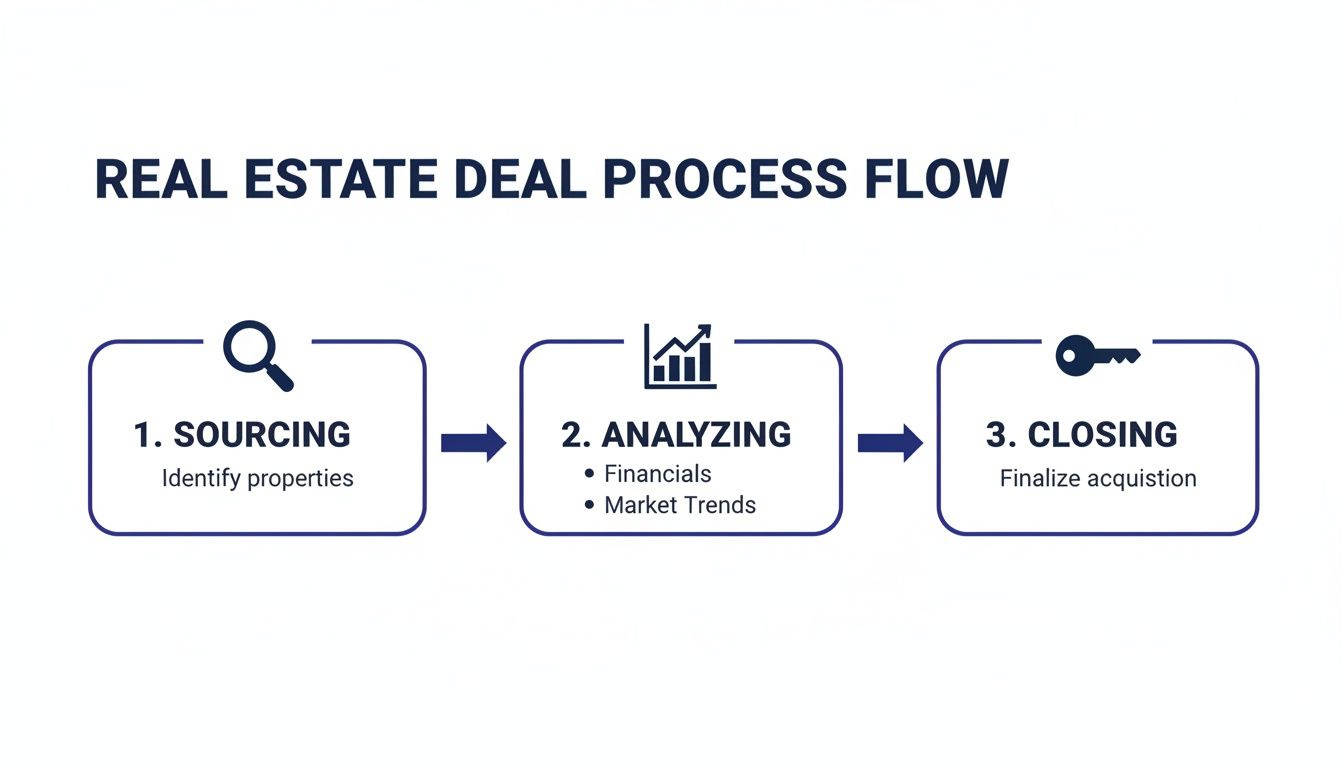
This graphic really simplifies the whole pipeline into its essential parts: finding opportunities, crunching the numbers, and getting the deal done.
Stage 1: Sourcing
This is the top of your funnel—where it all begins. The main goal here is simple: generate a consistent stream of potential investment opportunities. You're like a prospector, casting a wide net to pull in promising leads from every channel you can.
This means you're busy networking with brokers, tweaking your MLS alerts, sending out direct mail, or digging through online marketplaces. Success at this stage is all about volume. If you don't have a healthy flow of new leads coming in the door, the rest of your pipeline will starve.
Stage 2: Initial Screening
As soon as a lead comes in, it's time for a quick quality check. The idea is to immediately weed out the deals that are obvious non-starters. This saves your time and energy for the opportunities that actually have a shot. This isn't a deep dive; it's rapid triage.
You're just doing some back-of-the-napkin math and asking high-level questions. Is it the right property type for my strategy? Is it in one of my target neighborhoods? Is the asking price even in the same ballpark as reality? A quick "no" to any of these means you toss it and move on without a second thought.
Stage 3: In-Depth Due Diligence
Okay, a property made it past the first cut. Now it's time to put it under the microscope. The goal here is to verify every single one of your assumptions and uncover any nasty surprises before you're financially committed. This is where you roll up your sleeves and get into the nitty-gritty of the numbers and the building itself.
Your due diligence checklist should be non-negotiable and cover:
- Financial Verification: Get your hands on the rent rolls, P&L statements, and utility bills to make sure the numbers are real.
- Physical Inspection: Walk the property with a fine-toothed comb. You need to know the true condition of the roof, foundation, HVAC, and plumbing.
- Legal Review: Check for any title issues, liens, or zoning problems that could derail the deal.
A disciplined due diligence process is your best defense against catastrophic mistakes. It’s how you tell the difference between a genuinely good deal and one that just looks good on paper.
Stage 4: Offer And Negotiation
With your homework done, you can finally put together an offer rooted in hard data, not just gut feelings. Your objective is to lock down the property at a price and on terms that hit your financial goals. Your offer should be a direct reflection of the property's true value, accounting for any repairs or risks you found.
This part of the process is a delicate dance. You have to be strategic and communicate clearly. Honestly, your biggest advantage here is the willingness to walk away—a luxury you only have when your pipeline is full of other opportunities.
Stage 5: Closing
This is the final sprint where the deal becomes official. The goal is a smooth transfer of ownership, which means coordinating with everyone involved: lenders, attorneys, title companies, and the sellers.
You’ll be finalizing your financing, signing a mountain of legal documents, and wiring the funds. With direct investment volumes recently hitting $213 billion in a single quarter—a 17% jump year-over-year—a tight closing process is crucial for capitalizing on opportunities before they disappear. You can discover more about current market perspectives to see how different sectors are trending.
Once the keys are in your hand, the property is officially part of your portfolio. Your pipeline just did its job: it turned a lead into a real, income-producing asset.
Proven Sourcing Channels To Keep Your Pipeline Full
A well-designed pipeline is just an empty box without a steady stream of deals to fill it. The secret isn't finding just any deal; it's about consistently finding the right deals that fit your investment strategy like a glove. This requires a smart, multi-channel approach that blends old-school relationship building with new-school technology.
Think of it like fishing. You wouldn't just drop a single line in one spot and hope for the best, right? A serious angler uses multiple rods, different types of bait, and knows the best spots to cast a line. That's exactly how you need to think about building a resilient deal flow system in real estate.
The Power of Professional Networks
Let's be clear: the absolute best deals rarely, if ever, hit the open market. They're passed between trusted contacts, and your professional network is your all-access pass to these opportunities.
- Real Estate Agents and Brokers: A good agent does more than just forward you MLS listings. A great agent is your scout on the ground. They hear the whispers about pocket listings, pre-foreclosures, and sellers who are just starting to think about moving. Building a genuine relationship with a few key agents in your target market is non-negotiable.
- Wholesalers: These are the hunter-gatherers of the real estate world. They specialize in one thing: finding deeply discounted properties from motivated sellers. They do the heavy lifting, and for a fee, they can bring you deals with built-in equity from day one.
- Attorneys and Lenders: Professionals like probate attorneys, divorce lawyers, and even mortgage brokers are on the front lines. They often get an early look into situations that create a need to sell quickly. Nurturing these connections can open up a unique, less-crowded channel for deals.
The most profitable deals are often found, not searched for. They come from conversations, relationships, and a reputation for being a reliable buyer who can close.
Direct-To-Seller Marketing
While networking helps you intercept deals already in motion, direct marketing lets you generate your own. This is where you go straight to the source, reaching out to property owners who might be considering a sale but haven't taken that first step to list their property.
It's a numbers game, no doubt. It requires patience and consistency, but the rewards can be massive. You're facing far less competition and have the chance to negotiate directly with the owner, creating a true win-win situation.
Common Direct Marketing Tactics
- Direct Mail: Still incredibly effective. Sending targeted postcards or letters to specific lists—think absentee owners, tired landlords, or homeowners with high equity—can work wonders.
- Driving for Dollars: This one is a classic for a reason. You physically drive through your target neighborhoods, looking for signs of distress like overgrown lawns or boarded-up windows. Then, you use public records to track down the owner and start a conversation.
- Cold Calling: It's not for everyone, but directly calling property owners from a targeted list to ask if they'd consider an offer is a straightforward way to create opportunities from thin air.
The key here is focus. Don't try to do everything at once. Pick one or two methods, truly master them, and stick with it. A single mail campaign will probably get you nowhere, but a consistent six-month campaign almost always will.
Digital Deal Sourcing Channels
The internet has completely changed the game, offering speed and scale that were unimaginable just a decade ago.
Of course, you have the big online marketplaces. Platforms like Zillow, Redfin, and Realtor.com are essential for on-market deals. The trick is to get hyper-specific. Set up saved searches with your exact criteria—zip code, price, bed/bath count—and turn on instant alerts. Speed is your biggest advantage; being the first to see a new listing can make all the difference.
But don't stop there. Dig a little deeper to find these digital goldmines:
- Online Auctions: Websites like Auction.com and Hubzu are hotspots for foreclosure and bank-owned (REO) properties, which can often be bought for well below market value.
- For Sale By Owner (FSBO) Sites: Sellers on these platforms aren't paying a hefty agent commission, which sometimes gives them more flexibility on price. It's always worth a look.
- Social Media & Forums: Don't underestimate the power of community. Local real estate investing groups on Facebook and forums like BiggerPockets are buzzing with wholesalers and investors posting off-market deals daily.
It's also smart to keep an eye on the bigger picture. Global and regional trends can point you toward emerging opportunities. For instance, the residential sector in Europe is showing incredibly strong fundamentals, with vacancy rates in key markets hovering between a tight 2% and 3%. Back in the US, grocery-anchored retail centers continue to be a remarkably stable investment. Discover more insights in the global real estate strategic outlook to understand how different markets are shaping up.
Below is a quick breakdown of how these channels stack up against each other.
Comparison Of Real Estate Deal Sourcing Channels
This table compares the most common deal sourcing channels, giving you a sense of the tradeoffs between cost, effort, quality, and scalability for each.
| Sourcing Channel | Typical Cost | Time/Effort | Potential Deal Quality | Best For |
|---|---|---|---|---|
| Agents/Brokers | Low (Commissions paid at closing) | Medium (Relationship building) | Medium to High | Investors seeking on-market and pocket listings. |
| Wholesalers | Medium (Assignment fees) | Low to Medium | High (Often deeply discounted) | Investors wanting pre-vetted, off-market deals. |
| Direct Mail | High (Printing, postage, lists) | High (Requires consistency) | Very High | Investors looking for high-margin, off-market deals. |
| Online Marketplaces | Low (Free to browse) | Low | Low to Medium | Finding on-market deals quickly; high competition. |
| Online Auctions | Low to Medium (Platform fees) | Medium (Requires due diligence) | Medium | Experienced investors comfortable with auction risks. |
Ultimately, no single channel is the "best." The most successful investors build a blended system. By diversifying your sources—from handshakes to hashtags—you create a deal pipeline that's consistent, resilient, and always full of new opportunities.
How to Analyze and Qualify Deals in Minutes, Not Hours
A high-volume deal flow is worthless if you can't sort the gems from the junk—fast. If you're spending hours doing a deep dive on every single property that crosses your desk, you're going to drown in spreadsheets and let the real opportunities slip by.
The secret is developing a rapid screening process. It’s all about creating a quick, almost instinctual "go/no-go" filter that tells you whether a deal is worth a second look. This isn't about being sloppy; it's about being ruthlessly efficient with your most valuable asset: your time.

Quick Screening Rules for Rental Properties
For buy-and-hold investors, a couple of time-tested rules of thumb are perfect for that first pass. They act as a lightning-fast litmus test for a property's cash flow potential before you waste a single minute on due diligence.
1. The 1% Rule
This is the classic back-of-the-napkin test. The rule states that a property's gross monthly rent should be at least 1% of the all-in purchase price (including any immediate rehab costs). So, a $250,000 property needs to rent for at least $2,500 per month to pass. If it's way off, you'll likely struggle to make the numbers work.
2. The 50% Rule
This one gives you a quick and dirty way to estimate your operating expenses. It assumes that roughly 50% of your gross rental income will be eaten up by all the costs of owning the property—not including your mortgage payment. This bucket covers everything from property taxes and insurance to vacancies, repairs, and management fees.
The point of these rules isn't pinpoint accuracy. It's about speed. Their entire purpose is to help you instantly kick the obvious losers to the curb so you can focus your real energy on the deals that have a fighting chance.
Putting It All Together: A Real-World Example
Let's walk through how this works on the fly. You come across a single-family home listed for $200,000. A quick look at the market suggests you could rent it for $1,800 a month.
Here’s the five-minute analysis:
Step 1: Check the 1% Rule: Does the rent hit the mark? 1% of $200,000 is $2,000. The estimated rent of $1,800 falls short. That's a red flag, though not an automatic deal-killer if the property is in a high-growth area or is in perfect condition.
Step 2: Apply the 50% Rule: Let's estimate the Net Operating Income (NOI). We'll slice the gross rent in half to estimate expenses: $1,800 / 2 = $900 per month for expenses.
Step 3: Estimate the Mortgage: A quick mortgage calculation on a $160,000 loan (assuming a 20% down payment) at a 6.5% interest rate gives you a principal and interest payment of around $1,011 per month.
Step 4: Calculate Cash Flow: Now, let's see what’s left. $1,800 (Rent) - $900 (Expenses) - $1,011 (Mortgage) = -$111 per month.
The Verdict: Go or No-Go?
Right away, the numbers are screaming a negative cash flow of over $100 a month. For most investors, that's an immediate "no-go."
You just disqualified a deal in less time than it takes to make a cup of coffee, without ever opening a complex spreadsheet. That's the power of having a solid screening system in your toolbelt.
Of course, this quick math relies heavily on having a good feel for market rents and values. You can sharpen those skills with our guide on finding free real estate comps. By creating a simple, repeatable checklist from these principles, you can finally escape analysis paralysis and keep your pipeline flowing.
Building Your Deal Flow Management System
There's a moment in every investor's journey that separates the amateurs from the pros: the day they ditch the chaotic mix of sticky notes, cluttered spreadsheets, and foggy memories for a real, streamlined system. A flood of leads is a great problem to have, but without organization, it's just noise. The key is to build a dedicated deal flow management system that brings clarity and control to your entire operation.
Think of this system as your central command center. Modern Customer Relationship Management (CRM) software is built for this exact purpose, turning the abstract idea of a "pipeline" into a tangible, visual workflow. It’s designed to track every moving part, ensuring no promising lead ever slips through the cracks.

Why Spreadsheets Eventually Fail
Let's be honest, most of us started with a simple spreadsheet. And for tracking a handful of properties, it works just fine. But as your deal flow grows, that trusty spreadsheet quickly becomes your biggest bottleneck.
Spreadsheets are static. They can’t set follow-up reminders, store property photos and legal documents in one place, or log your entire communication history for a deal. Before you know it, you’re juggling a dozen different files, and crucial information gets lost in the digital shuffle. It’s a recipe for disaster.
A dedicated system isn't just about getting organized; it's about building institutional memory. It makes sure that every conversation, every number, and every hard-won lesson from a deal—won or lost—is captured and used to make you a smarter investor tomorrow.
Moving to a CRM is about creating a single source of truth for your business. It lets you automate the tedious stuff, gives you a bird's-eye view of your entire pipeline, and turns chaotic activity into predictable, efficient progress.
Setting Up Your Digital Pipeline
So, how do you actually structure this? The goal is to create distinct stages inside your CRM that perfectly mirror your investment process, all the way from a new lead to a closed deal. While the software might look different, the core principles are the same everywhere.
Most CRMs use a visual "Kanban" board. Imagine a whiteboard with columns for each stage. Each deal is a "card" that you can literally drag and drop from one column to the next as it moves forward. This visual layout is incredibly powerful because you can see where every deal stands in a single glance and spot bottlenecks before they derail your progress.
An effective, battle-tested pipeline for real estate investors usually includes these stages:
- New Lead: This is the front door. Every potential deal—whether from a broker, a direct mailer, or an online alert—starts right here.
- Initial Screening: The deal passed your five-minute test. You've confirmed it meets your basic criteria and is worth digging into.
- Due Diligence: Time to get serious. You're actively investigating the property, which means site visits, number crunching, and reviewing all the paperwork.
- Offer Made: You've officially submitted an offer to the seller. The deal card sits here while you wait for a response or get into negotiations.
- Under Contract: Success! Your offer was accepted. The property is now under contract, and you're working with your team to get to the finish line.
- Closed - Won: You got the keys. The deal is done, and the property is officially in your portfolio.
- Closed - Lost: The deal died for one reason or another. It's just as important to track these so you can learn what went wrong and refine your strategy.
Capturing The Right Information
For every deal card you create, you need to track the essentials. A good CRM will let you create custom fields, so you can capture the specific data points that matter to your unique strategy.
At a bare minimum, your system should track:
- Property Details: Address, property type, square footage, bed/bath count.
- Contact Information: The seller's name, their agent's info, your attorney's details.
- Key Financials: Asking price, your estimated rehab budget, projected rent, and your offer amount.
- Critical Dates: The offer deadline, inspection period end date, and the target closing date.
- Next Steps: This is huge. Always define the very next action item and assign a due date to keep the momentum going.
While a CRM is perfect for organizing the workflow, you still need a powerful tool for the financial analysis itself. Many seasoned investors find that pairing their pipeline management software with a detailed spreadsheet is the ultimate combination. To help with the number-crunching, you can use a real estate investment analysis spreadsheet designed to handle the deep-dive calculations.
This two-tool approach gives you the best of both worlds: a high-level, visual pipeline in your CRM and the power for granular financial modeling in your spreadsheet.
The Key Metrics For Optimizing Your Investment Pipeline
Trying to manage your real estate deal flow without tracking metrics is like flying blind. You might be busy, but are you actually getting anywhere? To turn your pipeline from a random list of properties into a predictable, deal-generating machine, you need to know your numbers.
These metrics tell the real story of your operation. They uncover hidden bottlenecks, show you which of your lead sources are actually goldmines, and point you exactly where to focus your energy. When you track the right KPIs, you stop guessing and start making smart, data-driven decisions that lead to more and better deals.
Essential Pipeline Conversion Metrics
Think of conversion rates as your pipeline's pulse. They measure how effectively you're turning a potential lead into a closed deal. Nailing down these three core metrics will give you an immediate, high-level picture of what’s working and what’s broken.
Lead-to-Offer Ratio: This is simple: what percentage of leads that you look at are actually worth making an offer on? If you’re making one offer for every 100 leads, your sourcing might be way too broad. You're wasting precious time sifting through junk.
Offer Acceptance Rate: Out of all the offers you submit, how many actually get a "yes"? A chronically low acceptance rate is a red flag. It could mean your offers are too aggressive, your negotiation skills need a polish, or you're simply playing in a market that's too hot.
Offer-to-Close Rate: This tracks how many of your accepted offers make it all the way to the closing table. If deals are consistently falling apart after you get a handshake, you likely have a problem with your due diligence process or your financing is not as solid as you think.
Tracking your pipeline KPIs isn't just about crunching numbers. It's about diagnosing problems before they kill a great deal. When your Lead-to-Offer Ratio suddenly plummets, you know your sourcing needs a tune-up—a fix you’d never know to make if you weren't watching the data.
Critical Efficiency and Financial Metrics
Beyond just converting leads, you have to look at how quickly and profitably you're moving deals through the system. After all, time is money in this business.
Average Time to Close is a big one. It measures the total number of days from when a lead first hits your desk to when you're signing the closing papers. A long cycle can tie up your capital and make you miss out on other opportunities. It's also incredibly insightful to break this down by lead source. You might find that wholesaler deals close in 30 days while your direct mail leads take 90.
Of course, none of this matters if the deals aren't profitable. The Capitalization Rate (Cap Rate) on the properties you acquire is your ultimate scorecard. This metric is a bedrock of real estate analysis, giving you a snapshot of your potential return on investment. If you're consistently closing deals with a healthy cap rate, you know your underwriting is on point. To really get this right, check out our guide on how to calculate cap rate.
Your Top Real Estate Deal Flow Questions, Answered
As you start putting a real system in place for your deal flow, you're bound to hit a few roadblocks. Let's tackle some of the most common questions that pop up when investors move from theory to the real world.
How Many Deals Do I Realistically Need to Analyze?
There's an old rule of thumb in real estate investing known as the “100-10-1 Rule.” It’s a simple but powerful concept.
The idea is that for every 100 properties you look at, you’ll probably find about 10 that are interesting enough to make an offer on. Out of those 10 offers, you might close on one great deal.
Now, this isn't set in stone. In a blazing hot seller's market, those numbers might look more like 200-10-1. But if you've dialed in a killer off-market strategy, you could easily beat this ratio.
Think of the 100-10-1 Rule as a mindset, not a mathematical certainty. It’s a reminder that this is a numbers game. It teaches you to stay persistent and not get bummed out when the first 50 properties you review don't make sense.
What Are the Best Free Tools to Manage My Pipeline?
You don't have to shell out big bucks for fancy software, especially when you're starting out. Many seasoned investors get by just fine with powerful free tools before ever paying for a dedicated system.
- Supercharged Spreadsheets: Forget basic Excel. A well-designed Google Sheet or an Airtable base can act as a surprisingly robust visual pipeline. You can use them to track every deal from initial contact to close.
- "Freemium" CRMs: Platforms like HubSpot or Zoho CRM offer free plans that are more than enough for a solo investor. They give you the core pipeline management features you need to get organized without the cost.
How Can I Put My Deal Sourcing on Autopilot?
Automation is your best friend for saving time and making sure you don't miss out on the perfect deal. A simple first step is setting up saved searches on sites like Zillow or Redfin. Just plug in your criteria and get instant email alerts the second a matching property hits the market.
Ready to take it up a notch? Hire a virtual assistant (VA). You can train a VA to do the initial legwork—combing through new listings, applying your quick-screen criteria, and only sending you the properties that actually deserve a closer look. It’s a game-changer.
Stop drowning in spreadsheets and start making smarter, faster investment decisions. Property Scout 360 gives you the instant analysis and market data you need to find and qualify profitable deals in minutes, not weeks. Find your next deal with Property Scout 360.
About the Author
Related Articles
2026 Investor's Guide: Cost of Installing a Sewer Clean Out
Understand the cost of installing a sewer clean out for investment properties in 2026. Get expert advice on prices, ROI, & budgeting for flips. Plan smart!
15 Year vs 30 Year Mortgage: The Investor's Choice
Deciding between a 15 year vs 30 year mortgage for a rental property? Our guide analyzes cash flow, ROI, and equity to help you pick the best loan.
Real Estate Appraisal Software: Features & Limits
Discover what real estate appraisal software is, its core features, and limits. See how it differs from investment tools for profitable deals.
