Finding Free Real Estate Comps A Practical Guide for Investors
Discover how to find and analyze free real estate comps to accurately value any property. This guide covers proven methods for reliable property valuation.
Finding free real estate comps boils down to a simple idea: you dig into public records and comb through major listing sites to find recently sold properties that look a lot like the one you're interested in. This whole process is what pros call a Comparative Market Analysis (CMA), and it’s the absolute foundation for figuring out what a property is really worth.
What Real Estate Comps Are and Why They Matter
Real estate comps—short for "comparable sales"—are the bedrock of any solid property valuation. Think of them as a benchmark. They're recently sold properties that share key traits with the property you're trying to value (we call this the "subject property"). By seeing what truly similar homes have recently sold for, you can land on a pretty reliable estimate of your property's current market value. This isn't just some helpful exercise; it's a critical step for making smart financial moves.
For anyone in real estate, from a first-time investor to a seasoned house flipper, comps provide the market intelligence you can't operate without. They take the guesswork out of pricing. Without solid comps, you're flying blind, risking a massive overpayment on a purchase or, just as bad, underselling a valuable asset. This data is the lifeblood of deals in a market valued in the trillions. In fact, the global real estate market was valued at approximately $393.3 trillion in 2025, which just goes to show how critical accurate valuation is.
Before we dive into how to find them, let's look at the best places to start your search.
Your Go-To Sources for Free Real Estate Comps
Here's a quick rundown of the most accessible free sources for finding comparable property sales, along with their main benefits and potential drawbacks.
| Source | Primary Benefit | Key Limitation |
|---|---|---|
| Major Listing Sites (e.g., Zillow, Redfin) | Easy to use with robust search filters for recently sold homes. | Data can sometimes be inaccurate or slightly delayed. |
| County Appraiser/Assessor Website | The most official source for recorded sales data, ownership history, and tax info. | Websites are often clunky and less user-friendly to navigate. |
| Local Real Estate Agents | Access to the MLS, the most accurate and up-to-date data source available. | They provide comps in hopes of getting your business, not as a free service. |
While free sources get you far, sometimes the speed and accuracy of a paid tool like Property Scout 360 are worth it when the stakes are high.
The Core Components of a Good Comp
Not every sold property is a useful comparable. The best comps are almost like a mirror image of your subject property, reflecting its most important features. To build an analysis you can actually trust, you need to find properties that line up on four key factors:
- Location: The closer, the better. Ideally, your comps should be in the exact same subdivision or neighborhood. Real estate is hyper-local, and values can change dramatically from one block to the next.
- Size: Look for homes with similar square footage and the same number of bedrooms and bathrooms. A 3,000 sq ft home is just not a good comp for a 1,500 sq ft bungalow, no matter how close it is.
- Age and Condition: A brand-new renovation will always sell for more than a dated property that needs a ton of work. Try your best to match the year built and the overall condition.
- Sale Date: The market is constantly moving. A sale from two years ago is ancient history in real estate terms. Stick to sales within the last 3-6 months to get the most accurate snapshot of current values.
By mastering the art of finding and analyzing free real estate comps, you're not just estimating a price—you're uncovering a property's true potential and protecting your investment from costly mistakes.
This data is vital for more than just settling on a purchase price. It drives everything, from figuring out your maximum offer on a flip to calculating a rental property's potential income. For investors, understanding these values is the first step in building out profitability metrics. Our guide on what is a good cap rate shows exactly how these initial valuations feed into the bigger investment picture. The goal is to build a complete financial forecast, and that always starts with solid comps.
Your Workflow for Finding Reliable Free Comps
Alright, now that you know what makes a good comp, it’s time to roll up your sleeves and start the hunt. Finding reliable free real estate comps isn't about stumbling upon one perfect source; it's about piecing together a clear picture from several different angles. Think of yourself as a detective building a case for your property’s value—one you can confidently stand behind.
My go-to workflow is a three-pronged attack that combines public records, the big real estate portals, and the boots-on-the-ground perspective of local brokerages. Each source gives you a different piece of the puzzle. When you put them together, you get a powerful, cost-free valuation toolkit. The trick is knowing what to look for and how to filter out the noise.
Start at the Source: Public Records
Your first stop should always be the official source of truth: public records. Every county has a property appraiser or tax assessor website. I’ll admit, they can feel a bit clunky and dated, but they contain the most accurate, legally recorded data on sales, tax history, and property details. This is your bedrock.
Here’s how I wring the most value out of them:
- Get Granular with Your Search: Don't just type in a street name. Dive into the advanced search filters to narrow things down by the legal subdivision, sale date (I always stick to the last 3-6 months), and key property features like square footage, bedrooms, and bathrooms.
- Confirm It's a "Real" Sale: You need to find "arm's-length" transactions, meaning a normal sale between a willing buyer and seller. Keep an eye out for anything that looks off. Foreclosures, family transfers, or estate sales are often sold at a discount and will absolutely skew your numbers, so do your best to toss those out.
A rookie mistake is just grabbing the first three sold properties you find. The real skill is in the validation—making sure every comp you use represents a true market-value transaction.
The data you pull from here, like the exact recorded sale price and date, becomes the baseline you'll use to check the accuracy of other, more user-friendly sites.
Ultimately, finding a property's value always comes back to the three pillars: location, size, and condition.
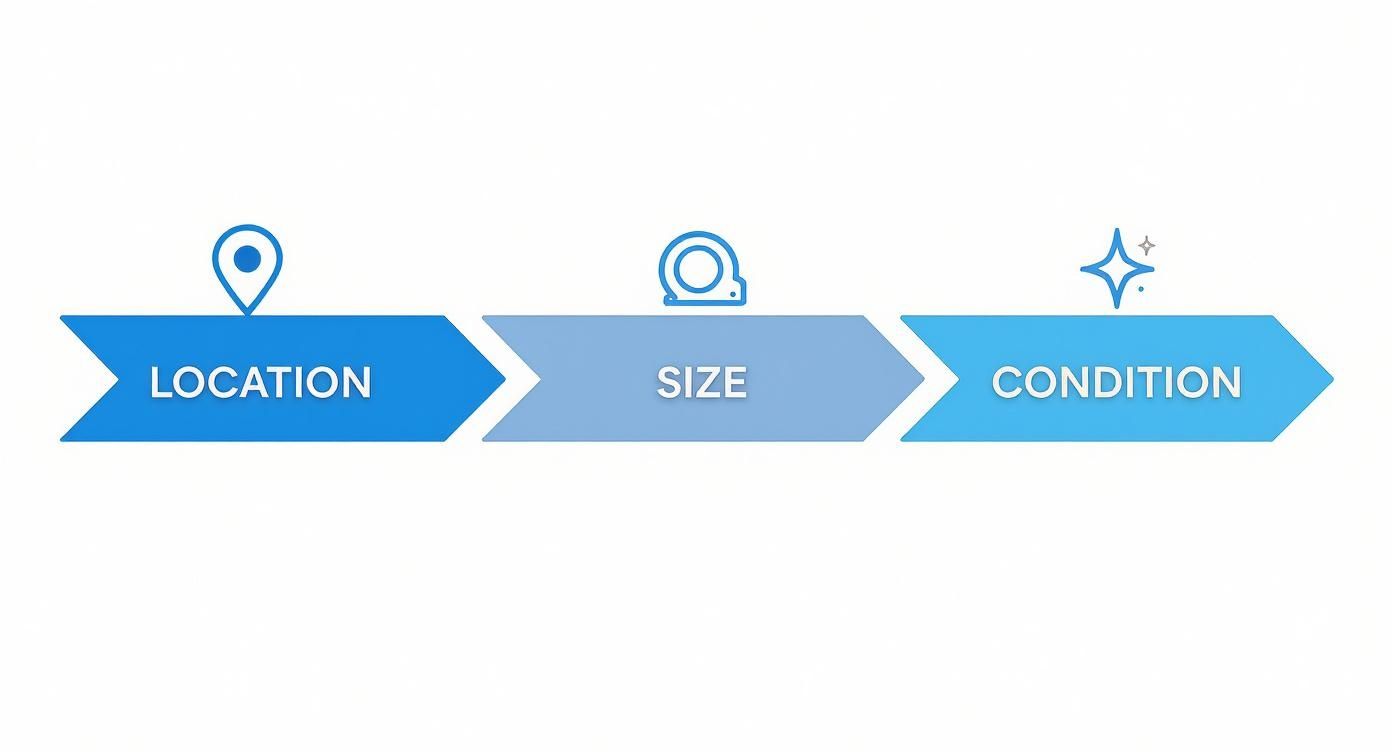
This just hammers home the point that you have to start broad with the location and then drill down into the nitty-gritty details of the property itself.
Cross-Reference with Real Estate Portals
Next up, I head over to free portals like Zillow and Redfin. These sites are fantastic because they aggregate sold data and display it with photos on a map. This is where you get the visual context that public records just can't give you.
Your mission here is to find the same properties you located on the county site. Use the "Recently Sold" filter, zoom in on your target neighborhood, and start matching up addresses to confirm the details. More importantly, this is your chance to play armchair appraiser and assess the property's condition from the listing photos—a critical piece of info public records never have.
Let's say you found a sale for $450,000 on the Cook County Property Tax Portal. You then pop over to Zillow, find the same address, and see from the photos it had a brand-new kitchen and stunningly updated bathrooms. That context is gold when comparing it to your subject property, which might have a kitchen straight out of the 90s.
Add Local Flavor with Brokerage Insights
Lastly, don't forget to check out the websites of local real estate brokerages. They might not have powerful search tools for sold properties, but they often publish market reports or blog posts with hyper-local insights. They might be talking about sales trends in a specific subdivision or highlighting a recent noteworthy sale. This kind of qualitative info can add another layer of confidence to your numbers.
Even in 2024, with high interest rates, the global real estate market has been surprisingly resilient, with prices climbing despite economic headwinds. This just shows how fast things can change and reinforces why you need the most up-to-date comps to truly understand what's happening right now. You can read more about these global real estate trends on RedPinCompany.com.
By weaving together these three free sources, you create a solid system of checks and balances. The county site gives you the hard data, the portals provide the visual story, and local brokerages add that crucial market color. Sure, it takes more legwork than a paid tool like Property Scout 360, but it leaves you with a list of free real estate comps you can actually trust.
How to Analyze and Adjust Comps Like a Pro
Finding a list of recently sold homes is just the start. The real skill—the part that separates seasoned investors from amateurs—is in analyzing and adjusting those free real estate comps to pinpoint a property's true market value.
This is where you stop being a data collector and become a sharp analyst. A raw list of sale prices gives you a ballpark figure, but since no two properties are ever identical, you have to intelligently account for the differences.
First, Vet Your Comps
Before you even think about adjustments, you need to make sure each potential comp is legitimate. Was it a fair, "arm's-length" transaction?
You're looking for a normal sale between a willing buyer and a willing seller. Throw out any outliers like foreclosures, family transfers, or estate sales. These often sell at a discount and will throw your entire analysis out of whack. Public records can offer clues, but a quick search on free listing sites usually tells the story behind the sale.
The age of the comp is also crucial. The real estate market is always in motion. In fact, global private real estate markets have seen transaction volumes hit $739 billion over the past year—a 19% jump. This activity provides a much richer dataset to pull from, but it also means yesterday's prices are already history. You can dig deeper into market trends and tactics at Nuveen.com.
My rule of thumb? Stick to sales within the last 3-6 months. Anything older, and you're not valuing the property for today's market.
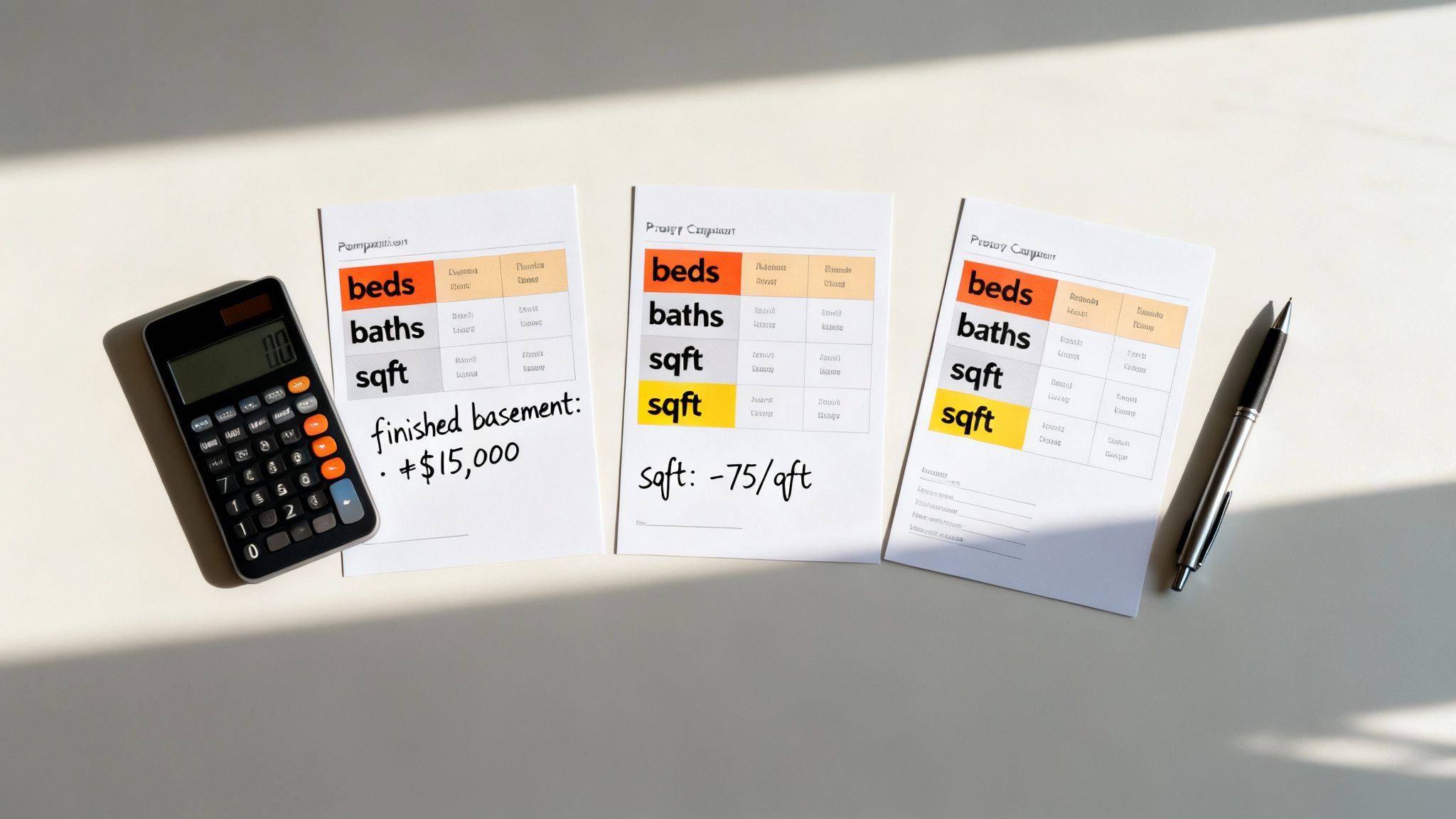
Making Smart Adjustments
With a clean list of valid comps, it's time to get down to the numbers. The core principle here is simple: if a comparable property is superior to yours, you subtract value from its sale price. If it's inferior, you add value.
Think of it this way: you're trying to figure out what the comp would have sold for if it were an exact clone of your property.
Here are some common adjustment values I use as a starting point. Remember, these are just guidelines—the actual dollar amounts will vary wildly depending on your specific market.
- Square Footage: This is usually the biggest adjustment. I typically find the average price per square foot in the neighborhood and apply a fraction of that, like $50-$100 per sq. ft. of difference.
- Bathrooms: A full bathroom is a major feature. I might adjust +$10,000 to +$20,000 for an extra one. A half-bath might get an adjustment of +$5,000.
- Bedrooms: An extra bedroom's value depends on the local norm. The jump from two to three bedrooms is almost always more valuable than going from four to five.
- Garage Space: A two-car garage is a big deal in some areas. The difference between a one-car and a two-car could easily be +$5,000 to +$15,000.
- Basement: A finished basement is usable living space. Compared to an unfinished one, it could add +$20,000 or more to the value.
The goal isn't to be perfect down to the last dollar. It's about creating a logical, defensible valuation range. Your adjustments should tell a clear story about why your subject property is worth more or less than the comparable sales.
A Real-World Adjustment Scenario
Let's walk through a quick example to see this in action. Imagine your subject property is a 3-bed, 2-bath, 1,800 sq. ft. home with a one-car garage. You've found three solid comps.
Here's a simple worksheet showing how I'd approach the adjustments.
Example Comp Adjustment Worksheet
| Feature | Subject Property | Comp 1 ($410,000) | Comp 2 ($435,000) | Comp 3 ($405,000) |
|---|---|---|---|---|
| Beds / Baths | 3 bed / 2 bath | 3 bed / 2 bath | 3 bed / 3 bath | 3 bed / 2 bath |
| Sq. Footage | 1,800 sq. ft. | 1,700 sq. ft. | 1,800 sq. ft. | 1,900 sq. ft. |
| Garage | 1-Car | 1-Car | 2-Car | 1-Car |
Here’s my thought process for adjusting each one:
- Comp 1 ($410,000): It's 100 sq. ft. smaller. Using a conservative $75/sq. ft. adjustment, I'll add +$7,500. The adjusted value becomes $417,500.
- Comp 2 ($435,000): This one is superior—it has an extra full bathroom and a two-car garage. I'll subtract -$15,000 for the bath and -$10,000 for the garage. Its adjusted value comes down to $410,000.
- Comp 3 ($405,000): This property is 100 sq. ft. larger. I'll subtract -$7,500 for that extra space. The adjusted value is now $397,500.
After running the numbers, my original wide range of sale prices has tightened into a much more reliable adjusted value range of $397,500 to $417,500. This is the kind of data-driven analysis that underpins every good deal.
To see how this crucial valuation step plugs into a complete financial breakdown, check out our guide on how to analyze a rental property. It’s this process that separates the successful investors from the hopeful speculators.
Putting Your Comps to Work in Investment Analysis
You’ve put in the legwork—gathering, scrubbing, and adjusting your free real estate comps. Now it's time for the fun part: turning all that data into a smart investment decision. That adjusted value you’ve calculated isn’t just a number; it’s the linchpin for your entire deal.
This is where the analysis stops and the action begins. Whether you're teeing up a fix-and-flip or looking for your next long-term rental, those comps form the bedrock of your financial projections. They tell you what to offer, what your profit could look like, and ultimately, whether to walk away or go all in.
Calculating After Repair Value for Flips
If you're in the flipping game, your world revolves around one key metric: the After Repair Value (ARV). This is your best estimate of what that rundown property will sell for once you’ve worked your magic. The trick is to use comps that already look like your finished product.
You'll want to zero in on recently sold homes in the neighborhood that are nicely updated. The adjusted value you get from these top-tier comps becomes your target ARV. From there, you can plug it into one of the most reliable formulas in the business.
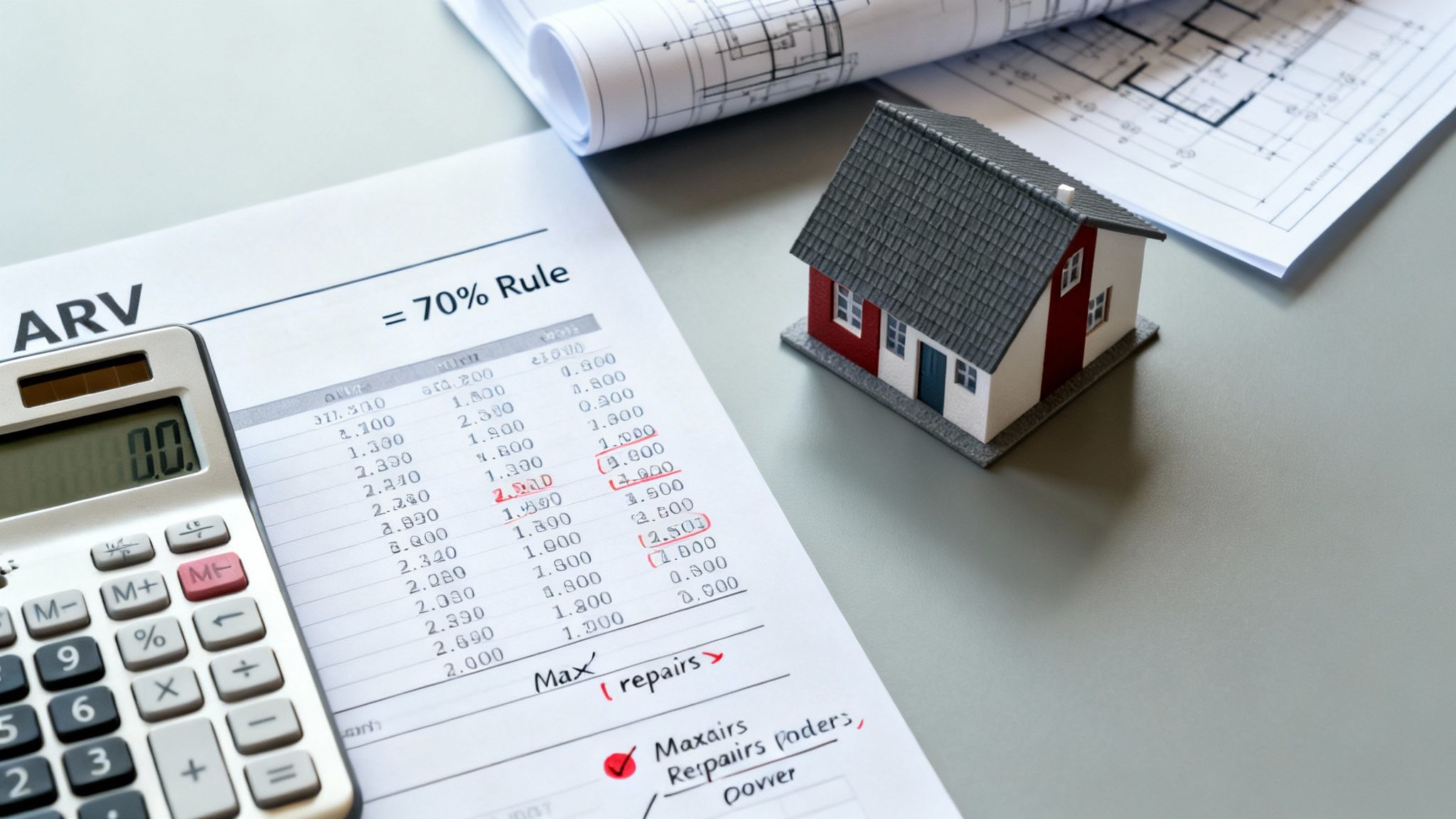
The 70% Rule is a time-tested guideline for calculating your maximum allowable offer (MAO). It’s a simple way to bake in your profit margin and create a buffer for the inevitable surprises.
- The Formula: (ARV x 0.70) – Estimated Repair Costs = Maximum Offer
Your comps don't just tell you what a property is worth today; they tell you what it could be worth and, most importantly, how much you can afford to pay for it to hit your profit goals.
Applying the 70% Rule in a Real Scenario
Let's run through a quick example. Say your comps analysis gives you a solid ARV of $400,000 for a house you're considering. You've walked it with your contractor, and the rehab budget comes in at $50,000.
Time to do the math:
- Calculate 70% of ARV: $400,000 x 0.70 = $280,000
- Subtract Repair Costs: $280,000 - $50,000 = $230,000
Your maximum offer on this property is $230,000. Every dollar you bid above that number is coming straight out of your pocket—your profit, your contingency fund, or both. This quick calculation, driven entirely by your comps, is your best defense against overpaying and starting a project in the red. If you want to get even more granular, a detailed real estate investment analysis spreadsheet can help you model out all the variables.
Setting Market Rents for Buy-and-Hold Properties
Comps are just as crucial for buy-and-hold investors, but the focus shifts from sales to rentals. Instead of sold properties, you’re hunting for rental comps—properties similar to yours in size, location, and condition that are either available now or were just rented.
Finding three to five solid rental comps will give you the confidence to set a competitive market rent. This is how you avoid the classic mistakes: undercharging and leaving money on the table, or overpricing and dealing with a costly vacancy. That monthly rent figure is the starting point for calculating your cash flow, cap rate, and every other metric that matters for a successful rental.
Knowing When to Go Beyond Free Resources
Learning to pull comps manually is a fantastic way to build your analytical muscle and get a real feel for a market. But let's be honest, there's a ceiling to what free resources can do. For any serious investor, a time comes when the DIY approach starts costing you more in time and potential mistakes than a good paid tool would.
The most glaring issue is the sheer time it takes. Hunting through clunky county websites, trying to match them with listings on Zillow, and then running manual adjustments is a grind. A task that a specialized tool like Property Scout 360 can knock out in minutes could easily burn a few hours of your day. That's time you could spend finding your next deal.
The Problem with Data Gaps and Guesswork
It's not just about speed, though. The data you get from free sources can be patchy and lead to some expensive miscalculations. This is a massive issue in non-disclosure states, where the actual sale prices are kept private. In those areas, you're basically flying blind, forced to rely on tax assessments, which are rarely a true reflection of market value.
And then there are the adjustments. You're left making educated guesses. Is a finished basement really worth $15,000 in this neighborhood, or is it closer to $25,000? How much do you add for that extra half-bath? Without the deep data from the MLS showing precisely how buyers value these features, you're essentially estimating.
A paid tool's real value isn't just saving you a few hours. It’s about swapping guesswork for data-backed confidence. The accuracy you gain from MLS data and automated adjustments is what protects your capital from bad deals.
This is where platforms like PropStream or DealCheck completely change the game. They plug you directly into nationwide MLS data, which gives you a huge leg up.
Here’s what that really means for you:
- Instant Comps: You get the most relevant and recent sales pulled for you in seconds. No more hunting.
- Accurate Data: You're working with verified MLS sale prices, which is critical in non-disclosure states.
- Automated Adjustments: The software applies current, market-specific values to features, giving you a far more reliable ARV.
- Deeper Insights: You can often uncover property history, liens, and owner details that you’d never find in public records alone.
So, when do you make the leap? It’s simple: when the value of your time and the financial risk of a bad comp outweigh the subscription cost. If you're analyzing several deals a week, a paid tool stops being a luxury and becomes an essential part of your toolkit for making smart, profitable decisions.
A Few Common Questions I Get About Real Estate Comps
Even after you get the hang of the workflow, a few questions always seem to pop up when you're in the trenches digging for free real estate comps. Nailing these details is what separates a decent guess from a solid, reliable valuation.
How Recent Do Comps Need to Be?
This is probably the number one question I hear. As a practical rule of thumb, you should be laser-focused on sales from the last 3 to 6 months. Markets move fast. A sale from even a year ago might as well be from a different era, reflecting an entirely different set of economic conditions. Sticking to recent sales ensures you're capturing today's value, not yesterday's.
Of course, sometimes you have no choice but to use older sales. If you do, just know that you're making a compromise and you absolutely must adjust that price for what the market has done since.
How Many Comps Should I Find?
Next up is the "magic number" question. While there's no single right answer, the industry standard—and what I always aim for—is three to five rock-solid, highly relevant comps. This gives you enough data to build a confident value range without muddying the waters with properties that are only kind of similar.
Remember, quality is everything here. If you can only find one or two properties that are practically twins to your subject property, that's far more valuable than five so-so matches.
Your goal isn't just to collect a list of sold homes. It's to build a tight, data-driven argument for a specific value. A few fantastic comps will do that far more effectively than a dozen questionable ones.
What if I Can't Find Anything?
So, what do you do when the well is dry? In slow markets or rural areas, finding recent, nearby sales can feel like searching for a needle in a haystack. This has been a huge issue lately, with some areas seeing 30% fewer sales than they used to, making the whole process a grind.
When you hit this wall, you’ve got two main levers to pull:
- Go Back in Time: You can start looking at sales from 6-12 months ago, but you have to do so with extreme caution. The critical step is applying a time adjustment. Has the market gone up or down since then? You need to adjust the sale price to reflect that change.
- Expand Your Search Radius: The other option is to cautiously venture into a neighboring, similar area or subdivision. Be incredibly careful with this. You know as well as I do that home values can fall off a cliff just by crossing the street into a different neighborhood.
This is exactly where free methods start to show their cracks. Making these kinds of nuanced adjustments without deep market data or sophisticated tools is tough and leaves a lot of room for error.
Learning to manually pull, validate, and adjust comps is an invaluable skill for any investor. But let's be honest—it takes a ton of time.
When you're ready to stop spending hours on research and start analyzing deals in minutes with MLS-backed data and automated adjustments, a tool like Property Scout 360 is the logical next step. Find your next profitable investment today at Property Scout 360.
About the Author
Related Articles
2026 Investor's Guide: Cost of Installing a Sewer Clean Out
Understand the cost of installing a sewer clean out for investment properties in 2026. Get expert advice on prices, ROI, & budgeting for flips. Plan smart!
15 Year vs 30 Year Mortgage: The Investor's Choice
Deciding between a 15 year vs 30 year mortgage for a rental property? Our guide analyzes cash flow, ROI, and equity to help you pick the best loan.
Real Estate Appraisal Software: Features & Limits
Discover what real estate appraisal software is, its core features, and limits. See how it differs from investment tools for profitable deals.
