Using the Rent to Value Ratio to Find Profitable Rentals
Learn how the rent to value ratio can help you spot profitable rental properties. Our guide breaks down the formula, benchmarks, and how to analyze deals fast.
The rent-to-value ratio, or RVR, is your back-of-the-napkin test for a rental property. Think of it as a quick financial health check that tells you how much income a property might kick off relative to what it costs. It’s the fastest way I know to filter out deals that simply won't cash flow.
A higher ratio usually signals stronger income potential, making it a critical first-pass metric for anyone serious about building a profitable portfolio.
Decoding the Rent to Value Ratio
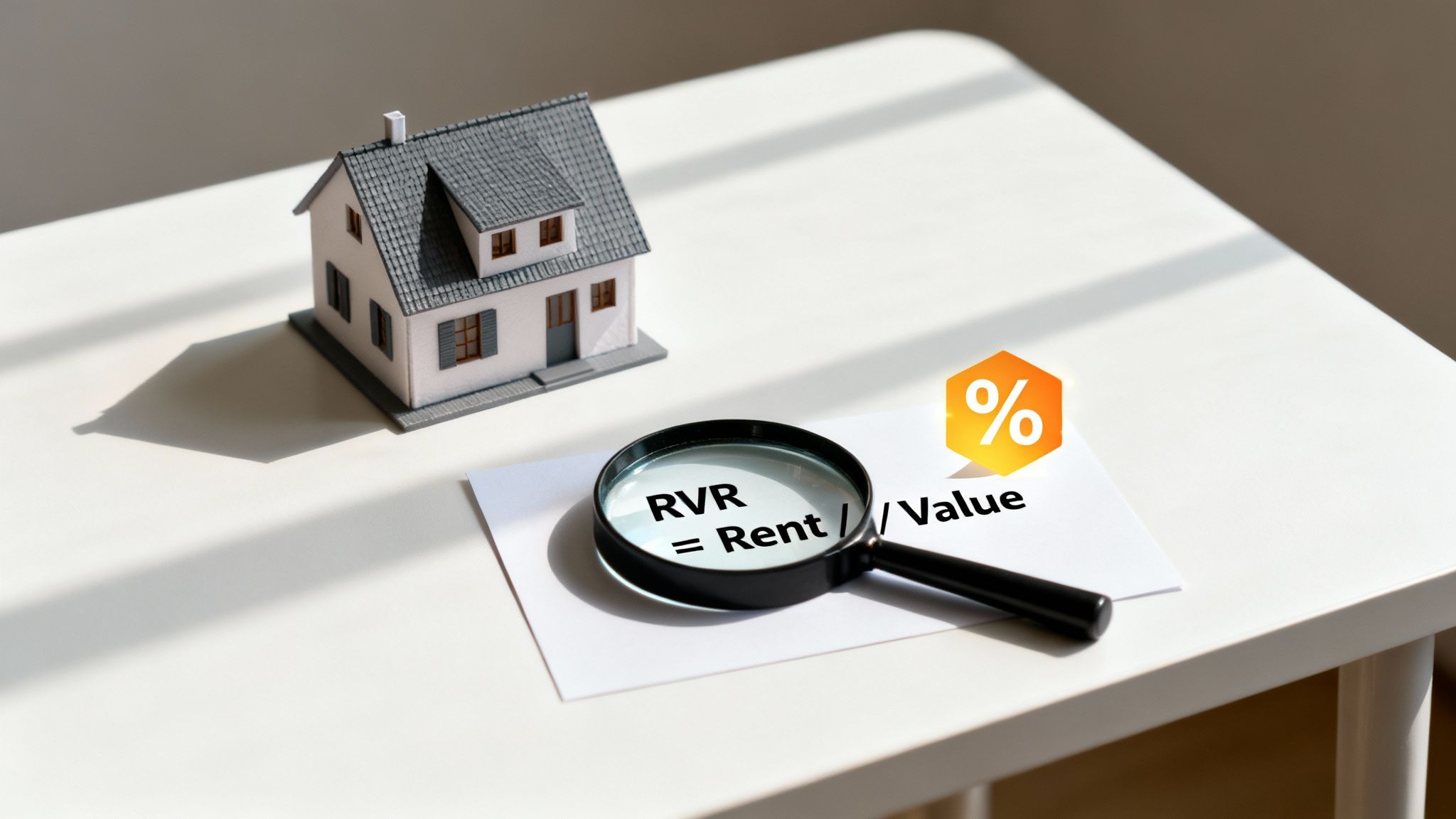
Imagine you're scrolling through dozens, maybe even hundreds, of property listings. You need a way to quickly separate the gems from the junk. The RVR is that powerful sorting tool.
It’s a simple percentage that answers one crucial question: Is the potential rent high enough to justify the property's price? It cuts right through the flowery listing descriptions and perfect photos to give you a hard number based on pure income potential. Understanding this ratio is a game-changer for making smart decisions in the broader real estate context.
Why RVR Is a Go-To Screening Metric
Instead of getting bogged down building detailed spreadsheets for every single property that catches your eye, experienced investors use the rent-to-value ratio to build a shortlist. It’s a foundational metric for a few good reasons:
- Speed and Simplicity: You only need two numbers—the monthly rent and the property value. That’s it. You can calculate it in your head or on your phone in seconds.
- Focus on Income: It immediately puts the spotlight on a property's ability to generate cash flow, which for most of us is the name of the game.
- Comparative Analysis: RVR lets you compare completely different properties—a condo in the city versus a duplex in the suburbs—on an apples-to-apples basis. It quickly reveals which one offers a better bang for your buck.
This initial check helps you avoid the dreaded "analysis paralysis" by narrowing your focus to only the most promising opportunities.
RVR in the Current Market
The tug-of-war between property prices and rental income is always in motion. Just look at the U.S. price-to-rent ratio, which saw huge swings over the last two decades. It peaked at 140.23 in 2022 before cooling off to 134.04 by late 2024.
This tells us that home prices have often climbed faster than rents, making it a real challenge to find those high-yield properties we're all after. For more on this, check out the U.S. real estate trends on tradingeconomics.com.
The rent-to-value ratio isn’t about providing the final answer on an investment. Instead, its job is to ask the right first question: "Does this property have enough income potential to be worth my time?"
By mastering this simple calculation, you can streamline your property search and dramatically increase your chances of finding deals that actually hit your financial goals. It’s the first, most important step toward building a successful and sustainable rental portfolio.
Calculating the Rent-to-Value Ratio
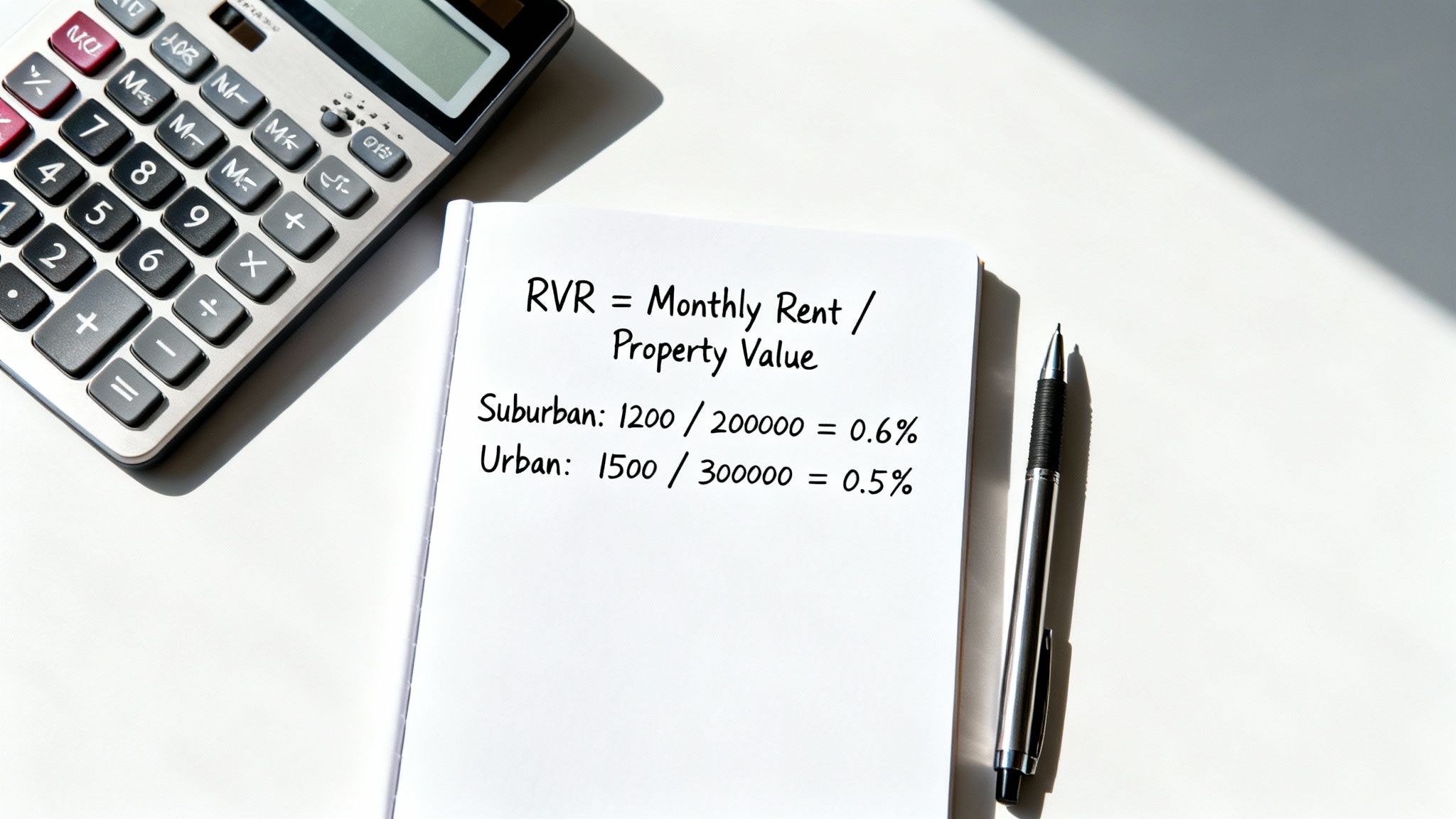
The math behind the rent-to-value ratio is refreshingly simple. That's a big part of its appeal and why it’s my go-to metric for a quick first look at a property. You don't need a fancy spreadsheet or a finance degree—just two key numbers: what the property brings in each month and what it's worth.
This quick calculation gives you a clean percentage, letting you compare completely different types of properties on an even footing. Let's walk through the formula and then plug in some real numbers.
The Core Formula
At its heart, the rent-to-value ratio is just simple division. You can do it on your phone's calculator while standing in the driveway of a potential deal.
Rent-to-Value Ratio (RVR) = Gross Monthly Rent / Property Value
Once you have that number, just multiply it by 100 to turn it into a percentage. This single figure tells you how much of the property's value you're getting back in rent each month, giving you an instant read on its income-generating muscle.
A Step-by-Step Calculation
To get a reliable RVR, you have to start with the right inputs. Garbage in, garbage out. Here’s the three-step process I use to make sure my numbers are solid.
- Get the Gross Monthly Rent: This is the total rent you collect from tenants before you take out a single dollar for expenses like taxes, insurance, or repairs. If the property is vacant, you’ll need to do some homework and find a realistic market rent by looking at comparable local rentals (comps).
- Pinpoint the Property's Market Value: This is the most important part. Don't use the seller's asking price. It's often just a starting point. You need the price the property would realistically sell for today. You can get this from a recent appraisal, a Broker Price Opinion (BPO), or by running your own comps.
- Divide and Convert: Now, divide the monthly rent by that market value. Multiply the result by 100, and you’ve got your RVR percentage. For a deeper dive into this and other key metrics, you can build your own analysis tool by following our guide to creating a rental property calculator in Excel.
Putting the Formula into Practice
Let's see how this works in the real world with two very different properties. This is where you'll see how RVR helps you compare apples to oranges.
Example 1: A Suburban Single-Family Home
Let's say you're looking at a three-bedroom house in a nice suburb. After checking recent sales, you figure its true market value is $350,000. Similar homes in the area are renting for about $2,800 a month.
- Monthly Rent: $2,800
- Property Value: $350,000
- Calculation: ($2,800 / $350,000) * 100 = 0.8% RVR
Example 2: An Urban Duplex
Next up is a duplex in a busier part of the city. Its market value is a hefty $500,000. Each of the two units rents for $2,100, bringing in a total gross monthly rent of $4,200.
- Monthly Rent: $4,200
- Property Value: $500,000
- Calculation: ($4,200 / $500,000) * 100 = 0.84% RVR
Notice anything? Even though the duplex costs $150,000 more, its rent-to-value ratio is slightly better. This tells us it generates a little more income for every dollar of its value compared to the single-family home. That’s the power of RVR—it cuts right through the price tag to show you the income efficiency underneath.
What Is a Good Rent to Value Ratio?
So, you’ve run the numbers and have your rent-to-value ratio. Now what? You're looking at a percentage, but what does it actually tell you about the deal in front of you? Is 0.8% a solid single, or is 1.2% a grand slam?
The honest answer, like with so much in real estate, is: it depends. There’s no single magic number that makes a deal “good.” A strong ratio is a moving target that changes based on the market you’re in, the type of property you’re buying, and what you’re trying to accomplish as an investor.
For a long time, investors had a go-to shortcut to figure this out. It was a simple, back-of-the-napkin rule that helped them quickly size up a property's potential.
The Famous 1% Rule
If you’ve spent any time around real estate investors, you’ve heard of the 1% Rule. It’s a classic guideline stating that a property's gross monthly rent should be at least 1% of its purchase price. So, for a $200,000 house, you'd want to see it renting for at least $2,000 per month.
A property that hits the 1% Rule has a rent-to-value ratio of exactly 1.0%. For years, this was the gold standard for investors who wanted strong, immediate cash flow.
But let's be realistic. In many of today's markets, finding a property that meets the 1% Rule is like finding a needle in a haystack. Soaring home prices have far outpaced rent growth in a lot of areas, making that 1.0% target feel more like a dream than a practical benchmark. While it’s still a useful concept, savvy investors know that context is everything.
Why Location Dictates the Ratio
A good RVR in Omaha, Nebraska, will look completely different from a good one in San Francisco, California. That's because every real estate market dances to the beat of its own economic drum.
- High-Cost Markets: Think expensive coastal cities or booming tech hubs where property values are sky-high. In these places, an RVR of 0.6% or 0.7% might be considered a great find. Investors here are often willing to accept lower initial cash flow because they're betting on massive long-term appreciation.
- Affordable Markets: In many Midwestern and Southern cities, property prices are much more down-to-earth. Here, finding properties that meet or even beat the 1% Rule is far more common. An RVR of 1.0% to 1.2%—or even higher—is often the goal for investors focused squarely on monthly rental income.
This isn't just a U.S. phenomenon; it's global. Price-to-rent ratios vary wildly from one country to another. For example, international housing data on Statista.com from late 2021 showed markets where home prices had completely detached from rents, while others offered much more balanced cash-flow opportunities.
Matching Your RVR Target to Your Strategy
Beyond geography, your personal investment strategy is the biggest factor in defining a "good" RVR. Are you playing the long game for appreciation, or do you need cash in your pocket at the end of every month?
Your answer changes the entire equation.
- Cash Flow Focus: If your main goal is generating passive income to cover your bills (and then some), you need a higher RVR. You’ll be hunting for deals in more affordable markets that can deliver 0.9% or better.
- Appreciation Focus: If you're investing in a high-growth area and betting on the property's value climbing over time, a lower RVR is perfectly acceptable. An investor with this mindset might be thrilled with 0.5% to 0.7%, knowing the real payday comes years later at the closing table.
- Hybrid Strategy: Many investors try to get the best of both worlds. They look for properties with a respectable RVR (maybe in the 0.8% to 0.9% range) in stable markets that also show solid signs of long-term growth.
To give you a clearer picture, let's break down how a "good" RVR target shifts based on market conditions and your investment goals.
Target Rent to Value Ratio Benchmarks by Market Type
This table shows how a 'good' Rent to Value Ratio (RVR) can differ based on market conditions, property type, and investment goals.
| Market Type / Strategy | Typical RVR Target | Primary Investor Focus |
|---|---|---|
| High-Appreciation Coastal City | 0.5% - 0.7% | Long-term equity growth and wealth building. |
| Stable Midwestern Suburb | 0.8% - 1.0% | A balance of steady cash flow and moderate appreciation. |
| Cash-Flow Focused Market | 1.0% - 1.3%+ | Maximizing monthly rental income and immediate returns. |
| BRRRR Strategy (Value-Add) | 0.7% (Pre-Reno) | Forcing appreciation and improving the ratio through renovation. |
Ultimately, a good RVR isn’t about hitting a universal number; it's about finding a property whose numbers align perfectly with your specific plan for building wealth.
Comparing RVR with Cap Rate and GRM
The Rent-to-Value Ratio is a fantastic tool for a quick "sniff test," but it never tells the whole story. To build a truly solid deal analysis, you need to understand how RVR works alongside two other heavy hitters in an investor's toolkit: the capitalization rate (cap rate) and the gross rent multiplier (GRM).
Think of it like a doctor's visit. The RVR is like the nurse taking your temperature—a quick, vital sign that tells you if something is worth looking into. The cap rate and GRM are the more detailed diagnostic tests that follow, giving you a much deeper understanding of the property's actual financial health.
Using all three gives you a panoramic view of an investment's potential. They help you move from a gut-feeling "maybe" to a confident "yes" or "no."
RVR vs. Cap Rate: What’s the Difference?
The biggest distinction between the RVR and cap rate comes down to one simple but critical word: expenses.
While RVR gives you a top-level snapshot based on gross rent, the cap rate dives deeper to measure a property's profitability after you've paid the bills.
- Rent-to-Value Ratio: A quick screening tool that measures gross rental income relative to the property's value. It completely ignores things like taxes, insurance, and maintenance.
- Cap Rate: A true profitability metric. It measures the net operating income (NOI) relative to the property's value, giving you a much clearer picture of your actual return.
Because it factors in expenses, the cap rate is a far better indicator of a property's ability to generate cash. You can get a full breakdown of this crucial metric by exploring what cap rate is in real estate in our detailed guide. An RVR might look amazing at first glance, but a high-expense property could have a depressingly low cap rate once you run the numbers.
RVR vs. Gross Rent Multiplier
If RVR is a monthly snapshot, think of the Gross Rent Multiplier (GRM) as a long-exposure photograph. The GRM tells you how many years it would take for the property's gross rent to pay for the property itself. It's all about the long-term payback period.
The formulas look similar but answer different questions:
- RVR (Ratio):
Monthly Rent / Property Value - GRM (Years):
Property Value / Annual Rent
A lower GRM is usually better, as it points to a quicker payback. For instance, a property with a $300,000 price tag and $30,000 in annual rent has a GRM of 10. This means it would take 10 years of gross rent to cover the purchase price, ignoring all other factors like expenses or financing. RVR helps you screen for monthly cash flow potential, while GRM helps you gauge the long-term value relationship.
This diagram shows how market conditions, your strategy, and the property itself all influence what a "good" Rent-to-Value Ratio really is.
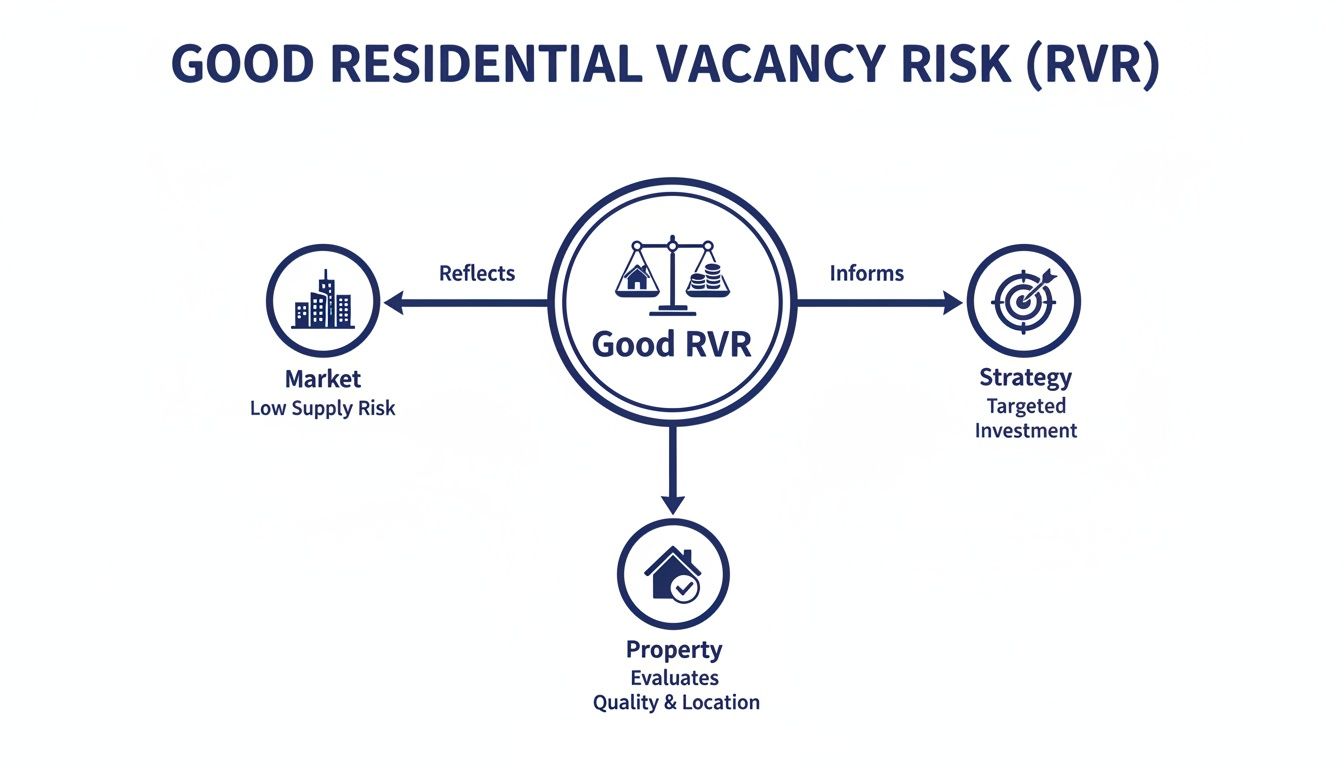
The takeaway here is that an ideal RVR isn't a single magic number. It's a flexible target that has to fit your specific investment context.
A Comparison of Key Real Estate Investment Metrics
The most successful investors never rely on just one metric. Instead, they use a combination of tools to build a complete and defensible analysis of any potential deal. This table breaks down how RVR, Cap Rate, and GRM each play a unique role.
| Metric | Formula | What It Measures | Best Use Case |
|---|---|---|---|
| Rent-to-Value Ratio | Monthly Rent / Property Value | The gross monthly income yield. | Fast, high-level screening of many properties to create a shortlist. |
| Cap Rate | Net Operating Income / Property Value | The unlevered return after expenses. | Deeper analysis of profitability and comparing similar properties. |
| Gross Rent Multiplier | Property Value / Annual Rent | The payback period in years from gross rent. | Quick comparison of property values relative to their income. |
By starting with the Rent-to-Value Ratio, you can efficiently filter through hundreds of listings to find the ones that meet your initial criteria. Once you have a handful of promising candidates, you can then dig in with a more detailed analysis using cap rate to confirm profitability and GRM to check the long-term value. This layered approach saves you a ton of time and makes sure you only focus your energy on deals with real potential.
Finding High RVR Properties with Property Scout 360
Let's be honest: manually calculating the rent-to-value ratio for dozens of properties is a miserable experience. It's a surefire way to get lost in spreadsheets, make a critical typo, and miss out on great deals while you're still crunching the numbers. This is exactly why savvy investors turn to modern tools, swapping tedious manual work for quick, data-backed decisions.
Using a platform like Property Scout 360 completely changes the game. It takes your property search from a slow, frustrating chore and turns it into a genuine strategic advantage. Instead of hunting down data points one by one, you can screen thousands of listings at once to find properties that hit your specific investment targets, including your ideal rent-to-value ratio.
Automating Your Deal Flow
The real power of Property Scout 360 is in its automation. The platform doesn't just calculate the RVR—it instantly runs a full financial analysis on every single property in its database. You get projected cash flow, cap rate, cash-on-cash return, and long-term ROI all laid out for you.
This means you can finally stop worrying about outdated listings and relying on guesswork. The system is fed by real-time data from over 800 Multiple Listing Services (MLS) nationwide, so the property values and rental estimates are about as current as you can get. You see the complete financial picture without ever having to touch a calculator.
Setting Up Advanced Filters for High RVR Deals
This is where the magic really happens. With advanced filtering, you can tell the platform exactly what you’re looking for and have it serve up only the properties that fit. Imagine you want to find deals that not only hit the 1% Rule but are also located in specific neighborhoods you know have strong rental demand.
You can set up your search with filters like:
- Minimum Rent to Value Ratio: Tell the system to show you only properties with an RVR of 0.9% or higher.
- Monthly Cash Flow: Filter for properties projected to generate at least $300 in positive cash flow each month.
- Geographic Area: Zero in on specific zip codes, cities, or even entire states known for great rental returns. For some ideas on where to start looking, check out our guide on the best cities to invest in rental property.
- Property Type: Narrow your search to single-family homes, duplexes, or small multi-family buildings that match your investment strategy.
This kind of precise control helps you build a highly targeted pipeline of pre-vetted deals. It saves you countless hours of frustrating grunt work and lets you focus your energy only on the most promising opportunities.
The dashboard view in Property Scout 360 shows how key financial metrics, including the RVR, are presented side-by-side for easy comparison.
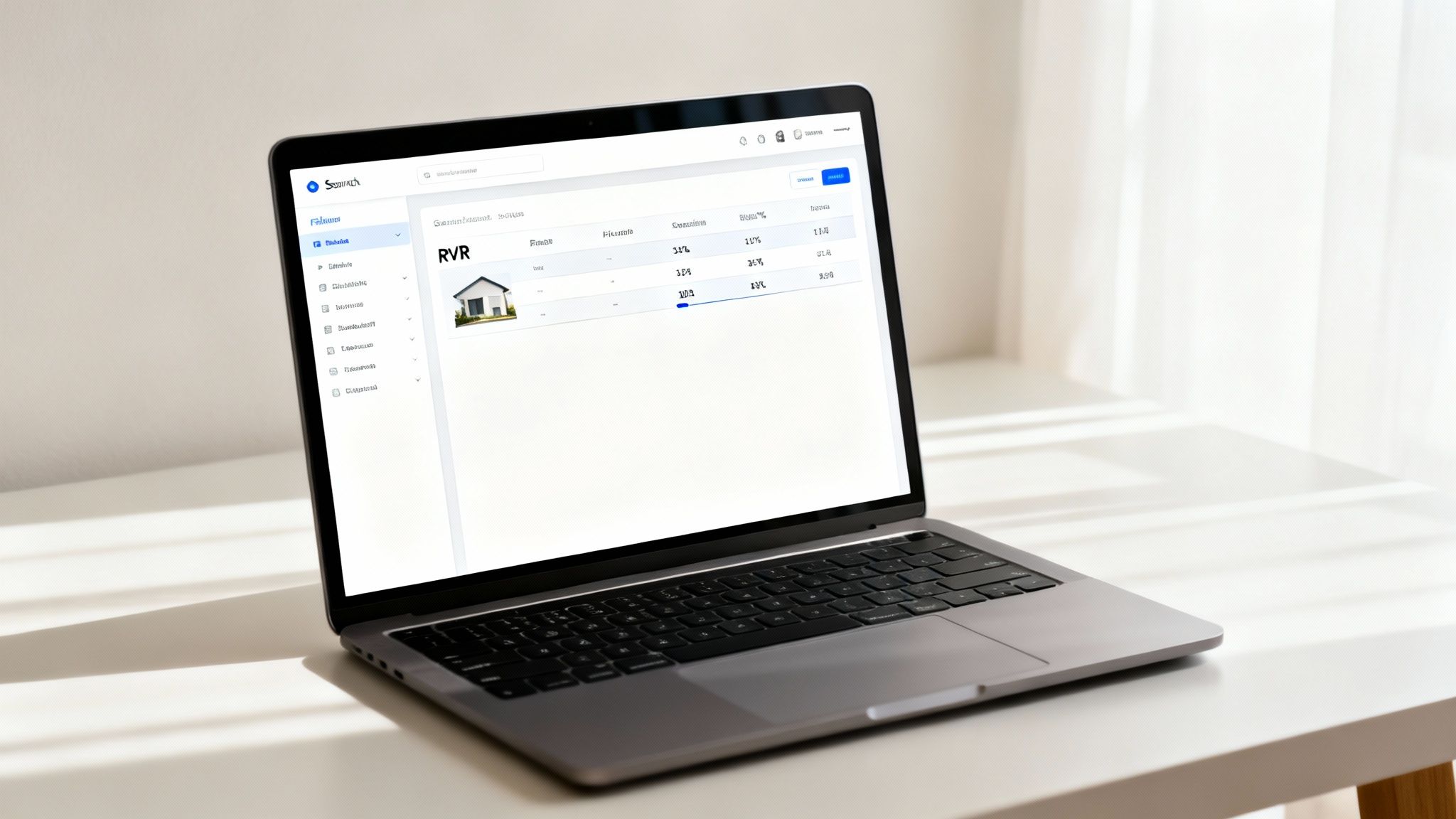
You can see at a glance which properties offer the best mix of cash flow, RVR, and long-term return, making your analysis incredibly fast and effective.
Think of a tool like Property Scout 360 as having a whole team of analysts working for you 24/7. It systematically cuts through the market noise to bring you only the deals that match your financial fingerprint.
By moving beyond analyzing a single metric, you can make investment decisions with confidence because they’re backed by comprehensive data. The platform’s detailed reports even break down projected expenses—like taxes, insurance, and maintenance—giving you a holistic view that the simple rent-to-value ratio can never provide on its own. It transforms your process from hoping you found a good deal to knowing you did.
Actionable Ways to Improve a Property's RVR
A mediocre rent-to-value ratio doesn't have to be a deal-killer. In fact, for a savvy investor, it can be a flashing green light—an opportunity to create value where others only see average numbers. With the right game plan, you can turn a so-so property into one of the best performers in your portfolio.
There are really only two ways to move the needle on a property's RVR: increase the monthly rent or decrease the purchase price. Getting good at one is great, but mastering both is how you uncover the real hidden gems.
Drive Down the Purchase Price
The most direct way to get a better RVR is to simply pay less for the property. Think about the formula (Monthly Rent / Property Value). When you lower the denominator, the ratio instantly gets healthier—before you’ve even collected your first rent check.
Strong negotiation skills are a must, but your deal-sourcing strategy is just as important. When you find properties off-market, directly from sellers, or scoop up a distressed home, you gain a massive advantage. These sellers are often motivated and more willing to negotiate, giving you a shot at closing a deal well below its market value.
A 5% reduction on a $300,000 property saves you $15,000 at the closing table and gives you a much stronger starting RVR. That's a win that pays dividends for the life of the investment.
Don't forget the ripple effect, either. A lower purchase price means less cash needed upfront and a smaller monthly mortgage payment. This improves your RVR and your cash flow from day one, giving you more financial breathing room.
Increase the Rental Income
The other side of the coin is pushing up the numerator—the monthly rent. This is where "value-add" investing truly shines. By making smart, targeted upgrades, you can justify higher rents and attract a better pool of tenants.
To get the most bang for your buck, you need to know how to increase home value with improvements renters actually care about.
Here are a few high-impact upgrades that consistently pay off:
- Cosmetic Renovations: Never underestimate the power of fresh paint, modern flooring, or updated light fixtures. These are low-cost changes that can completely transform a unit’s feel and easily command $100-$200 more per month.
- Adding In-Demand Amenities: An in-unit washer and dryer is a game-changer. It's one of the top amenities on any renter's list and can justify a significant rent bump while keeping your good tenants from leaving.
- Improving Curb Appeal: The first impression is everything. Some basic landscaping, a new front door, or fresh exterior paint makes the property feel well-cared-for and helps you rent it faster at your target price.
- Finishing a Basement or Attic: If the property has unused space, converting it into a legal bedroom, home office, or rec room can add hundreds of dollars to the monthly rent, completely reshaping its RVR.
By getting creative, you can actively engineer a better financial outcome. A property that looks just "okay" on paper can become a serious cash-flowing asset with a bit of vision and sweat equity. This hands-on approach is what separates the average investor from a truly great one.
Your Rent-to-Value Ratio Questions, Answered
Once you get the hang of the rent-to-value ratio, you start seeing deals in a new light. But as with any powerful tool, a few common questions always come up when you begin putting it to work in the real world. Let's tackle them head-on so you can analyze properties like a pro.
Does the Rent-to-Value Ratio Include Expenses?
This is the big one, and the answer is a firm no. It's crucial to remember that the rent-to-value ratio is a gross metric. It gives you a quick, top-level look at a property's potential by comparing rental income to its price, but it completely ignores operating costs.
Think of it as the first filter, not the final verdict. Your real-world cash flow will always be lower once you subtract all the necessary expenses that come with owning a rental, such as:
- Property taxes and insurance
- Maintenance and repairs
- Vacancy periods
- Property management fees
Because of this, a property could have a phenomenal rent-to-value ratio but still be a money pit if the expenses are out of control. A high RVR is a green light to dig deeper with metrics like cap rate and cash-on-cash return, which do factor in those costs.
Can I Use This Ratio for Commercial Properties?
Technically, you could calculate it, but you really shouldn't. The rent-to-value ratio is a specialist's tool, built almost exclusively for residential real estate. It shines when you're analyzing single-family homes, duplexes, and smaller multi-family buildings where the income side is fairly simple.
Commercial properties like office buildings, retail spaces, or industrial warehouses are a different beast entirely. They have much more complicated lease structures, income streams, and expense reports. Trying to assess one with a simple RVR would be like trying to measure a skyscraper with a ruler.
Key Takeaway: Stick to what works. The rent-to-value ratio is for the residential investor's toolkit. When you step into the commercial arena, the pros use industry-standard metrics like Net Operating Income (NOI), Cap Rate, and Internal Rate of Return (IRR) to get the full picture.
How Reliable Is the 1% Rule These Days?
Ah, the famous 1% Rule. This classic rule of thumb, which just means a 1.0% rent-to-value ratio, is still a handy benchmark, but you have to treat it as a guideline, not gospel. In today's market, its relevance is all about location.
Finding a property that hits the 1% mark in a high-cost coastal city is like finding a unicorn. In those markets, a deal at 0.6% to 0.7% could be an absolute home run, especially if you're banking on long-term appreciation.
Flip that around, and in many affordable markets in the Midwest or South, seasoned investors won't even look at a deal unless it's well above 1.0%. They're playing a cash-flow game, and the numbers need to be strong from day one.
So, is it reliable? It depends entirely on your market and your goals. It's a fantastic way to quickly sift through listings and build a shortlist, but it should never be the only reason you chase—or reject—an investment.
Ready to stop guessing and start analyzing deals with precision? Property Scout 360 automates RVR, cash flow, and ROI calculations on thousands of U.S. properties, helping you find profitable investments in minutes, not weeks. Find your next rental property with Property Scout 360.
About the Author
Related Articles
2026 Investor's Guide: Cost of Installing a Sewer Clean Out
Understand the cost of installing a sewer clean out for investment properties in 2026. Get expert advice on prices, ROI, & budgeting for flips. Plan smart!
15 Year vs 30 Year Mortgage: The Investor's Choice
Deciding between a 15 year vs 30 year mortgage for a rental property? Our guide analyzes cash flow, ROI, and equity to help you pick the best loan.
Real Estate Appraisal Software: Features & Limits
Discover what real estate appraisal software is, its core features, and limits. See how it differs from investment tools for profitable deals.
