A Guide to Using a Rental Property Valuation Calculator
Master real estate investing with our guide to using a rental property valuation calculator. Learn to analyze deals, forecast cash flow, and calculate ROI.
Ever wonder how seasoned investors seem to spot a great rental deal from a mile away? It’s not magic. It’s math. A rental property valuation calculator is the tool they use to run the numbers, helping them figure out a property's true financial potential by calculating key figures like cash flow, ROI, and cap rate.
Think of it as your financial pre-flight checklist. Before you even think about investing, it forces you to account for everything—from the obvious income to all those pesky hidden expenses. This is how you stop guessing and start making smart, data-driven decisions that build a profitable real estate portfolio.
Why a Valuation Calculator Is Your Most Important Tool

Before you invest a single dollar, you need a solid answer to one question: will this property actually make money? A rental property valuation calculator is your financial co-pilot, designed to help you navigate the tricky terrain of real estate investing with a lot more confidence.
It’s easy to get swept up in gut feelings or a slick sales pitch. This tool grounds you in reality. It strips the emotion out of the decision and focuses solely on the cold, hard numbers, turning a potential gamble into a calculated business move.
From Confusion to Clarity
Trying to evaluate a rental property without a calculator is like trying to build a complex piece of furniture without the instructions. You've got all the parts scattered around—the purchase price, the potential rent, the property taxes—but no clear idea how they fit together to create the final product.
A valuation calculator is that step-by-step guide. It organizes your thinking by asking for specific numbers and then runs all the essential calculations for you. Suddenly, financial metrics that once seemed intimidating become crystal clear.
A calculator gives you a standardized way to analyze deals, which is crucial for comparing different properties apples-to-apples. It helps you see which investment truly offers the best return, not just which one has the nicest curb appeal.
The Foundation of a Strong Portfolio
Making a rental property valuation calculator a regular part of your process isn't just a one-time check; it's a core habit for long-term success. When you consistently analyze deals this way, you learn to spot and avoid common rookie mistakes, like underestimating your expenses or paying too much for a property that won't perform.
This is the kind of discipline that separates casual dabblers from serious investors who build real, sustainable wealth. It ensures every property you consider for your portfolio is put through its paces and lines up with your financial goals. At the end of the day, it's all about making smarter, faster, and more profitable decisions.
The Core Metrics: Learning the Language of a Good Deal
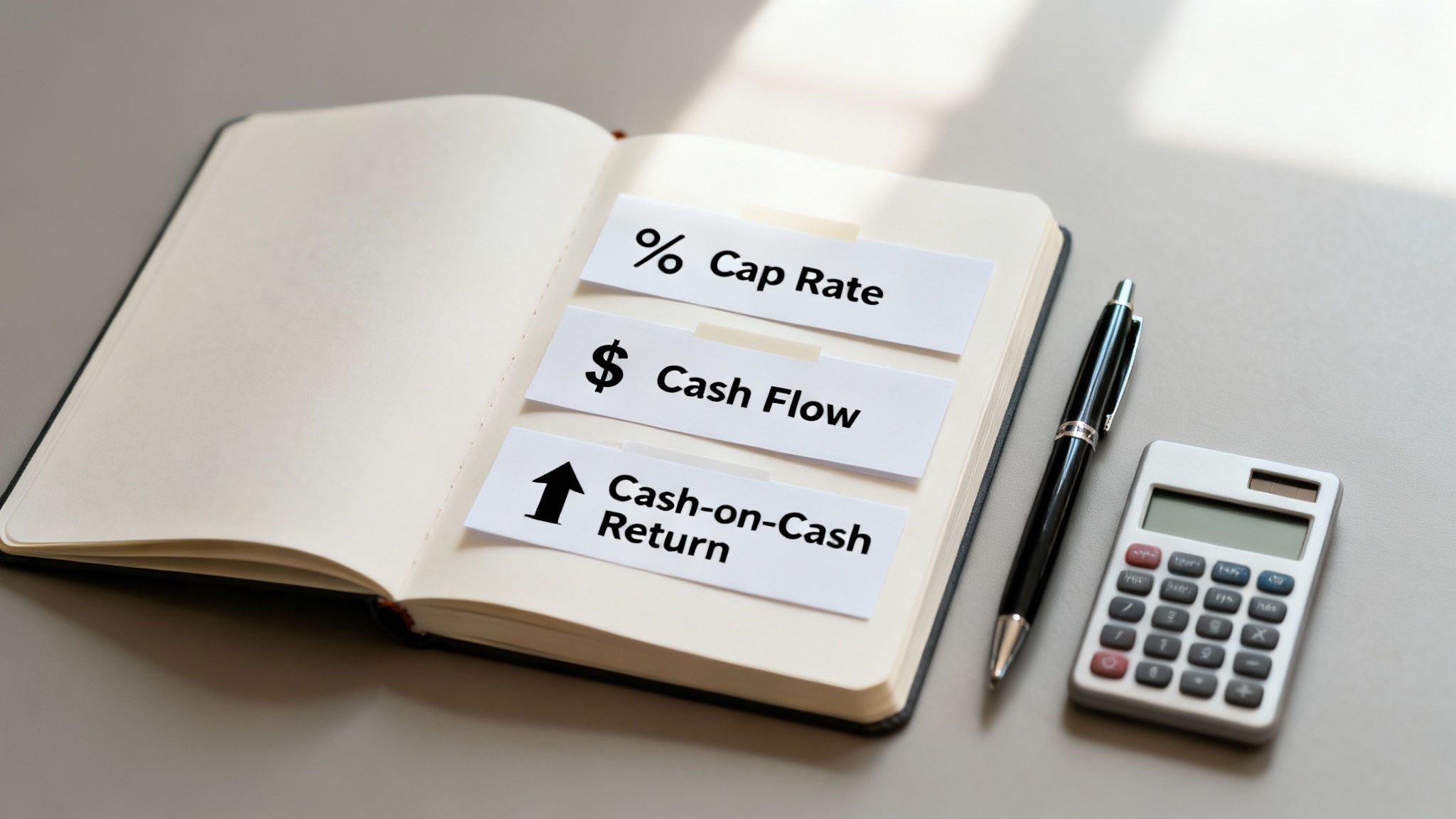
Smart investors all speak the same language—the language of numbers. A good rental property valuation calculator is your Rosetta Stone. It takes a jumble of data—purchase price, rent, taxes—and translates it into a clear, compelling story about an investment's potential.
To really get it, you need to know the key vocabulary. Let's break down the essential formulas that every calculator relies on, using some simple analogies to make sense of it all. Once you master these numbers, you stop being just a hopeful buyer and start becoming a savvy investor who can spot a winner from a mile away.
Capitalization Rate: The Property’s Raw Potential
First up is the Capitalization Rate, or Cap Rate. Think of the cap rate as the raw horsepower of a car's engine, completely separate from who's driving it. It measures the pure, unleveraged earning power of the property itself, ignoring your specific loan or financing.
The formula is pretty straightforward:
Cap Rate = (Net Operating Income / Property Value) x 100
Your Net Operating Income (NOI) is all the money the property brings in for a year, minus the operating expenses—but, and this is important, before you factor in your mortgage payment. A higher cap rate often signals a higher potential return, but it can also mean higher risk.
This metric is your best friend for quickly comparing different properties in the same area. If Property A has a 6% cap rate and Property B has a 4% cap rate, you know instantly that Property A has a stronger earning engine for its price. This is exactly the kind of side-by-side comparison a good rental property valuation calculator was built for.
Cash Flow: Your Monthly Reality Check
While cap rate shows the theoretical horsepower, Cash Flow is your real-world, month-to-month reality. It’s the actual cash left in your bank account after you've collected all the rent and paid every single bill, including the mortgage.
If the cap rate is the engine, cash flow is the fuel gauge. It tells you whether you’re running on full or about to stall out.
Positive cash flow means the property is not only paying for itself but also putting extra money in your pocket every month. Negative cash flow means you're dipping into your own savings just to keep the investment afloat.
For buy-and-hold investors focused on building a stream of passive income, this is probably the single most important number. Getting this figure right is the primary job of any worthwhile valuation tool. For a deeper dive, check out our guide on how to calculate cash flow on a rental property.
Cash-on-Cash Return: The Real Score for Your Money
Finally, we have the Cash-on-Cash (CoC) Return. This metric is all about you and your specific deal. It directly answers the question: "For every dollar I put into this, how much am I getting back each year?"
If cash flow is the fuel gauge, then your cash-on-cash return is the miles per gallon (MPG). It shows you just how efficiently your invested capital is performing.
Here’s the formula:
CoC Return = (Annual Pre-Tax Cash Flow / Total Cash Invested) x 100
"Total Cash Invested" is everything you paid out-of-pocket: your down payment, all the closing costs, and any money spent on initial repairs. This number is deeply personal because it's tied directly to your financing. An investor who buys with all cash will have a totally different CoC return than someone who put down 20%.
Putting It All Together for a Clear Picture
A property could have an incredible cap rate, but if your loan has terrible terms, your cash flow might be zero. On the flip side, a property with a lower cap rate in a neighborhood that's appreciating quickly could be a fantastic long-term play. A calculator shows you the entire dynamic, not just one piece of the puzzle.
You also have to remember how banks see the deal. Lenders use metrics like the loan-to-value (LTV) ratio to gauge their risk, which directly impacts the financing you can get and, in turn, your final cash-on-cash return.
The big picture is promising. As of Q4 2025, the U.S. rental market shows an average gross rental yield of 6.56%. When you use a rental property valuation calculator, this national average serves as a handy benchmark to see if the deal you're analyzing is a dud, average, or a true standout.
To help you keep these straight, here's a quick summary of the core metrics.
Key Valuation Metrics At A Glance
| Metric | Simple Formula | What It Measures |
|---|---|---|
| Cap Rate | (NOI / Property Value) x 100 | The property's raw, unleveraged earning power. |
| Cash Flow | Total Income - Total Expenses | The actual profit left in your pocket each month. |
| Cash-on-Cash Return | (Annual Cash Flow / Total Cash Invested) x 100 | How hard your personal invested cash is working for you. |
Think of these three numbers as the vital signs of any rental property. Knowing what they mean and how they relate to each other is the foundation of making smart, confident investment decisions.
How to Find Accurate Data for Your Calculations
A rental property calculator is an amazing tool, but it lives by one simple, unbreakable rule: garbage in, garbage out. The entire analysis—your cap rate, cash flow, and final investment decision—hinges completely on the quality of the data you feed it. Plug in overly optimistic numbers, and even a terrible deal can look like a grand slam, setting you up for a nasty surprise down the road.
Think of yourself as a financial detective. Your mission is to hunt down realistic, verifiable numbers for every single line item. This is the nitty-gritty due diligence that separates investors who build lasting wealth from those who get blindsided by hidden costs.
Let's break down where to find the reliable data you need for both income and expenses.
Sourcing Verifiable Income Figures
Your income projection is the engine of your investment, so it has to be grounded in reality, not wishful thinking. The goal is to figure out what properties like yours are actually renting for right now.
- Rental Comparables (Comps): Start by looking for recently rented properties that are similar in size, bedroom count, condition, and location. Listing sites are a great place to begin, but always remember that the asking rent isn't the same as the rent someone actually paid.
- Local Property Managers: These folks are in the trenches of the rental market every single day. A quick phone call can give you an incredibly accurate picture of current demand and the real-world rent you can expect for a specific property type.
- Vacancy Rate: Never, ever assume your property will be occupied 100% of the time. A common rule of thumb is to budget 5-10% of your gross annual rent for vacancy, but this number can vary wildly from one neighborhood to the next. Check local market data or ask a property manager for a realistic figure.
Accurate rental data is the cornerstone of a solid valuation. Failing to verify local comps and using a generic vacancy rate are two of the fastest ways to miscalculate a deal's potential. To learn how to find reliable data points, you can read our complete guide on how to pull free real estate comps for your analysis.
Building a Complete Expense Checklist
This is where so many new investors get tripped up. Expenses are a lot more than just the mortgage payment. They include a whole host of recurring and long-term costs that will eat into your profits if you don't account for them.
Here is a checklist of the essential expenses you absolutely must track down:
Property Taxes: Don't just take the seller's current tax bill at face value. A sale often triggers a reassessment. The only way to be sure is to go directly to the source: the county assessor or tax collector's website. It’s all public record and the most accurate number you’ll find.
Landlord Insurance: Your standard homeowner's policy won't cut it for a rental. You need to call a local insurance agent and get a specific quote for a landlord policy on the property you’re considering. Rates can vary a lot based on location, property age, and coverage.
HOA Fees: If the property is part of a homeowners' association, get your hands on the HOA documents. This will confirm the monthly or annual fee and, more importantly, reveal any upcoming special assessments that could wreck your budget.
Maintenance and Repairs: Sooner or later, things will break. A good, conservative estimate is to set aside 1% of the property's value each year for routine maintenance. If you're looking at an older home, you might want to bump that up to 2% just to be safe.
Capital Expenditures (CapEx): This is the big one that many people forget. CapEx is for replacing major systems like the roof ($8,000-$15,000), HVAC ($5,000-$10,000), or water heater. A smart habit is to sock away 5-10% of the monthly rent into a separate savings account just for these future big-ticket items.
By diligently gathering these real-world figures, you arm your rental property calculator with the data it needs to give you a trustworthy result. You’ll get a clear, realistic forecast of your investment's financial future—no guesswork required.
Let's Walk Through an Example Property Analysis
Theory is great, but nothing beats seeing the numbers in action. Let’s walk through a real-world example to see how a rental property valuation calculator can take a messy pile of data and turn it into a clear "yes" or "no."
We’ll follow "Alex," a first-time investor who’s found a promising single-family home. Alex has already done the legwork to gather all the necessary data and is ready to plug it in. Does this deal actually make sense? Let's find out.
The Property and Purchase Details
First things first, we need to lay out the basic financial framework. Alex is eyeing a three-bedroom, two-bathroom house in a stable suburban neighborhood. After some back-and-forth, here are the final purchase numbers:
- Purchase Price: $300,000
- Down Payment: 20% ($60,000)
- Loan Amount: $240,000
- Interest Rate: 6.5% on a 30-year fixed mortgage
- Closing Costs: $9,000 (a good estimate at 3% of the purchase price)
Right away, the calculator can figure out Alex's monthly principal and interest payment, which comes to $1,517. That’s a huge piece of the puzzle, but it’s far from the only cost. We also need to know the total cash Alex needs to bring to closing.
Total Cash Invested = Down Payment + Closing Costs
$60,000 + $9,000 = $69,000
This $69,000 is the key figure for measuring the performance of Alex’s personal investment. We’ll come back to it when we calculate the Cash-on-Cash Return.
Calculating Income and Expenses
Next, Alex plugs in all the income and operating expense data collected during due diligence. This is where accuracy is everything—garbage in, garbage out.
Monthly Income:
- Gross Monthly Rent: $2,400 (based on solid local comps)
- Vacancy Allowance (5%): -$120 (a smart move to budget for one month of vacancy every 20 months)
Monthly Expenses:
- Property Taxes: $250 (pulled directly from the county assessor's website)
- Landlord Insurance: $100 (from a quote with a local agent)
- Maintenance (5%): $120 (for all the little things that inevitably break)
- CapEx (5%): $120 (saving for the big-ticket items down the road, like a roof or HVAC system)
- Property Management (8%): $192 (even if Alex plans to self-manage, it's wise to budget for this)
The calculator crunches these numbers, giving Alex a complete picture of the monthly financial obligations and preventing the common mistake of underestimating the true cost of owning a rental.
The Final Verdict from the Calculator
With all the data loaded, the rental property valuation calculator spits out the key metrics that truly tell the story of this potential investment. Here’s what it found.
Monthly Cash Flow: This is the bottom line. The calculator subtracts all monthly expenses, including the mortgage, from the rent.
- $2,400 (Rent) - $1,517 (P&I) - $782 (Operating Expenses) = $101
- The property generates a positive cash flow of $101 per month, or $1,212 per year. It pays for itself and leaves a little extra, which is a good start.
Capitalization (Cap) Rate: This metric ignores the loan to show the property's raw earning potential. It uses the Net Operating Income (NOI)—annual rent minus operating expenses (but not the mortgage).
- Annual NOI = ($2,400 - $782) x 12 = $19,416
- Cap Rate = ($19,416 / $300,000) x 100 = 6.47%
- A 6.47% Cap Rate is pretty solid for the area, suggesting a healthy return on the asset itself.
Cash-on-Cash (CoC) Return: Finally, the most important metric for Alex. How hard is that $69,000 working?
- CoC Return = ($1,212 Annual Cash Flow / $69,000 Total Cash Invested) x 100 = 1.76%
- This 1.76% return is… low. Really low. While the property is technically cash-flow positive, Alex's initial investment isn't generating much of an immediate return. This is a critical insight.
This scenario is playing out against the backdrop of a global housing affordability crisis, which is reshaping the rental market. With research showing that over 80% of households in many developed economies are choosing to rent, the demand for rentals is surging. This makes precise valuation tools more important than ever for finding markets where price-to-rent ratios still make sense. You can dive deeper into this trend in a detailed analysis of global living standards from Hines.com.
For Alex, the calculator has laid out a clear conclusion. The deal isn't a total disaster, but it falls short of the goal for a strong return from day one. That low cash-on-cash return is a red flag, suggesting Alex should try to negotiate a lower price or look for a different property altogether. This is the true power of a rental property valuation calculator—it strips away the emotion and gives you a cold, hard, data-driven 'go' or 'no-go' decision.
Using Smart Tools for a Competitive Edge
While a trusty spreadsheet can get the job done, let's be honest—in a fast-moving market, it's like bringing a knife to a gunfight. Modern real estate investment platforms give you a serious advantage, acting as a complete analysis engine that sharpens your decision-making in three critical ways: speed, accuracy, and robust scenario planning.
Instead of spending hours digging through tax records or manually punching numbers into cells, you can get a clear picture of a deal in minutes. This isn't just about convenience; it's a game-changer that lets you analyze more properties and jump on the great ones before they're gone.
Accelerate Your Deal Analysis
The biggest win you get from a dedicated platform is the sheer speed. This is a strategic edge, plain and simple. It lets you go deeper on more deals, faster.
Think of it like navigating with a paper map versus using a GPS. Sure, both can get you where you're going, but one is faster, gives you real-time traffic updates, and helps you steer clear of roadblocks.
These platforms work their magic by plugging directly into the data you need.
- Automated Data Integration: Tools like Property Scout 360 automatically pull property details, tax history, and comps straight from MLS records and public databases. No more tedious data entry.
- Instantaneous Calculations: The second the data loads, every key metric—from Cap Rate to ROI—is calculated on the fly. You get a complete financial snapshot in seconds.
- Standardized Reporting: Every property is run through the same consistent framework, making it incredibly easy to compare multiple investments side-by-side, apples-to-apples.
Improve Accuracy and Reduce Human Error
We've all been there. Manually entering dozens of numbers into a spreadsheet is just asking for a tiny, costly mistake. A single misplaced decimal or a typo in a formula can completely wreck your cash flow projections, making a bad deal look like a winner.
Smart tools virtually eliminate this risk by automating the most error-prone steps. By pulling verified data directly from the source, they ensure the foundation of your analysis is rock-solid. This gives you the confidence that your numbers reflect the property's real potential, not a simple fat-finger error.
A rental property valuation calculator built into an investment platform removes the guesswork. It ensures you're not just fast, but also consistently accurate, protecting you from the costly consequences of a simple human error.
Stress-Test Investments with Scenario Planning
This is where modern software really flexes its muscles: the ability to model different "what-if" scenarios. A great investment doesn't just look good on paper today; it needs to be resilient enough to perform well when things don't go exactly as planned.
Here, you can really put a deal through its paces. Advanced calculators let you instantly see how your returns are affected when you tweak key variables.
- What if interest rates jump 0.5% before you close?
- How does your cash-on-cash return look with a 25% down payment instead of 20%?
- Can the property still break even if you have to drop the rent by $100 a month?
This kind of analysis turns you from a passive number-cruncher into an active strategist. To get a leg up, exploring solutions specifically for property investors is key to building a portfolio that can weather any storm. You can also see how different platforms stack up in our breakdown of the best real estate investment software.
This capability is more important than ever. After a recent cooling-off period, the global real estate market is showing signs of life as inflation eases and buyers and sellers find common ground. For investors, this points toward stable rental income, making it a perfect time to use a rental property valuation calculator to pinpoint deals with a solid risk-return profile. By modeling different outcomes, you can build an investment strategy that's ready for whatever the market throws at it.
Common Valuation Mistakes That Cost Investors Money

Knowing the right formulas is one thing, but knowing what not to do can save you from a financial nightmare. Even the best rental property valuation calculator is just a tool; it's completely dependent on the quality of the numbers you feed it. A few overlooked expenses can quickly turn what looks like a great deal into a money pit.
These aren't just rookie mistakes, either. They're common traps that even seasoned investors fall into when they're in a hurry. Understanding these pitfalls ahead of time helps you build a conservative, realistic analysis that protects your capital from completely avoidable losses.
Ignoring the Silent Killers: Maintenance and CapEx
By far, the most frequent and damaging mistake is confusing monthly cash flow with true profitability. It's easy to focus on the big three—mortgage, taxes, and insurance—and completely forget that buildings naturally wear out over time. This is where maintenance and Capital Expenditures (CapEx) come into play.
Maintenance covers the small stuff, like a leaky faucet or a broken doorknob. CapEx, on the other hand, is for the big-ticket items—the major replacements that can absolutely wreck your returns if you aren't saving for them.
- Roofs: A new roof can easily cost $8,000-$15,000 and typically lasts 20-25 years.
- HVAC Systems: Replacing a furnace and AC unit will set you back $5,000-$10,000.
- Water Heaters: Plan on spending $1,000-$2,000 for a new one every 10-12 years.
Let's talk about Ben. He found a deal that looked fantastic on paper, projecting a $400 monthly cash flow. What he ignored was the 20-year-old furnace in the basement. When it inevitably died his first winter, the surprise $7,000 replacement bill instantly wiped out nearly two years of his "profits."
Forgetting About Vacancy
Another classic blunder is assuming your property will have a tenant 100% of the time. That just isn't reality. People move out, and it always takes time to clean up, market the unit, and find a new, qualified tenant. Every month your property sits empty, you're looking at a total loss of income.
A smart rental property valuation always includes a vacancy allowance, usually somewhere between 5% and 10% of the gross annual rent. If you have a property renting for $2,000 a month, a 5% vacancy rate means you need to budget for an annual loss of $1,200. Forgetting this single line item creates a dangerously optimistic and fundamentally flawed forecast.
Your Questions, Answered
Jumping into real estate investing always brings up questions. It's just part of the process. Let's tackle some of the most common ones that pop up when you're using a rental property valuation calculator.
What's a Good Cap Rate for a Rental Property?
Honestly, there's no magic number here. A "good" cap rate really depends on the market, the type of property you're looking at, and your own comfort level with risk.
In a hot, big-city market, you might see deals with a 4-6% cap rate that are considered excellent. But if you're investing in a smaller town with a less predictable economy, you’d probably want to see something closer to 8% (or even higher) to make the risk worthwhile. A good calculator helps you stack up a property's cap rate against others in the same neighborhood, so you know if you're looking at a fair deal or not.
How Does a Calculator Handle Vacancy?
Any solid calculator will treat vacancy as a non-negotiable expense. It's an amount you subtract directly from your potential rental income right from the get-go.
While many investors use a 5-10% rule of thumb, the best approach is to get local. A condo in a bustling downtown core might have a much lower vacancy rate than a single-family home in a quiet suburb with fewer renters. The goal is to plug in a realistic number, even a conservative one. This keeps your cash flow numbers grounded in reality, not wishful thinking.
It's so easy to fall into the trap of assuming your property will be rented 100% of the time. Building in a realistic vacancy rate from day one is one of the smartest things you can do to avoid nasty cash flow surprises down the road.
Can I Use This for a BRRRR Strategy?
Absolutely. The math is the same, you just have to look into the future a bit. For a BRRRR deal (Buy, Rehab, Rent, Refinance, Repeat), you’ll use the calculator to model the property’s value after you’ve fixed it up.
You'll plug in the After Repair Value (ARV) instead of the purchase price, and use the new, higher market rent you expect to get post-renovation. The key is to remember to add your total rehab budget to your down payment. This gives you your true total investment, which is crucial for figuring out an accurate Cash-on-Cash Return on every dollar you put into the project.
Ready to stop guessing and start making confident, data-backed decisions? The Property Scout 360 platform puts a powerful rental property valuation calculator, live market data, and a full financial analysis suite right at your fingertips. Find your next profitable investment today.
About the Author
Related Articles
2026 Investor's Guide: Cost of Installing a Sewer Clean Out
Understand the cost of installing a sewer clean out for investment properties in 2026. Get expert advice on prices, ROI, & budgeting for flips. Plan smart!
15 Year vs 30 Year Mortgage: The Investor's Choice
Deciding between a 15 year vs 30 year mortgage for a rental property? Our guide analyzes cash flow, ROI, and equity to help you pick the best loan.
Real Estate Appraisal Software: Features & Limits
Discover what real estate appraisal software is, its core features, and limits. See how it differs from investment tools for profitable deals.
