The Best Real Estate Investment Software To Maximize Your ROI
Discover the best real estate investment software to analyze deals, manage properties, and maximize ROI. Our guide helps you choose the right tool.
If you're a serious investor, you know the pain of wrestling with messy spreadsheets. The best real estate investment software is built to solve that exact problem, replacing manual data entry with powerful, automated analysis. Platforms like Property Scout 360 are engineered to crunch the numbers on ROI, cash flow, and cap rates in seconds, transforming a pile of property data into clear financial insights.
What Exactly Is Real Estate Investment Software?

Think of it as a financial co-pilot for every deal you consider. At its heart, this software is a purpose-built calculator that takes all the complex variables of a property—purchase price, expected rent, taxes, insurance, repairs—and translates them into simple, actionable metrics. It’s the bridge that gets you from error-prone spreadsheets to a dynamic digital dashboard where you can truly model an investment's future.
Instead of dedicating hours to building formulas and double-checking your math, you get an immediate and accurate financial snapshot of a potential deal. This is the core value: moving from manual number-crunching to automated analysis. It’s less about doing the math and more about understanding what the math means for your portfolio and long-term wealth.
From Guesswork to Guided Decisions
Without the right tools, analyzing a property is often filled with educated guesses and hidden assumptions. You might eyeball a vacancy rate or lowball the maintenance budget, only to find out later your profit projections were way off. Good investment software is designed to prevent these costly mistakes by giving your analysis a reliable structure.
It forces you to account for every critical expense and income stream, so nothing important gets missed. The core functions almost always include:
- Deal Analysis: Running the numbers instantly on metrics like cash flow, cap rate, and cash-on-cash return.
- Forecasting: Projecting how a property will perform financially over 5, 10, or even 30 years, factoring in appreciation and loan paydown.
- Risk Assessment: Modeling "what-if" scenarios, like a sudden jump in interest rates or a longer-than-expected vacancy.
- Financing Modeling: Easily comparing different loan options, down payments, and rates to see exactly how financing shapes your bottom line.
This structured approach is everything. A detailed breakdown of these numbers is the foundation of any successful investment. To go even deeper, check out our complete guide on how to analyze a rental property.
The goal is to build confidence through clarity. When you can see a 30-year projection of your cash flow, your investment decision transforms from a hopeful leap into a calculated step forward.
The Growing Market for Smarter Investing
The rising popularity of these tools signals a fundamental shift in the real estate world. The global commercial real estate software market was already valued at USD 26.36 billion in 2024 and is on track to hit nearly USD 49.94 billion by 2032.
Investment analysis platforms are a huge piece of that pie, with experts predicting a compound annual growth rate between 9–12%. This explosive growth isn't just a trend; it's proof that data-driven decision-making is no longer a luxury but a necessity for investors who want to compete and win.
When you're in the market for real estate investment software, think of it less like buying a product and more like hiring a critical team member. You need a partner that does the analytical heavy lifting, freeing you up to focus on the big picture: making smart, strategic moves. If the software doesn't give you clarity, it’s just a glorified spreadsheet that complicates your life. The whole point is to find a platform that automates the tedious number-crunching and delivers insights in an instant.
This isn't just about finding a better calculator. It's about getting a complete, 360-degree view of any deal you're considering. From sniffing out opportunities in the market to forecasting long-term performance, the right software should have your back every step of the way. It’s not enough to get the numbers right; you have to understand the story those numbers are telling about an investment's true potential.
Core Deal Analysis and Financial Metrics
First things first, any software worth its salt has to absolutely nail the fundamental metrics of real estate investing. These are the non-negotiables, the bedrock of any solid property analysis. Think of them as the vital signs of an investment property; without them, you’re just guessing.
A great platform takes all the raw data and instantly translates it into clear, understandable performance indicators. Here are the core metrics you should never have to calculate by hand again:
- Cash Flow: This is your bread and butter—the money left in your pocket each month after every single expense is paid, from the mortgage and taxes to insurance and maintenance. For most buy-and-hold investors, positive cash flow is the name of the game.
- Capitalization (Cap) Rate: Calculated by dividing the Net Operating Income (NOI) by the property’s current market value, the Cap Rate is a quick way to gauge a property's unleveraged return. It’s indispensable for comparing the relative value of different properties or even entire markets.
- Return on Investment (ROI): This metric gives you the big-picture view of your total return, factoring in both the cash flow you collect and the equity you build through appreciation over time. It tells you exactly how hard your capital is working for you.
- Cash-on-Cash Return: I'd argue this is one of the most critical numbers. It shows the annual cash flow you receive as a percentage of the actual cash you put into the deal (down payment, closing costs, and upfront repairs). It’s the ultimate measure of your capital's efficiency.
These numbers should pop up on your screen instantly. But a truly great tool does more than just spit out figures—it helps you understand what they mean in a practical context. If you want to get into the weeds on how these are calculated, our guide on using a real estate investment calculator breaks it all down.
Advanced Modeling and Reporting
Once you've got the basics covered, the best software helps you peer into the future. A simple, one-year analysis just doesn't cut it in the real world. You need to be able to model different what-if scenarios and project performance over the entire life of your investment. This is where the truly powerful platforms leave the basic ones in the dust.
An investment decision isn't just about a property's performance today; it's about its resilience and profitability over the next 10, 20, or 30 years. Scenario modeling is your crystal ball for navigating future uncertainties.
Look for tools that let you stress-test your assumptions and prepare for whatever the market throws at you.
Essential advanced features include:
- Financing Scenario Comparison: You should be able to instantly compare different loan options—a 30-year fixed versus a 15-year ARM, for example—or see how different interest rates and down payment amounts ripple through your entire financial picture. This shows you exactly how your financing choices will impact your cash flow and long-term wealth.
- Long-Term Projections: A full 30-year forecast is a game-changer. Seeing a visual timeline of your cash flow, loan amortization, appreciation, and eventual sale proceeds helps you truly visualize the wealth-building journey ahead.
- Customizable Expense Inputs: No two properties are the same. Your software must let you get granular with your expenses, inputting specific numbers for property management fees, HOA dues, vacancy rates, and capital expenditures (CapEx).
- Professional Reporting: The ability to generate a clean, professional PDF report at the click of a button is crucial. Whether you're sharing your analysis with a partner, a private lender, or a client, these reports need to summarize all the key metrics and projections in a format that’s easy to digest.
To get a better sense of how crucial data analysis is in day-to-day operations, it's worth checking out reviews of the best property management apps on the market. Many of the same analytical principles apply, showing how solid data leads to smarter decisions. At the end of the day, a top-tier software platform should give you the tools to analyze a deal from every conceivable angle, giving you the confidence to act decisively.
How to Match Software to Your Investor Profile
Finding the right real estate investment software isn't a one-size-fits-all deal. The “best” platform is the one that fits your specific strategy. What’s a game-changer for a seasoned pro managing a sprawling portfolio could just be confusing clutter for a first-time buyer. The goal is to match the tool to the job.
Think of it like buying a vehicle. A general contractor needs a heavy-duty truck with serious towing capacity. A city commuter, on the other hand, is better off with a fuel-efficient sedan. Both are fantastic vehicles, but they're built for completely different purposes. In the same way, your investment goals determine which software features are essential versus just nice to have.
The real estate tech world is booming to meet these different needs. The sector is seeing serious investment—about USD 2.3 billion poured into PropTech during the first half of 2025 alone. For you, that means more options, better tools, and competitive pricing. You can read more about the PropTech market's growth here.
The First-Time Home Buyer or Beginner Investor
When you're just starting, you need two things above all else: clarity and confidence. You aren't just running numbers on a deal; you're learning the fundamental principles of real estate investing. Your software should be your guide, not a cryptic puzzle.
At this stage, a dashboard packed with a hundred data points and complex modeling tools will do more harm than good. You need a clean interface and educational guardrails that help you build good analytical habits from the start.
Crucial Features for Beginners:
- Simple Deal Calculators: You need tools that cleanly lay out cash flow, cash-on-cash return, and basic ROI without making you feel like you need a finance degree to understand them.
- Guided Workflows: Look for a step-by-step process that walks you through entering the key numbers—purchase price, estimated rent, taxes, insurance, and so on.
- Built-in Education: Helpful tooltips, glossaries, or short articles that explain what metrics like Cap Rate actually mean in the real world are invaluable.
The right software for a beginner makes the whole process less intimidating, turning a scary analysis into a manageable checklist.
The Experienced Portfolio Manager
Once you're juggling multiple properties, your whole perspective shifts. You’re no longer just analyzing one deal at a time. You're focused on portfolio-level performance, and your main questions become, "How does this new property affect my overall cash flow? Does it balance my risk?"
Efficiency and a 30,000-foot view are everything. Trying to track each property on a separate spreadsheet just isn't going to cut it anymore.
For the portfolio manager, software becomes the command center. It needs to pull all your data into one place to give you a clear, unified picture of asset performance, risk, and opportunities for growth.
Key Features for Portfolio Managers:
- Portfolio-Wide Dashboards: At a glance, you need to see your total cash flow, aggregate property value, overall portfolio ROI, and other key performance indicators (KPIs).
- Advanced Risk Modeling: The ability to stress-test your entire portfolio is huge. What happens if interest rates jump by a point, or if vacancies rise across the board? Your software should be able to model these scenarios.
- Customizable Reporting: You need to generate professional reports for partners, lenders, or your own review that summarize performance at both the individual property and total portfolio levels.
The House Flipper and BRRRR Investor
If your game is short-term projects like fix-and-flips or the Buy, Rehab, Rent, Refinance, Repeat (BRRRR) strategy, your financial analysis is a completely different beast. Your success lives and dies by your ability to nail your costs, timeline, and after-repair value.
This decision tree shows the core analytical paths an investor takes, whether focusing on immediate income (Cash Flow), comparative value (Cap Rate), or overall profitability (ROI).
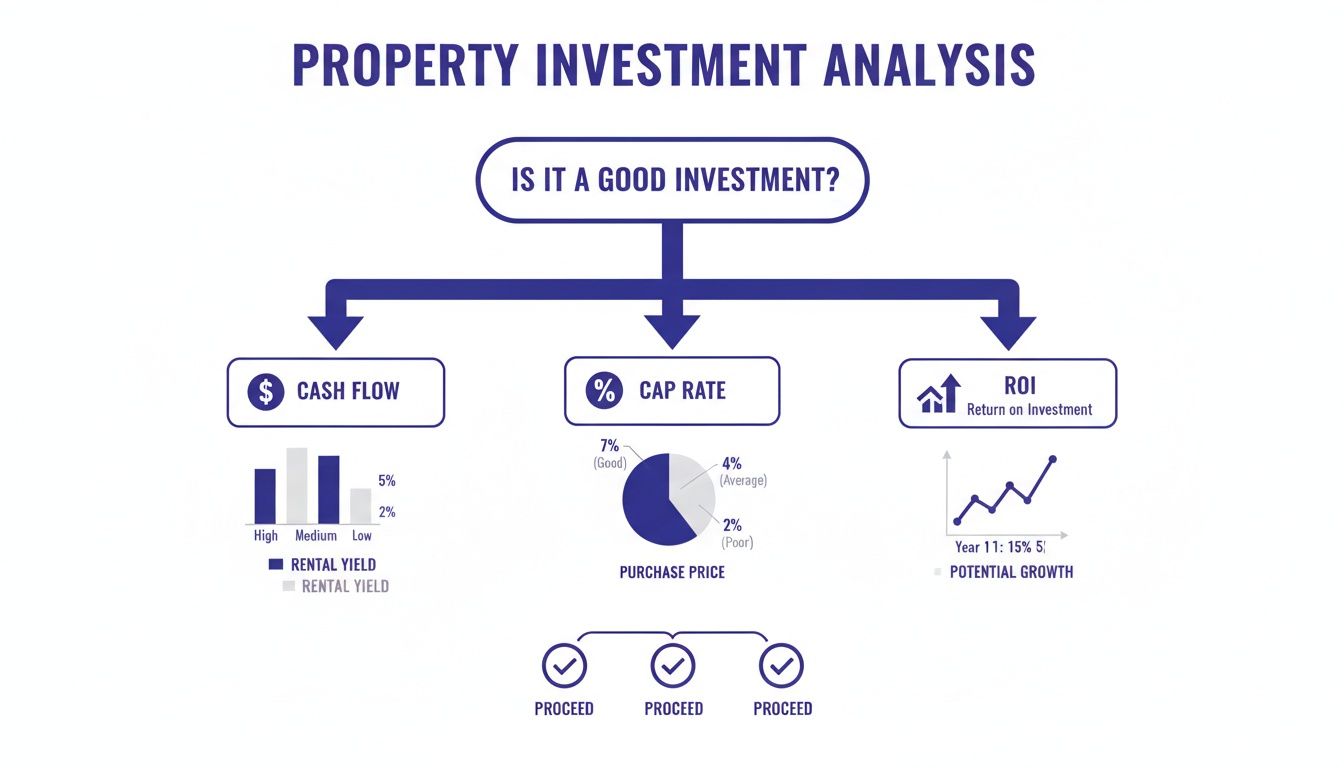
As the chart shows, different strategies lean on different metrics. That's a critical point to remember when picking your software. A tool designed for long-term rental forecasting will completely miss the mark here.
Must-Have Features for Flippers:
- Rehab Budgeting Tools: You absolutely need features to create a line-item renovation budget, track every dollar spent, and see how your actuals are measuring up against your estimates.
- ARV (After Repair Value) Calculators: Solid tools that help you pull and analyze comparable sales (comps) are non-negotiable for accurately predicting what the property will sell for once the work is done.
- Profit Analysis: The software must give you a crystal-clear calculation of your total project profit, accounting for purchase price, holding costs (like insurance and taxes), all your reno expenses, and closing costs.
A Simple Framework for Evaluating Your Options
With so many real estate investment software options out there, trying to pick the right one can feel like a chore. To get past the marketing fluff, you need a smart, repeatable way to compare platforms side-by-side. The goal isn't to find the tool with a million features; it's to find the one that actually solves your problems and slots right into how you work.
Think of it like test-driving a car. You wouldn't just look at the horsepower and call it a day. You'd get behind the wheel and check the handling, comfort, and whether the controls make sense. Evaluating software is the same—it requires a balanced look at powerful number-crunching and simple, everyday usability. A scoring system helps you get past gut feelings and make a choice you can stand behind.
The Five Pillars of a Great Platform
To start your evaluation, let's break down any software into five core areas. These pillars are what separate a true workhorse tool from just another monthly subscription you forget to cancel.
For every platform you look at, measure it against these five categories:
- Core Analytics Engine: How good is it at the math? You need instant, reliable numbers for essentials like cash flow, cap rate, cash-on-cash return, and long-term ROI projections.
- User Experience (UX) and Interface: Is the platform actually pleasant to use? Can you find what you need in a few clicks, or is critical information buried under confusing menus?
- Data Accuracy and Scope: Where is the data coming from? Look for transparency on their sources for rental comps, property values, and vacancy rates. The data needs to be fresh and relevant to your target markets.
- Reporting and Sharing: Can you generate clean, professional-looking reports to send to partners, lenders, or clients? Good software lets you customize these and makes them easy for anyone to understand.
- Customer Support and Resources: What happens when you hit a wall? Check for live chat, quick email support, video tutorials, and a solid knowledge base. You'll need it eventually.
When you're digging into different platforms, especially if you’re looking at short-term rentals, check out detailed comparisons of the best Airbnb analytics tools available. This can seriously help narrow down your choices.
Creating Your Personalized Scoring Card
Okay, let's make this framework practical. A personalized scoring card is where you assign importance to each category based on what you need. This part is key because every investor's priorities are different. A beginner might care most about ease of use, while a data-driven pro will put the deepest analytics at the top of their list.
Your scoring card turns a fuzzy, subjective decision into a clear, numerical comparison. It's your personal algorithm for finding the perfect software fit.
Here’s how you can build a simple scoring card to make an objective decision.
Software Evaluation Scoring Card
This checklist will help you systematically score and compare different software options. Just assign a weight to each category based on its importance to your investment strategy, then score each platform you're considering.
| Feature Category | Evaluation Criteria | Weight (1-5) | Software A Score (1-10) | Software B Score (1-10) |
|---|---|---|---|---|
| Core Analytics | Accuracy & depth of financial metrics (ROI, cash flow, cap rate) | |||
| User Experience | Intuitive design, easy navigation, and overall workflow | |||
| Data & Market Intel | Reliability of comps, property data, and market trends | |||
| Reporting & Sharing | Quality and customizability of reports for partners/lenders | |||
| Support & Training | Availability of help docs, tutorials, and human support |
To use the card, first fill out the "Weight" column (1 for least important, 5 for most). Then, as you evaluate each tool, give it a score from 1 to 10 in the corresponding column.
Once you’ve filled it out, multiply the Weight by the Score in each row for each software and add up the totals. This simple exercise gives you a clear, weighted final score, instantly showing you which platform is the best match for your specific needs.
Putting the Software to the Test: Real-World Scenarios

Checklists and theory are one thing, but the real magic of top-tier investment software happens when you plug in a live deal. Let's walk through two completely different scenarios to show how these tools take the guesswork out of complex decisions, turning a raw property listing into a rock-solid financial game plan.
We'll follow two investors on opposite ends of the spectrum: one is chasing long-term passive income, and the other is hunting for a quick and profitable flip. Each story will highlight how the right software features are absolutely essential for their specific strategy.
Scenario 1: The Buy-and-Hold Investor
Let’s start with Alex. He’s looking to add a steady, cash-flowing single-family home to his growing rental portfolio. He stumbles upon a promising three-bedroom property listed for $320,000. Before software, his analysis was a chaotic mess of napkin math and scribbled notes on a legal pad.
He types the property address into his software, and it immediately gets to work, pulling in property taxes, insurance estimates, and the going market rent for that specific neighborhood. That alone just saved him hours of tedious digging on county and Zillow-like websites.
Now, Alex starts painting the full financial picture:
- Plugging in the Deal: He confirms the $320,000 purchase price and inputs his planned 20% down payment.
- Modeling the Loan: This is where it gets fun. He can compare loan options side-by-side. He models a 30-year fixed loan at 6.5% against a 15-year loan at 5.75%, instantly seeing how each one affects his monthly mortgage payment and long-term equity growth.
- Projecting Cash Flow: He tweaks the numbers to match his own experience, bumping the maintenance budget to 8% of the gross rent and setting a 5% vacancy factor. The software does the heavy lifting, projecting a solid $285 in monthly cash flow with the 30-year loan.
- Forecasting the Future: With a single click, Alex generates a projection that spans the entire 30-year life of the loan. He gets a clear visual of his cash flow ticking up, his loan balance melting away, and his total ROI climbing higher every single year.
The entire process took him less than ten minutes. He went from a simple property listing to a comprehensive 30-year wealth plan, giving him the unshakable confidence he needed to write a competitive, data-backed offer.
Scenario 2: The House Flipper
Next up is Maria, a house flipper who just found a diamond in the rough—a distressed property in a fantastic neighborhood. It’s listed for $250,000, but she knows it needs a ton of work. For her, success hinges on two things: nailing the rehab costs and accurately predicting the After Repair Value (ARV).
Maria’s approach with her software is all about speed and short-term profit. She uses a platform built specifically for the chaos of a fix-and-flip.
Here’s what her workflow looks like:
- Budgeting the Rehab: Forget messy spreadsheets. Maria uses the software’s built-in rehab calculator to create a detailed, line-item budget for everything. New kitchen? That’s $15,000. Updated bathrooms? $8,000. Landscaping? Another $4,000.
- Pinpointing the ARV: The software’s market analysis tools are her secret weapon. She pulls up-to-the-minute sales comps for recently renovated homes within a half-mile radius, which helps her confidently peg the ARV at $415,000.
- Analyzing the Profit: Finally, she plugs in all her costs—the purchase price, closing fees, the full rehab budget, and holding costs like taxes and insurance for a six-month project timeline. In seconds, the software spits out a profit summary: an estimated net profit of $72,000, which is a 24% return on her total investment.
For flippers, every dollar and every day counts. The right software provides the financial guardrails needed to ensure a project stays on track and delivers the expected profit, preventing costly overruns and miscalculations.
These stories show exactly how purpose-built software solves the unique problems of different investors. Whether you're projecting returns over decades or calculating the profit on a six-month flip, the core benefit is the same: clarity, speed, and confidence. To get a better handle on one of the more advanced metrics, check out our guide on using an Internal Rate of Return calculator for real estate.
Making Your Final Decision
At the end of the day, picking the right real estate investment software is a gut check. After all the feature comparisons and framework evaluations, your final choice should feel like bringing on a trusted partner, not just buying another subscription. The right tool becomes an extension of how you think, handling the grunt work so you can stay focused on the big picture.
This isn't about finding the software with the longest feature list. It's about clarity. A first-time investor needs a helping hand to walk them through a deal, while a seasoned portfolio manager needs a 30,000-foot view at a glance. A house flipper is dead in the water without a reliable rehab calculator. The best software speaks your language and gets right to the heart of your specific challenges.
Bridging Your Strategy with the Right Tech
Great software closes the gap between your investment goals and the technology you use to hit them. It gives you the analytical power to back up your instincts with hard numbers and the reporting tools to clearly explain your vision to partners or a loan officer. Without that bridge, software is just a fancy calculator.
This alignment is crucial when you think about where you're investing. The software market isn't one-size-fits-all; different regions have different demands. For example, North America has long been the biggest player, accounting for about one-third of the global share, thanks to a mature market and tech-savvy institutional investors. Software aimed at this market tends to be heavy on features like sophisticated accounting and compliance tools. You can discover more insights about these regional market dynamics and what it means for the tools being developed.
Your final decision should empower you. The right software builds confidence by turning complex data into a clear, actionable story about an investment's potential.
One Last Check Before You Commit
Before you pull the trigger, run through one final mental checklist. These last few questions will confirm that your choice truly lines up with everything we’ve talked about.
- Does it fit my investor DNA? Make sure the features are truly built for your game, whether that's buy-and-hold rentals, quick flips, or managing a diverse portfolio.
- Is it actually easy to use? Fire up a free trial. Does it feel intuitive, or are you fighting the interface? If you can't run a deal analysis in just a few minutes, it’s going to hold you back.
- Can I trust the numbers? Check where the market data, rent comps, and property details come from. Reliable outputs can only come from accurate inputs.
- Will it scale with me? The tool you pick today needs to handle your ambitions for tomorrow, whether you're going from one door to twenty or breaking into a new city.
Answering these questions honestly helps ensure you're not just buying a piece of software, but investing in a platform that will grow with your portfolio. This is the final step in making sure the tool you choose isn't just good on paper, but is the absolute best real estate investment software for you.
Have a Few Questions? We’ve Got Answers.
Jumping into a new software platform always brings up a few questions. It’s a big decision, and you want to be sure it’s the right fit. Let’s tackle some of the most common things investors ask.
What’s the Best Free Real Estate Investment Software?
If you're just dipping your toes in the water or want to test-drive a platform before committing, a free plan is the way to go. Most of the best services offer a free version with some basic features. You can usually analyze a few deals, use a simple ROI calculator, and get a peek at the market data.
It won't have all the bells and whistles like in-depth market reports or long-term financial modeling, but it's the perfect way to get a feel for the software. Think of it as a trial run to see if the workflow clicks with you before you even think about pulling out your wallet.
Do These Platforms Link Up with Airbnb?
Absolutely. Many of the best real estate investment software tools, especially those built for short-term rentals, connect directly with platforms like Airbnb. This is usually done through something called an API or a built-in channel manager.
This isn't just a "nice-to-have" feature; it's a huge time-saver. It keeps your booking calendar, pricing, and guest messages in sync across platforms. No more double-bookings or out-of-date nightly rates.
How Accurate Are the Revenue Projections?
The projections are only as good as the data behind them. The best platforms pull from a massive pool of information—historical booking data, seasonal demand shifts, local events, and even machine-learning models—to give you a solid forecast. For the top-tier tools, you can expect projections to be within a 5% to 10% range of your actual earnings.
Of course, no projection is a crystal ball. Think of it as an expert-level estimate that gives you the confidence to back up your own analysis, not a hard guarantee.
Ready to stop guessing and start making data-driven decisions? Property Scout 360 gives you the tools to analyze deals, forecast returns, and build your portfolio with confidence. Explore our features and find the perfect plan for you at PropertyScout360.com.
About the Author
Related Articles
2026 Investor's Guide: Cost of Installing a Sewer Clean Out
Understand the cost of installing a sewer clean out for investment properties in 2026. Get expert advice on prices, ROI, & budgeting for flips. Plan smart!
15 Year vs 30 Year Mortgage: The Investor's Choice
Deciding between a 15 year vs 30 year mortgage for a rental property? Our guide analyzes cash flow, ROI, and equity to help you pick the best loan.
Real Estate Appraisal Software: Features & Limits
Discover what real estate appraisal software is, its core features, and limits. See how it differs from investment tools for profitable deals.
