Real Estate Investment Calculator: Analyze Deals with Confidence
Master the real estate investment calculator: a practical guide on cash flow, cap rate, and ROI to analyze properties and make smarter decisions.
Think of a real estate investment calculator as your financial X-ray for a potential property. It's a tool that lets you see past the curb appeal and slick listing photos to the numbers that actually matter, showing you whether a deal is a goldmine or a money pit before you risk a single dollar.
This isn't just about crunching numbers; it's about turning a hopeful guess into a smart, calculated investment.
Your Financial Crystal Ball for Property Investing
Ever try to build IKEA furniture without the instructions? Investing in real estate without a proper analysis tool is a lot like that—confusing, frustrating, and you'll probably end up with a wobbly, unstable result. A real estate investment calculator is your instruction manual, your financial GPS that guides you away from costly dead ends.
This guide isn't about getting bogged down in complicated spreadsheets. Instead, think of a good calculator as your personal financial 'crystal ball.' It takes a property’s potential and turns it into real, actionable numbers. This simple shift is what separates investors who rely on gut feelings from those who build wealth with data-backed strategies.
From Hopeful to Confident
We’ve all been there. You find a duplex in a great neighborhood. The asking price seems reasonable, and you can already imagine the rent checks rolling in. But nagging questions start to creep in:
- Will the rent actually cover the mortgage, taxes, insurance, and the inevitable repairs?
- How many years will it take to get my down payment back?
- Is this property's return really better than just putting my money somewhere else?
A real estate investment calculator takes care of these questions in minutes. It gives you the clarity to either confidently make an offer or wisely walk away from a deal that only looks good on the surface.
This is more crucial now than ever. The 2025 outlook suggests a real turning point for investors, as property prices finally start to settle after a wild few years. With the financial landscape changing, simply collecting rent might not be enough to secure strong returns; smart, active management is key. You can learn more about evolving investor strategies in the current real estate climate.
A great investment isn't about finding a good property; it’s about deeply understanding the numbers behind it. The calculator is what connects a promising listing to a profitable asset.
Before we dive into the nitty-gritty, let's get a bird's-eye view of the core metrics you'll be using. The table below breaks down the essential numbers a calculator will spit out. Each one tells a different part of the property's financial story, and learning to read them together is how you'll unlock the complete picture.
Key Investment Metrics at a Glance
| Metric | What It Measures | Why It's Important |
|---|---|---|
| Cash Flow | Your net income after every single expense is paid. | This is the clearest sign of a property's monthly profitability. |
| Cap Rate | The rate of return based on the property's income stream. | It’s the industry standard for quickly comparing different properties. |
| Cash-on-Cash Return | The annual return on the actual cash you put into the deal. | It tells you how hard your down payment is working for you. |
| Return on Investment (ROI) | The total profit you make relative to the total cost. | This gives you the big-picture view of your investment's success. |
Once you get a feel for these key figures, you'll be able to analyze properties faster and with far more confidence. Let's start by breaking them down one by one.
Decoding the Numbers Every Investor Must Know
A good real estate investment calculator does one thing incredibly well: it takes a mountain of financial data and boils it down into a handful of powerful, easy-to-understand metrics. These numbers are the language of property investing. Getting fluent is the first step toward making consistently smart decisions and building a profitable portfolio.
Instead of drowning in jargon, let's break down what each key metric really tells you about a property's health. Think of these numbers not as complex formulas, but as vital signs—they reveal the true story behind an investment opportunity. They take you from hoping a property is a good deal to knowing exactly how good it is.
The calculator's job is to turn guesswork into clarity, a journey this visual captures perfectly.
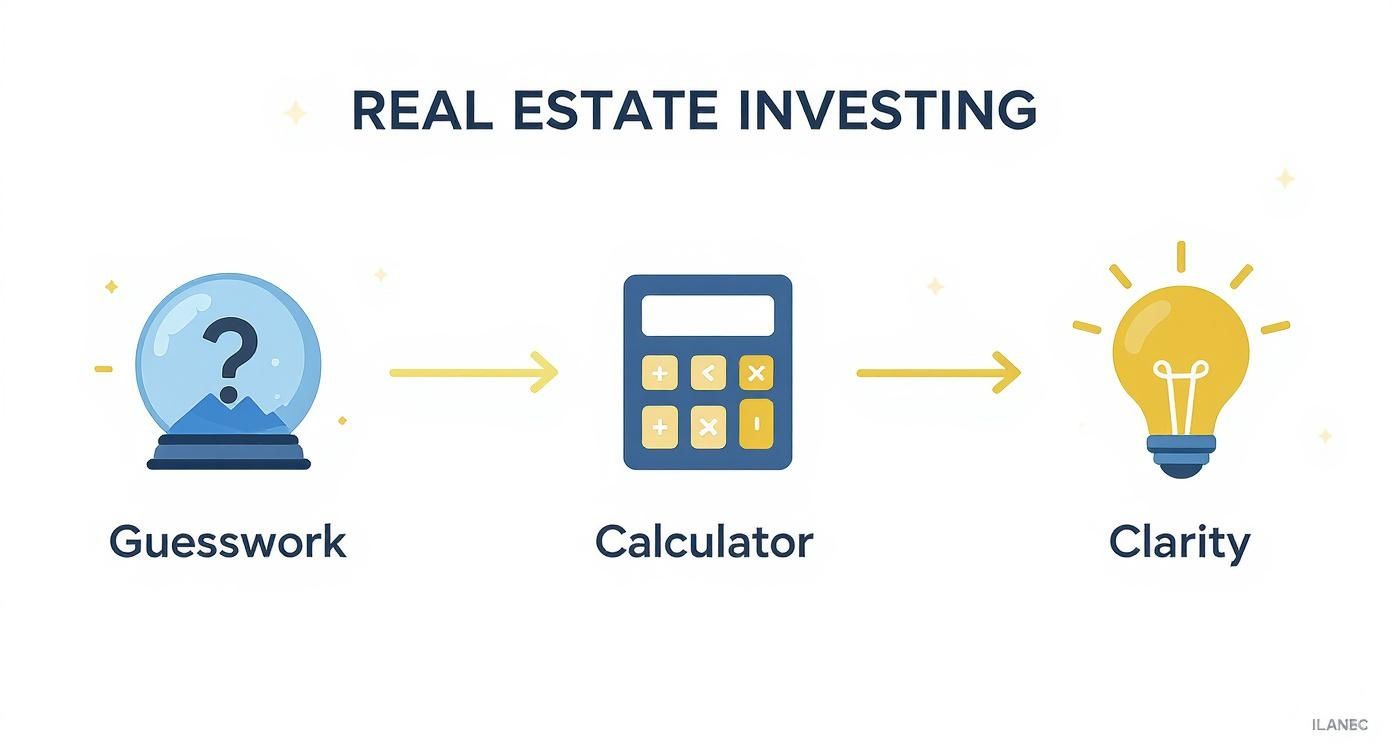
This shift from uncertainty to data-driven confidence is exactly what we're aiming for.
Cash Flow: The Property’s Monthly Paycheck
The most intuitive metric is cash flow. It's the money left in your bank account each month after you've collected rent and paid every single bill associated with the property. Simple as that.
Think of your property as a small business. Rent is your income. The mortgage, taxes, insurance, maintenance, and management fees are your expenses. Positive cash flow means your little business is profitable every month.
A property with $300 in positive monthly cash flow is putting that money directly into your pocket. Negative cash flow, on the other hand, means you have to feed the property money from your own pocket just to keep it running—a hole in your bucket no investor wants.
Capitalization Rate: The Universal Yardstick
Next up is the Capitalization Rate, or Cap Rate. It sounds technical, but its job is simple: to give you a standardized way to judge a property’s profitability, completely separate from the mortgage.
A great way to think about cap rate is like a car's miles per gallon (MPG). It doesn't matter if you paid cash for the car or took out a loan—its fuel efficiency is what it is. The cap rate does the same thing for a property, showing its raw earning power based on its price.
How it's calculated: Cap Rate = Net Operating Income (NOI) / Property Purchase Price
A higher cap rate generally points to a more profitable investment for its price. This makes it an essential tool for quick, apples-to-apples comparisons. For example, a property with a 7% cap rate is working harder and generating more income for every dollar you spend than a similar one with a 5% cap rate.
Cash-on-Cash Return: Your Personal ROI
While cap rate tells you about the property's performance, Cash-on-Cash (CoC) Return tells you about your performance. It answers the most important question for any investor: "For every dollar of my own money I put into this deal, how much am I getting back each year?"
Your CoC return laser-focuses on the actual cash you pulled out of your pocket—the down payment, closing costs, and upfront repair money. It then measures that initial investment against the annual cash flow the property produces.
Here’s a quick example:
- You invest $50,000 of your own cash to buy a rental.
- After all expenses are paid, the property generates $4,000 in positive cash flow for the year.
- Your CoC return is 8% ($4,000 / $50,000).
This metric is incredibly powerful because it shows you how hard your capital is working for you. Many savvy investors won't even look at a deal unless it meets their minimum CoC return target, like 10% or more.
Return on Investment: The Complete Profit Picture
Finally, there’s the Return on Investment (ROI). This is the big-picture metric. It looks beyond the monthly check and accounts for all sources of profit over time, including cash flow, your tenant paying down the loan, and the property (hopefully) going up in value.
While CoC return is a snapshot of your cash performance, ROI gives you a more complete film of how your wealth is growing. It recognizes that even with modest cash flow, you’re still building equity as the mortgage balance shrinks and the property appreciates.
For a deeper dive into how returns are measured over time, many seasoned investors also rely on a metric called the Internal Rate of Return (IRR). To get a handle on it, check out our guide on how to use an internal rate of return calculator for real estate. Understanding all these different return metrics is what gives you a truly well-rounded view of any deal, allowing you to invest with total confidence.
Let's Run the Numbers: A Real-World Walkthrough
Theory is great, but nothing builds confidence like running the numbers on an actual deal. Let's get our hands dirty and put a real estate investment calculator to work with a concrete example. This will show you just how quickly you can move from "what if" to "what is."
For this exercise, we'll analyze a hypothetical duplex listed for $400,000. We'll walk through the whole process: gathering the initial data, plugging it into the calculator, and then making sense of what the numbers are telling us.

This kind of careful analysis is crucial right now. After a market correction, global private real estate has been bouncing back, with transaction volumes jumping to $739 billion over the last year. That’s a 19% increase, year-over-year, which tells us that smart investors are making moves, backed by solid numbers. You can dig into this market shift in this detailed real estate trends report.
Phase 1: Gathering Your Initial Inputs
Before you can get any answers, you need to collect the raw data. Think of yourself as a detective piecing together the financial puzzle of a property. The more accurate your inputs, the more trustworthy your results will be.
Here’s the data we’ll use for our $400,000 duplex:
Purchase & Loan Details:
- Purchase Price: $400,000
- Down Payment: 20% ($80,000)
- Loan Amount: $320,000
- Interest Rate: 6.5% on a 30-year fixed loan
- Closing Costs: Estimated at 3% of purchase price ($12,000)
Income Projections:
- Monthly Rent per Unit: $1,500 (for a total of $3,000/month)
- Other Income: $50/month (let's say from coin-op laundry)
Fixed Operating Expenses:
- Property Taxes: $4,800 annually ($400/month)
- Homeowners Insurance: $1,800 annually ($150/month)
- Property Management: 8% of gross rent ($240/month)
Phase 2: Budgeting for the "What-Ifs"
This is where so many new investors get into trouble. You absolutely have to account for the costs that aren't on a fixed schedule, like vacancies and repairs. Skipping this step gives you a dangerously rosy picture of the property's potential.
In real estate analysis, conservative estimates are your best friend. It’s far better to be pleasantly surprised by extra cash flow than to be blindsided by an expense you didn't plan for.
Let's apply some common rules of thumb to our duplex:
- Vacancy (5%): We’ll assume one unit might be empty for about two weeks a year. On a $3,000 gross monthly rent, that means setting aside $150 every month to cover potential vacancies.
- Repairs & Maintenance (8%): A smart budget for routine upkeep is 5-10% of gross rent. We'll use 8%, which works out to $240 per month. This covers everything from a leaky faucet to touching up paint between tenants.
- Capital Expenditures (CapEx) (5%): This is your savings account for the big-ticket items—the new roof in ten years, the water heater that will eventually fail. We'll budget another 5%, or $150 per month, for this fund.
With our numbers in hand, we’re ready for the calculator. Using a dedicated tool is infinitely faster and more accurate than building a complex model from the ground up. If you do prefer the DIY route, our guide to creating a real estate investment analysis spreadsheet is a great place to start.
Phase 3: Plugging It In and Getting Answers
Now for the satisfying part. We simply enter all the figures we've gathered into the calculator's fields. A good tool will have clearly marked sections for the purchase, financing, income, and all your different expenses.
Here's a quick summary of what we're plugging in:
| Category | Item | Value |
|---|---|---|
| Purchase | Price | $400,000 |
| Down Payment | $80,000 | |
| Closing Costs | $12,000 | |
| Income | Gross Monthly Rent | $3,000 |
| Other Monthly Income | $50 | |
| Expenses | Property Taxes | $400/month |
| Insurance | $150/month | |
| Management Fee | $240/month | |
| Vacancy (5%) | $150/month | |
| Repairs (8%) | $240/month | |
| CapEx (5%) | $150/month |
Once you hit that "calculate" button, the tool does all the heavy lifting in an instant, spitting out the key performance metrics. This is the moment of truth—when you find out if this duplex is a golden opportunity or a deal you should walk away from. The next section will break down exactly how to read and understand these powerful results.
Interpreting Your Results for Smarter Decisions
So, the calculator has done its job. It’s taken your inputs, run the numbers, and spit out a neat summary. But these figures aren’t just abstract data points; they're the bedrock of a massive financial decision. The real skill is learning to read between the lines—that’s what transforms a simple calculation into a powerful investment strategy.
Let's go back to our example $400,000 duplex. The calculator crunched the numbers and gave us its verdict. Now what? What does a $250 monthly cash flow or a 7% cap rate actually tell you about your future? Is this deal a home run, a solid base hit, or a property you should walk away from right now? The answer is all about context.

Putting Your Metrics into Perspective
A number floating in space is completely meaningless. A 7% cap rate might be a fantastic return in a stable, high-demand city, but it could be pretty lackluster in a riskier, more speculative market. The very first thing you need to do is benchmark your property's numbers against the local market and your own personal goals.
- Market Benchmarks: How does this deal stack up against others in the same neighborhood? Find out what typical cap rates are for similar duplexes in that area. A good real estate agent can tell you this, or you can use platforms like Property Scout 360. If the local average is 6%, your 7% deal is starting to look pretty good.
- Personal Goals: What's your minimum acceptable return? Maybe you have a rule that you won't touch any deal with less than a 10% cash-on-cash return. Does this property clear that personal hurdle?
This comparison keeps you from falling for a deal in a vacuum. It forces you to consider the opportunity cost—is this really the best place for your capital to be working right now?
The goal isn't just to find a property that makes money. It's to find the best property for your money at that given moment. A "good deal" is always relative to your other options and your own financial endgame.
The Power of Stress-Testing Your Deal
Pro investors never, ever trust a single, rosy projection. They plan for things to go wrong. The true power of a good real estate investment calculator is the ability to run different scenarios in seconds—a process we call stress-testing. This is where you intentionally poke at the weak spots in your analysis to see if the deal holds up under pressure.
Think of it like an engineer testing a new bridge. They don't just assume it will work; they pile on heavy loads to find its breaking point before a single car crosses it. You have to do the same thing with your investment's finances. Start asking the tough "what if" questions and plug those new numbers into your calculator.
Here are a few scenarios every investor should run:
- What if I have to lower the rent by 10%? A shiny new apartment building opens down the street, and suddenly you have competition. Does the property still produce positive cash flow, or is it now costing you money each month?
- What if a big-ticket repair hits in year one? Your furnace dies in the middle of winter. That’s a surprise $8,000 bill. How does that torpedo your first-year returns?
- What if interest rates are higher when I refinance? If your plan involves refinancing in a few years, model the deal with a higher interest rate to make sure the numbers still make sense.
- What if the vacancy is worse than I planned? A tenant moves out, and it takes you three months to find a good replacement, not the one month you budgeted for. How does that extra downtime eat into your annual profit?
When you run these scenarios, you’re not looking for a single answer. You’re finding the property’s true break-even point and testing its financial toughness. A deal that only works in a perfect, best-case world is a fragile one. But a deal that still looks decent after you’ve thrown a few curveballs at it? That’s a robust investment far more likely to build real, long-term wealth. This is the kind of proactive thinking that separates the amateurs from the pros.
Common Pitfalls and How to Ensure Your Numbers Are Solid
A real estate investment calculator is an amazing tool, but it lives by one simple rule: garbage in, garbage out. The most powerful analysis in the world will point you in the wrong direction if it's based on wishful thinking or bad data. Your first job is to protect your capital by feeding the calculator realistic, well-researched numbers.
Think of it this way: the numbers you plug in aren't just digits. They represent real-world costs that can either sink your investment or help it succeed. Getting this part wrong is like building a house on a shaky foundation—it might look fine on day one, but it's not going to hold up.

Overlooking the Hidden Expenses
One of the easiest traps to fall into, especially for new investors, is underestimating what it truly costs to own a property. It's easy to remember the mortgage, but it’s the smaller, nagging expenses that often chip away at your profits until there's nothing left.
Three areas, in particular, tend to get misjudged:
- Maintenance and Repairs: Just because a property looks new doesn't mean it will be maintenance-free. A solid rule of thumb is the "1% Rule," which means you should budget at least 1% of the property's purchase price for annual repairs. For a $300,000 property, that’s $3,000 a year, or $250 every single month.
- Vacancy Rate: Your property will not be rented 100% of the time. It’s just not realistic. Budgeting for vacancy is non-negotiable, and a standard rate is 5-8% of the gross annual rent. In a slower market, you might even want to bump that up to 10% to be safe.
- Capital Expenditures (CapEx): This isn't the same as routine maintenance. CapEx is for the big-ticket items you'll eventually have to replace—a new roof, an HVAC system, or major appliances. Ignoring this fund is just setting yourself up for a massive, stressful bill down the road.
Sourcing Reliable and Localized Data
Using national averages for local expenses is a recipe for disaster. Property taxes, insurance rates, and even utility costs can swing wildly from one town to the next, sometimes even between neighborhoods. Generic estimates will completely sabotage your calculator's accuracy.
The best analysis is built on hyper-local data. Never guess when you can verify. A few phone calls can save you from a multi-thousand-dollar mistake.
To make sure your numbers are grounded in reality, you need to do a little homework:
- Get Real Insurance Quotes: Don't guess. Call a local insurance agent and get an actual quote for the specific property you're analyzing.
- Verify Property Taxes: Go to the county assessor’s website and look up the property's tax history yourself. Never rely on what the seller was paying, as a sale can trigger a tax reassessment.
- Confirm Market Rent: Check local rental listing sites and, if you can, talk to a local property manager to confirm your rent estimates are in line with what similar units are actually getting.
This kind of diligence is always important, but it’s especially crucial when the market is active. For example, commercial real estate transaction volumes in Europe climbed to €188.8 billion in 2024, a 13.7% increase, while Asia saw a 13.4% jump. This data shows that investors are out there competing for good properties, which makes accurate local analysis your best competitive advantage. You can read the full analysis of these global real estate trends to see why precise numbers matter more than ever.
How to Choose the Right Analysis Tool
Not all real estate investment calculators are built the same. The tools available to investors run the gamut from basic spreadsheets you build yourself to sophisticated software platforms, and the best one for you really depends on your goals and how deep you want to go.
Choosing the right tool is about more than just convenience. It's about getting accurate numbers, working efficiently, and ultimately, making smarter financial decisions.
Think of it like this: a simple hammer is great for hanging a picture, but you wouldn't use it to build a house. You need the right tool for the job. Your analysis tool should match your investment ambitions, whether you're buying your first rental or managing a growing portfolio.
Comparing Your Options
Let's walk through the main types of tools you'll come across. Each has its own set of strengths and weaknesses, making them a good fit for different kinds of investors.
Comparison of Real Estate Analysis Tools
Picking the right tool is a crucial step in your investment journey. This table breaks down the most common options to help you decide which one fits your strategy, from quick estimates to in-depth portfolio management.
| Tool Type | Pros | Cons | Best For |
|---|---|---|---|
| DIY Spreadsheets | Completely customizable; no cost to start; you own the data and logic. | Prone to human error (formulas can break easily); time-consuming to build and update; no live data integration. | Detail-oriented investors who want total control and have strong spreadsheet skills. |
| Free Online Calculators | Quick and easy to use; great for initial, high-level estimates; no cost. | Often oversimplified; may miss crucial expenses like CapEx or vacancy; limited customization. | Beginners doing "back-of-the-napkin" math on a single property to see if it's worth a closer look. |
| Premium Software | Integrates real-time market data; automates complex calculations; reduces errors; advanced features like scenario modeling. | Subscription or purchase cost; may have a slight learning curve. | Serious investors who value their time, want to analyze deals quickly, and need reliable, comprehensive data. |
Ultimately, the best tools remove the tedious work from your plate. They let you focus on what really matters—finding great deals—instead of getting bogged down in formulas and data entry.
The goal is to spend less time crunching numbers and more time making strategic decisions.
For a closer look at one of the most important metrics these tools calculate, check out our guide on the cash-on-cash return calculator. It shows just how much precise calculations can change your perspective on a deal.
Features That Make a Difference
When you're comparing tools, look for a few key features that solve real-world investor problems.
A top-tier real estate investment calculator should let you:
- Model different financing scenarios to see how they impact your returns.
- Account for all potential expenses, from property taxes to long-term capital expenditures.
- Generate long-term projections that show you how the investment performs over 5, 10, or even 30 years.
The ability to compare multiple properties side-by-side using the exact same metrics is also a huge advantage. This is the only way to make a true apples-to-apples comparison, something that's nearly impossible when you're jumping between different free calculators or using inconsistent spreadsheets.
In the end, the right platform gives you the power to analyze deals faster and with a whole lot more confidence.
Frequently Asked Questions
Even the most seasoned pros have questions when running the numbers. Here are a few common ones that pop up when you're digging into a deal with a real estate investment calculator.
What Is a Good Cash on Cash Return for a Rental Property?
This is the million-dollar question, isn't it? While there’s no single right answer, a common benchmark many investors aim for is a cash-on-cash (CoC) return of 8-12%.
But a "good" return really depends on your goals and your market. In a fast-growing area like Austin or Denver, you might be perfectly happy with a lower CoC, say 5-7%, because you're banking on appreciation to build wealth. On the other hand, if you're investing in a market prized for steady income, you might not even look at a deal that projects less than 15%. It all comes down to your personal strategy.
How Accurate Is a Real Estate Investment Calculator?
A calculator is only as good as the numbers you feed it. Think of it this way: garbage in, garbage out. If you plug in accurate, well-researched data for rent, taxes, insurance, and all the other costs, the output will give you a solid financial picture.
The tool is only as smart as its inputs. Using overly optimistic guesses for rent or underestimating repair costs will produce misleading results.
To keep your analysis honest, always ground your numbers in reality. Pull local comps, get real quotes from contractors and insurance agents, and always build in a buffer for things like vacancies and unexpected repairs.
Can I Use a Calculator for Commercial or Multi Family Properties?
Absolutely, but you'll likely need a calculator built for the job. The basic math—income minus expenses—is the same, but commercial and multi-family properties have a lot more moving parts.
For example, you'll need to account for:
- Varied Lease Structures: Things like Triple Net (NNN) leases, where the tenant covers taxes, insurance, and maintenance, completely change the expense side of the equation.
- Multiple Income Streams: You might have extra income from laundry machines, paid parking spots, or storage units.
- Complex Expense Categories: Managing a larger property comes with its own unique set of costs.
A simple calculator designed for single-family homes just won't have the fields to handle that level of detail. It’s always best to find a specialized real estate investment calculator that matches the type of property you’re analyzing.
Ready to stop guessing and start analyzing deals with precision? Property Scout 360 gives you the power to calculate ROI, cash flow, and long-term returns in minutes. Find your next profitable investment today.
About the Author
Related Articles
2026 Investor's Guide: Cost of Installing a Sewer Clean Out
Understand the cost of installing a sewer clean out for investment properties in 2026. Get expert advice on prices, ROI, & budgeting for flips. Plan smart!
15 Year vs 30 Year Mortgage: The Investor's Choice
Deciding between a 15 year vs 30 year mortgage for a rental property? Our guide analyzes cash flow, ROI, and equity to help you pick the best loan.
Real Estate Appraisal Software: Features & Limits
Discover what real estate appraisal software is, its core features, and limits. See how it differs from investment tools for profitable deals.
