A Guide to 1031 Exchange Investment Property
Unlock tax-deferred growth with a 1031 exchange investment property. This guide explains the rules, timelines, and strategies to maximize your returns.
A 1031 exchange investment property transaction is one of the most powerful tools in a real estate investor's arsenal. At its core, it lets you sell an investment property, roll 100% of the proceeds into a new one, and push off paying capital gains taxes. Think of it less as a sale and more as a "swap," allowing your investment to grow without a major tax hit slowing you down.
This isn't some shady loophole. It's a long-standing provision in Section 1031 of the IRS code, designed to help investors keep their money working in the market.
The Foundation of Tax-Deferred Investing
Let's put this into real terms. Imagine you sell a rental property and walk away with a significant profit. In a normal sale, Uncle Sam would take a big slice of that gain right off the top. But with a 1031 exchange, you get to reinvest that entire amount into your next property.
The logic from the IRS's perspective is simple: you haven't actually cashed out your investment, you've just changed its form. You're still in the game.
This tax deferral is what really fuels portfolio growth. By using your pre-tax dollars to buy bigger or better-performing assets, you're compounding your wealth much faster. It’s a night-and-day difference compared to selling, paying taxes, and then reinvesting with what's left over.
Understanding the "Like-Kind" Rule
The term "like-kind" trips a lot of people up, but it's far more flexible than it sounds. It doesn't mean you have to trade a duplex for an identical duplex. For real estate, the IRS definition is incredibly broad. Essentially, any property held for investment or business purposes can be exchanged for any other property held for the same purposes.
This flexibility is where the strategy really shines. You could easily exchange:
- A single-family rental for a small apartment building.
- A parcel of raw land for a commercial retail space.
- An office building for a portfolio of vacation rentals.
The only real rule is that you can't swap an investment property for your personal home. Both the property you sell (the relinquished property) and the one you buy (the replacement property) must be used for business or investment. To get a solid grasp of the basics, this introduction to 1031 exchanges is a great starting point.
The Role of the Qualified Intermediary
Now for the most important rule: you can't touch the money. If the proceeds from the sale of your property hit your bank account for even a second, the entire exchange is blown, and the sale becomes fully taxable.
This is where a Qualified Intermediary (QI) comes in. A QI is an independent, professional third party who holds your funds in escrow after you sell the old property and before you buy the new one. They are the essential gatekeeper of a valid exchange.
Having a QI isn't optional; it's a requirement for nearly every 1031 exchange. They handle all the critical paperwork, manage the funds according to strict IRS rules, and make sure you stay compliant every step of the way. Choosing a reliable, experienced QI is arguably the first and most critical decision you'll make when planning a 1031 exchange investment property deal.
The Critical Timelines and Rules You Can't Ignore
Think of a 1031 exchange not as a clever tax loophole, but as a tightly choreographed dance with the IRS. Every step, every deadline, is non-negotiable. One wrong move, and the whole tax-deferral benefit you’re counting on can evaporate.
The most unforgiving parts of this dance are the timelines. These deadlines are absolute—there are no extensions for weekends, holidays, or bad luck. Success demands careful planning from the very beginning.
This timeline lays out the three critical phases you'll navigate.
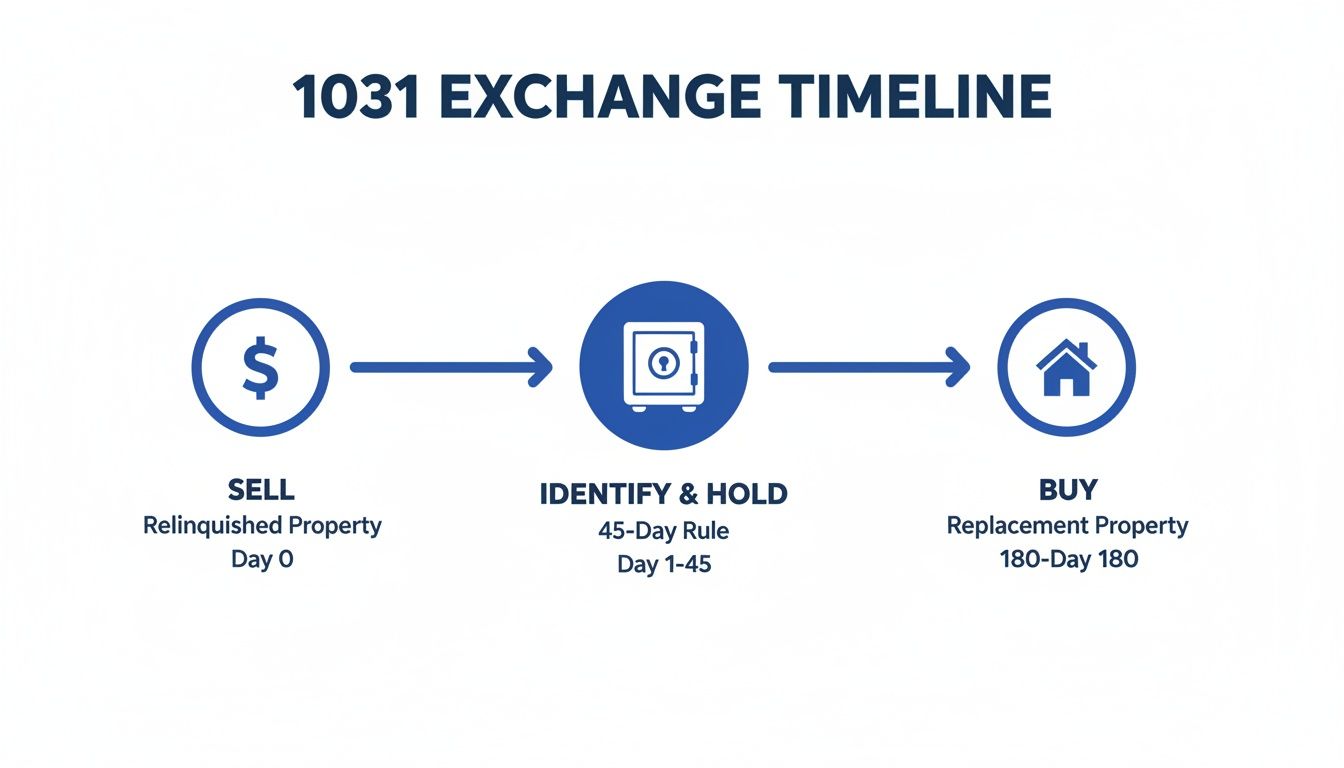
As you can see, the moment you close on your old property, both the 45-day and 180-day clocks start ticking at the same time.
The 45-Day Identification Period
The second you close the sale of your "relinquished" property, the pressure is on. You have exactly 45 days to formally identify potential replacement properties. This isn't just a mental list; you have to deliver a signed, written document to your Qualified Intermediary (QI) spelling out which properties you're targeting.
Let's say you sell your old property on March 1st. Your deadline to submit that list is April 15th. It’s an ironclad date. Miss it by a single day, and the exchange is dead on arrival.
The IRS gives you three ways to identify properties. You only have to follow one of these rules:
- The Three-Property Rule: This is the go-to for most investors. You can identify up to three potential properties, no matter what they cost. You just have to close on at least one of them to complete the exchange. Simple and straightforward.
- The 200% Rule: Need more options? You can identify more than three properties, but there's a catch. The total value of all the properties on your list can't be more than 200% of the value of the property you sold. If your old property sold for $500,000, you could identify five properties as long as their combined worth is $1 million or less.
- The 95% Rule: This one is rarely used because it’s so risky. You can identify as many properties as you want, but you must ultimately purchase at least 95% of the total value you identified. It leaves almost no room for error.
The 180-Day Closing Period
The second clock that starts on day one is the 180-day Closing Period. This is the total amount of time you have to actually purchase and close on one or more of the properties you identified. Crucially, this 180-day window includes the 45-day identification period—it doesn't start after it ends.
Back to our March 1st example: you have until August 28th (180 days) to get the deal done. Once you’ve submitted your list by April 15th, you have the remaining 135 days to handle inspections, get your financing in order, and officially close.
Crucial Takeaway: The 180-day deadline is the final cutoff. If you don’t have the keys to your new property by then, your 1031 exchange fails. The proceeds from your sale become fully taxable, just as if you never started the exchange.
Avoiding Taxes by Avoiding "Boot"
To defer 100% of your capital gains tax, you have to avoid what the IRS calls "boot." Boot is any non-like-kind property (like cash or debt relief) you receive in an exchange, and it's always taxable. It usually shows up in two forms.
Cash Boot: This one is easy to spot. If you don't reinvest all the cash proceeds from your sale, the leftover money is considered boot and gets taxed. For example, if your sale nets you $400,000 and you only put $350,000 into the new property, that $50,000 difference is taxable cash boot.
Mortgage Boot: This happens when you have less debt on the new property than you did on the old one. If you paid off a $200,000 mortgage when you sold but only took on a $150,000 loan for the replacement, the IRS sees that $50,000 of "debt relief" as a gain, and it becomes taxable mortgage boot.
The golden rule for a fully tax-deferred exchange is simple: buy a new 1031 exchange investment property with a value equal to or greater than the one you sold, and roll all of your equity into the new deal.
Navigating the Exchange Process Step by Step
Knowing the rules of a 1031 exchange is one thing, but actually pulling one off successfully is a different beast altogether. Think of it as a carefully choreographed dance where every player—you, your real estate agent, and a crucial figure called the Qualified Intermediary (QI)—has a specific part to play on a very tight schedule.
Let's walk through what a standard exchange looks like from beginning to end.

This roadmap will show you how each piece connects to the next, helping you stay compliant and protect that all-important tax deferral.
Step 1: Engage a Qualified Intermediary
Your first—and most critical—move happens before you even list your property for sale. You absolutely must hire a Qualified Intermediary (QI) and get a formal exchange agreement signed before you close on the property you're selling.
Let me be clear: this step is non-negotiable. The QI acts as an independent third party who will hold your sale proceeds. This is key because it prevents you from having "constructive receipt" of the cash, which would instantly blow up the exchange and trigger a taxable event.
Once you find a buyer, you’ll also need to add a simple "cooperation clause" to your sale agreement. It’s just a bit of language that lets the buyer know you're doing a 1031 exchange and that they agree to cooperate. Don't worry, it doesn't add any liability or cost on their end.
Step 2: Close on Your Relinquished Property
When you get to the closing table, the proceeds from your sale are wired directly from the buyer (or their title company) straight into your QI's secure escrow account. The money never touches your hands.
The very moment this sale is final, two clocks start ticking down at the same time: the 45-day Identification Period and the 180-day Exchange Period. The closing date is Day Zero.
Investor Tip: Do not wait until your property sells to start looking for replacements. That 45-day window is unforgiving, and having a shortlist of potential properties ready to go gives you a massive advantage.
Step 3: Identify Your Replacement Properties
You now have exactly 45 calendar days to formally identify potential replacement properties. This isn't a casual list; it must be a signed, written declaration that you deliver to your QI.
Your identification list has to be specific and unambiguous, meaning you need to include the property address or a legal description. And remember, you have to follow one of the three big identification rules: the Three-Property Rule, the 200% Rule, or the 95% Rule.
This is usually the most stressful part of the whole process. Once you submit that list on or before midnight of Day 45, it’s locked in. You can't change it, and you can only buy properties that are on it.
Step 4: Conduct Due Diligence and Secure Financing
With your properties identified, the game shifts to actually acquiring one (or more) of them. Now is the time to negotiate purchase agreements, line up inspections, and get your financing finalized.
This part feels just like a regular property purchase, but that 180-day clock is always looming in the background. Rushing is a mistake, so thorough due diligence is a must. To make sure you don't miss anything, it helps to follow a structured guide, like a comprehensive real estate due diligence checklist, which can keep you on track with inspections and document reviews.
Step 5: Close on Your Replacement Property
The final step is closing on your new investment property. Your QI will wire the exchange funds directly to the seller or their title company to complete the purchase. Any new loan you've taken out will also be funded at this time.
To get the full tax deferral, the goal is to acquire a replacement property of equal or greater value and to reinvest all of your equity. If you've done everything correctly and within that 180-day window, your exchange is complete.
Congratulations! You’ve successfully used a 1031 exchange to defer your capital gains taxes and keep your investment portfolio growing.
Common 1031 Exchange Strategies for Investors
While the rules for a 1031 exchange investment property are rigid, the strategies you can use are surprisingly versatile. This isn't just a simple "sell one, buy one" game. There are several powerful ways to structure an exchange to fit your financial goals, adapt to market conditions, and build a stronger portfolio.
Thinking beyond a basic swap allows you to turn the exchange from a simple tax deferral tactic into a strategic growth engine. Let's walk through four of the most effective strategies savvy investors use.
The Forward Exchange
This is the classic, the one you hear about most often. The Forward Exchange is the bread and butter of the 1031 world. You sell your property, a Qualified Intermediary (QI) holds onto the cash, and you then use that money to buy your next property. Simple as that.
This is the most common path because it’s predictable and follows the 45-day identification and 180-day closing deadlines to the letter.
- Best For: Investors who are confident they can find a suitable replacement property in a reasonable amount of time and aren't rushing to close on a new deal before their old one sells.
The Reverse Exchange
But what if you stumble upon the perfect property before you've even listed your current one? In a hot market, he who hesitates is lost. That’s where the Reverse Exchange becomes your best friend.
In this scenario, you lock down the new property first. Your QI sets up a special entity called an Exchange Accommodation Titleholder (EAT) to "park" the title to your new property. Once you sell your old place, the funds go to the QI and are used to officially purchase the parked property from the EAT, completing the exchange.
A Reverse Exchange gives you the power to pounce on a great deal in a fast-moving market. You can secure a desirable asset without sweating that another buyer will snatch it up while you're waiting for your old property to close.
It’s definitely more complex and comes with higher fees, but when timing is everything, this strategy is invaluable.
The Improvement Exchange
Sometimes, the best replacement property isn't perfect—yet. An Improvement Exchange (also called a Construction Exchange) is a brilliant strategy that lets you use your tax-deferred funds to not only buy the property but also to pay for the renovations.
Here's the play-by-play: the EAT acquires and holds the title to your new property while the construction or renovation happens. The exchange funds held by your QI are then paid out to cover the improvement costs. For the exchange to work, the final value of the property plus the improvements must be equal to or greater than the value of the property you sold.
This is a fantastic tool for creating your ideal 1031 exchange investment property from a fixer-upper and building in sweat equity from day one.
The Delaware Statutory Trust (DST)
Tired of being a landlord but still want to own real estate? For investors looking to step back from the day-to-day grind, the Delaware Statutory Trust (DST) is a game-changer.
A DST lets you buy a fractional interest in a large, professionally managed commercial property—think institutional-grade apartment buildings, medical centers, or logistics warehouses. The IRS considers this fractional interest "like-kind" real estate, so it qualifies for a 1031 exchange.
This makes DSTs a perfect fit for investors who:
- Are up against the 45-day identification deadline and can't find the right property.
- Want to diversify their capital across several high-quality assets instead of just one.
- Are ready to trade tenant headaches for truly passive income.
The multifamily sector, for instance, is a popular target for DSTs right now. After a brief slowdown, U.S. multifamily investment is picking back up, with sales for properties over $2.5 million projected to reach $131 billion. Cap rates are also stabilizing around 5.6%. You can dig into more data on these 2025 market dynamics to see how these trends are shaping investment choices. The proven stability of large apartment complexes makes them a prime destination for 1031 investors seeking reliable returns.
Finding and Analyzing Replacement Properties
The 45-day identification window is, without a doubt, the most intense part of any 1031 exchange investment property deal. The clock is ticking, and the pressure to find a suitable replacement can easily lead to rushed decisions and expensive mistakes. Your success really boils down to how quickly and confidently you can find and analyze potential properties.
This is where the rubber meets the road. Forget about manually sifting through listings and fighting with spreadsheets. Modern tools can give you a serious advantage, turning a frantic search into a calm, data-driven process.

The goal here isn't just to find a property; it's to find the right property by focusing on the numbers that will dictate your portfolio's long-term health.
Sourcing Viable Candidates Quickly
First things first, you need to build a solid shortlist of properties that meet the "equal or greater value" rule. Let's be honest, generic real estate websites just aren't cut out for this. They're built for homebuyers, not investors. You need filters that go beyond bedrooms and bathrooms and let you screen for specific financial metrics.
Using a tool like Property Scout 360, you can zero in on properties by filtering for:
- Minimum Cap Rate: Instantly kick underperforming assets to the curb.
- Targeted Rental Yield: See only properties that generate the kind of cash flow you’re looking for.
- Price Range: Make sure every property you even look at already satisfies the 1031 value requirements.
This laser-focused approach cuts through all the noise. It saves you precious time and ensures every property on your radar is a real possibility. You can pull together a preliminary list for your Three-Property Rule identification in a fraction of the time it would take to do it the old-fashioned way.
Running Instant Side-by-Side Analysis
Once you’ve got a list, the next hurdle is comparing them fairly. A property that looks great on paper might have awful financials, while a more modest-looking one could be a cash-flow powerhouse. You have to vet them apple-to-apples.
This is where instant analysis completely changes the game. Instead of building a new spreadsheet for every single property—a tedious and error-prone task—you can plug in the numbers and get back comprehensive financial projections in seconds.
The real power of rapid analysis is shifting your mindset from "Does this property look good?" to "Which of these three properties performs the best?" Under the pressure of a 45-day deadline, that shift is everything.
You can lay out all the key performance indicators—cash-on-cash return, ROI, net operating income—side-by-side. This makes it incredibly easy to spot the strongest financial contender in the group.
Modeling Financing to Avoid Taxable Boot
Here’s a critical rule for a fully tax-deferred exchange: your new mortgage has to be equal to or greater than the one you just paid off. If you take on less debt, the IRS considers that difference "mortgage boot," and it's taxable. So, getting the financing right is just as important as picking the right asset.
Running different financing scenarios is absolutely essential. You need to see exactly how different down payments, interest rates, and loan terms will affect your monthly cash flow and overall return. For a much deeper dive, check out our guide on how to finance a rental property.
An investment analysis tool lets you model these scenarios on the fly:
- Input the purchase price of your target replacement property.
- Enter your total exchange equity as the down payment.
- Adjust the loan amount to make sure it’s higher than your old mortgage.
- Watch the cash flow and ROI calculations update instantly.
This ability lets you perform fast, data-backed due diligence. You can move forward and formally identify a replacement property with full confidence, knowing it not only hits your investment goals but also ticks all the boxes for a successful 1031 exchange.
The Economic Ripple Effect of 1031 Exchanges
A 1031 exchange does a lot more than just help a single investor defer taxes and grow a portfolio. Think of it as a powerful engine for the U.S. economy. By letting investors reinvest their full pre-tax proceeds, Section 1031 keeps capital moving, productive, and constantly cycling back into the market.
Without it, that money would likely sit parked in an aging asset, with the owner hesitant to sell and trigger a massive tax bill. This constant flow of capital has a direct, tangible impact. It fuels jobs in construction, property management, skilled trades, and real estate services.
Imagine an investor selling an older, low-maintenance property and exchanging it for a neglected apartment building that needs a complete overhaul. That exchange is what makes the redevelopment possible. It transforms a community eyesore into valuable housing, creating jobs and boosting local property values in the process.
A Surprising Driver of Job Creation
When you add up all those individual transactions, the macroeconomic impact is huge. Research consistently shows that 1031 exchanges support approximately 976,000 jobs and generate around $48.6 billion in labor income every single year.
It’s a classic economic multiplier effect. The tax deferral is a small price to pay for the massive economic activity it unlocks.
What's truly telling is how investors rely on this tool during tough times. From 2019 to 2023, while overall real estate transactions plunged by over 22%, the number of 1031 exchanges actually grew by 15%. This shows just how essential the 1031 exchange is for adapting and reinvesting, especially when the market gets choppy.
How Smart Investors Adapt to Market Shifts
A savvy investor's strategy is never static; it shifts with the market. When interest rates are high or the economy feels uncertain, a 1031 exchange becomes a critical tool for repositioning.
You might see investors exchanging out of a high-maintenance property into a more passive, hands-off asset like a DST. Or they might move their capital from a stagnant market to a region with better growth prospects. Knowing where to look is key, which is why we put together our guide on the best markets for rental properties to help you pinpoint those high-potential areas for your next move.
To really grasp how these cycles work, it helps to look at the past. Broader financial trends, like the performance of commercial mortgage-backed securities from 2006, offer a window into market sentiment and risk during different economic periods. Understanding these forces makes it clear that the 1031 exchange isn't just a tax loophole—it's a vital component of a dynamic and healthy real estate ecosystem.
Got Questions? We’ve Got Answers: Your 1031 Exchange FAQ
When you're first exploring a 1031 exchange investment property, it's natural for a lot of questions to pop up. Let's tackle some of the most common ones I hear from investors, clearing up the confusion so you can move forward with confidence.
Can I Exchange My Vacation Home?
This is one of the trickiest questions, and it all comes down to one critical phrase: "held for investment." A property you use mostly for personal getaways won't make the cut. The IRS needs to see clear investment intent.
So, how do you prove it? You need to convert its use. A good rule of thumb, often recommended by tax advisors, is to limit your personal use and rent it out at fair market value for at least 14 days a year for the two years leading up to the sale. This demonstrates that you've shifted its purpose from personal enjoyment to an income-producing asset.
What Happens If I Miss the 45-Day Identification Deadline?
Let me be blunt: the 45-day identification deadline is non-negotiable. There are no extensions and no exceptions. If you don't deliver a signed, written list of potential replacement properties to your Qualified Intermediary (QI) by midnight on day 45, the entire exchange is off.
A failed exchange is a painful lesson. Your sale is no longer a tax-deferred exchange; it's just a regular sale. That means you’ll owe capital gains tax on the profit in the same year you sold, completely losing the benefit you were trying to achieve.
Is It Possible to Take Some Cash Out During an Exchange?
Yes, you can pull cash out, but it won't be tax-free. Any money you receive from the sale that you don't roll into the new property is known as "cash boot," and the IRS will want its share.
That boot is taxed as income, up to the total amount of your capital gain. Imagine you have a $100,000 gain and decide to pocket $20,000 of the sale proceeds. You'll be paying taxes on that full $20,000. Since the whole point of a 1031 exchange investment property is to defer taxes, most savvy investors make it their goal to reinvest 100% of the proceeds.
Ready to stop guessing and start analyzing your next replacement property with confidence? Property Scout 360 gives you the instant ROI, cash flow, and financing scenarios you need to make a smart, data-driven decision before your 45-day clock runs out. Find and vet your next deal in minutes at https://propertyscout360.com.
About the Author
Related Articles
2026 Investor's Guide: Cost of Installing a Sewer Clean Out
Understand the cost of installing a sewer clean out for investment properties in 2026. Get expert advice on prices, ROI, & budgeting for flips. Plan smart!
15 Year vs 30 Year Mortgage: The Investor's Choice
Deciding between a 15 year vs 30 year mortgage for a rental property? Our guide analyzes cash flow, ROI, and equity to help you pick the best loan.
Real Estate Appraisal Software: Features & Limits
Discover what real estate appraisal software is, its core features, and limits. See how it differs from investment tools for profitable deals.
