House Flipping Taxes A Guide to Keeping More of Your Profit
Master house flipping taxes with our expert guide. Learn how to navigate deductions, classifications, and tax strategies to maximize your fix-and-flip profits.
So, you’ve made a profit flipping a house. Congratulations! Now, let's talk about what Uncle Sam expects from that success. The way the IRS sees it, house flipping profits are almost always treated as ordinary business income, not the more favorable capital gains you might hear about from long-term investors.
This is the single most important tax concept for a flipper to understand, and it can have a huge impact on your actual take-home pay.
Understanding the Core Tax Rules for House Flippers
The easiest way to think about it is to imagine your flipping business is like any other retail operation. The houses you buy, fix up, and sell are your inventory. A boutique owner pays income tax on the profit from selling a dress; you pay income tax on the profit from selling a house.
It's a completely different world from selling a stock you've held for five years or even a personal residence. Because you're actively and regularly engaged in the business of buying and selling real estate, the IRS generally classifies you as a "dealer," not a passive "investor." That classification changes everything.
Here’s a quick breakdown of what that means for your wallet:
- Ordinary Income Tax: Your net profit gets added right on top of any other income you have (like a W-2 job) and is taxed at your standard federal income tax rates.
- Self-Employment Tax: This is the big one that catches many by surprise. On top of income tax, you'll owe self-employment taxes—about 15.3%—to cover your contributions to Social Security and Medicare.
- No Long-Term Capital Gains: The much lower tax rates (0%, 15%, or 20%) that apply to assets held for more than a year are off the table for properties you flip as part of your business.
The difference in tax rates is no small matter. Flipping profits in the U.S. can be taxed as high as 37% as ordinary income, a stark contrast to the 0-20% long-term capital gains rate. Depending on your tax bracket, this distinction alone can shrink your net profit by 15-30%. Effective tax planning isn't just a good idea; it's essential.
To get a crystal-clear picture of your potential profit, you need to start with an accurate valuation. Our guide on finding free real estate comps is a great resource for nailing down those numbers from the very beginning. For an even deeper dive into the tax code specifics, check out this comprehensive guide on taxes for flipping houses.
House Flip vs. Long-Term Investment Tax at a Glance
Let's put the two scenarios side-by-side. The tax treatment couldn't be more different, and seeing it laid out like this really drives the point home.
| Tax Aspect | Typical House Flip (Held <1 Year) | Long-Term Rental (Held >1 Year) |
|---|---|---|
| Income Type | Ordinary Business Income | Passive Income / Capital Gains |
| Tax Rate | Standard personal income tax rates | Lower long-term capital gains rates |
| Self-Employment Tax | Yes, typically applies (approx. 15.3%) | No, does not apply to rental income |
| 1031 Exchange | Generally not eligible | Eligible to defer capital gains tax |
As you can see, the path you choose—quick flip or long-term hold—sends your profits down two very different tax roads. For flippers, planning for ordinary income and self-employment taxes from day one is the key to avoiding nasty surprises when tax season rolls around.
Understanding Your IRS Status: Are You an Investor or a Dealer?
The single biggest factor that will shape your tax bill as a house flipper isn’t your profit margin—it’s how the IRS sees you. Are you an “investor” who occasionally sells a property, or are you a “dealer” running a house-flipping business? Getting this distinction right is the bedrock of a solid tax strategy.
Think of it this way. Imagine a classic car enthusiast who reluctantly sells a prized vehicle from his personal collection after owning it for years. Now, picture a used car lot that buys, details, and sells dozens of cars every single month. For tax purposes, the IRS almost always sees a house flipper as the dealership, not the collector.
Why? Because your profits come from selling inventory (the houses), not from the passive appreciation of a long-term investment. This classification is what triggers the higher tax rates—ordinary income and self-employment taxes—that often surprise new flippers.
The Litmus Test: Dealer vs. Investor
The IRS doesn't have a single, black-and-white rule. Instead, they look at the whole picture, using a collection of clues to understand your intent. Your actions need to consistently show whether you're holding a property for a quick resale or for long-term appreciation.
Here are the key factors the IRS will weigh:
- Frequency and Volume of Sales: How many properties are you flipping in a year? A history of frequent transactions is a dead giveaway for dealer status.
- Purpose of Acquisition: Did you buy the house with the clear intention of renovating it and immediately putting it back on the market? That’s classic dealer activity.
- Extent of Improvements: Were your renovations substantial and aimed directly at boosting the resale price? This looks a lot like a manufacturer creating a product for sale.
- Marketing and Sales Efforts: Are you actively listing properties, hiring real estate agents, and running ads? That’s the behavior of a business, not a passive investor.
This classification has huge tax implications. It’s crucial to understand the broader tax principles at play, like the distinction between a trade and a hobby for tax purposes, because this concept underpins the entire framework.
This flowchart breaks down the typical tax path for a flipper who is classified as a dealer.
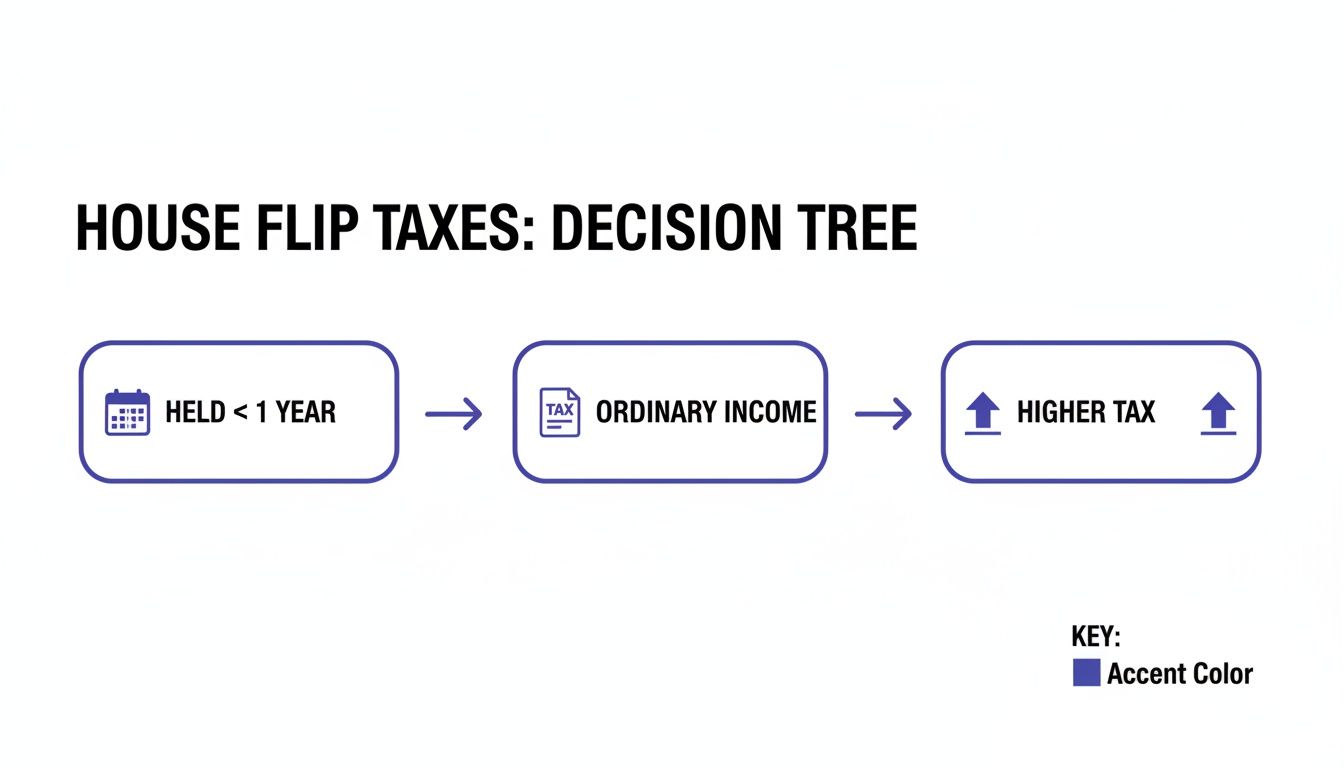
As you can see, holding a property for a short time—usually less than a year—channels your profit directly into the ordinary income bucket, which means a much bigger tax bite.
Why Dealer Status Means Higher Taxes
Being treated as a dealer completely changes the tax math. All those tax breaks that long-term real estate investors talk about? They’re generally off the table for you.
The most painful consequence of dealer status is that your net profit gets hit with both ordinary income tax and self-employment taxes. This one-two punch can easily push your combined tax rate to 40% or more, a nasty surprise for anyone expecting lower capital gains rates.
Let's unpack the two taxes you'll face as a dealer.
Ordinary Income Tax: Your net profit from a flip is simply added to your other income (like your day job salary) and taxed at your standard marginal rate. If you're already in the 24% or 32% federal tax bracket, your flip profit gets taxed at that same high rate.
Self-Employment Tax: This is how you pay into Social Security and Medicare when you work for yourself. For 2024, it's a hefty 15.3% on the first $168,600 of your net earnings (and 2.9% on earnings above that). As a dealer, you're considered self-employed, so you have to pay both the employee and employer portions of this tax.
The difference is night and day. An investor who sells a rental property after five years pays a long-term capital gains tax (often 15% or 20%) and zero self-employment tax. A dealer who sells a flip after five months pays their high ordinary income rate plus the full 15.3% self-employment tax.
The financial outcome is worlds apart. That’s why you have to plan for these taxes from the moment you even think about buying a property—it's the only way to protect your bottom line.
How to Calculate Profit and Maximize Deductions

The real magic in keeping more of your flip profit isn't just about selling for a high price—it’s about strategically minimizing what you owe the IRS. Your taxable profit is never as simple as the sale price minus what you paid for the house. It's a much more nuanced calculation that involves subtracting every single legally allowed expense you incurred along the way.
Mastering how to categorize and track these costs is what separates seasoned pros from amateurs. The IRS forces you to split your expenses into two main buckets: deductible operating expenses and capitalized improvements.
Getting this right isn't just good practice; it's essential for building an audit-proof tax return and confidently defending your numbers if Uncle Sam ever takes a closer look.
Understanding Your Property's Cost Basis
Before we get into the nitty-gritty of deductions, we need to talk about cost basis. Think of it as the official starting line for your investment in the eyes of the IRS. It's the number from which all profit or loss is ultimately calculated.
Your initial cost basis starts with the purchase price, but it doesn't end there. You also get to include many of the closing costs you paid to acquire the property in the first place.
Here are a few examples of buying costs that get added to your basis:
- Real estate transfer taxes
- Title insurance
- Legal and recording fees
- Land surveys
Your purchase price plus these acquisition costs create your adjusted cost basis. This is your true starting point, and every major improvement you make from here on out will increase it even more.
Capitalized Improvements Add to Your Basis
So, what are these "capitalized improvements"? These are the big-ticket items that significantly add value to the property, extend its useful life, or adapt it for a new purpose. The key thing to remember is that you don't write these off in the year you pay for them. Instead, you add their cost to your property's basis.
Think of it like restoring a classic car. A brand-new engine isn't just a repair; it becomes part of the car's total value. For a house, a full kitchen gut and remodel or a complete roof replacement adds to the property's fundamental worth.
Adding these costs to your basis is a huge deal because it directly reduces your taxable gain when you sell. A higher basis means a smaller "on-paper" profit, which translates directly to a lower tax bill.
Key Takeaway: Every dollar you correctly classify as a capital improvement is a dollar you won't pay taxes on later. That $25,000 kitchen remodel, when added to your basis, means you’ll pay tax on $25,000 less profit.
Deductible Expenses Lower Your Current Income
While major improvements get added to your basis, a whole other category of costs can be deducted right away. These are the day-to-day expenses of running your flip—the costs of simply holding and selling the property. If you're flipping as a business, these are deductible in the year you pay them.
These are your "soft costs" or "operating expenses." Picture them as the fuel your business burns while the project is underway. Just like a trucking company deducts fuel and insurance, a house flipper can deduct things like property taxes and utilities.
Common deductible expenses include:
- Holding Costs: Property taxes, mortgage interest, homeowners insurance, and utilities (water, gas, electric).
- Financing Costs: Loan origination fees and points paid on loans to finance the project.
- Marketing & Selling Costs: Real estate agent commissions, professional staging, advertising, and legal fees for the closing.
- Business Overheads: A portion of your home office, business-related travel, accounting fees, and professional licenses.
Keeping a meticulous paper trail for these expenses is non-negotiable. You can adapt tools like a well-organized rental income and expenses spreadsheet to track your flips and ensure no deduction gets left behind.
Common Flipper Expenses Deductible vs Capitalized
To make this distinction clearer, it helps to see the costs side-by-side. This table breaks down common expenses flippers encounter and shows how they are typically handled for tax purposes.
| Expense Category | Examples | Tax Treatment |
|---|---|---|
| Capital Improvements | New roof, kitchen remodel, adding a bathroom, new HVAC system, finishing a basement. | Capitalized: Added to the property's cost basis. |
| Repairs & Maintenance | Fixing a leaky faucet, patching drywall, painting a single room, replacing broken window panes. | Deductible: Treated as a current business expense. |
| Holding Costs | Property insurance, utilities, HOA fees, mortgage interest on the construction loan. | Deductible: Treated as a current business expense. |
| Selling Costs | Real estate commissions, closing costs paid by the seller, legal fees, advertising. | Reduces Sale Proceeds: Subtracted from the final sale price. |
By diligently tracking and correctly categorizing every dollar you spend, you’re not just doing bookkeeping—you're building a powerful tax strategy that lets you keep more of your hard-earned profit where it belongs: in your pocket.
Navigating Self-Employment and Estimated Taxes
When the IRS decides your flipping is a full-fledged business, it’s a game-changer for your taxes. You're not just paying income tax on your profits anymore; you're officially self-employed. This is where many new flippers get a nasty surprise: the self-employment tax.
Think of it this way. When you have a regular W-2 job, your employer pays half of your Social Security and Medicare taxes, and your half is automatically taken out of your paycheck. But as a flipper, you wear both hats—employer and employee. That means you're on the hook for the whole thing.
This tax is calculated on top of your regular income tax, and it's a hefty 15.3% of your net business profit. It breaks down into 12.4% for Social Security and 2.9% for Medicare. Trust me, it’s a number that can seriously eat into your profit margins if you haven't planned for it.
The Pay-As-You-Go System
Unlike a salaried employee who has taxes withheld every couple of weeks, a house flipper’s income often comes in large, unpredictable chunks. The U.S. tax system accounts for this with a "pay-as-you-go" requirement, handled through estimated tax payments. You can't just wait until April 15th to write one giant check for last year's taxes.
The IRS expects you to predict your total tax bill for the year—that’s both your income tax and your self-employment tax—and send it to them in four quarterly installments.
This isn't just a friendly suggestion. If you don't pay enough tax throughout the year, you'll get hit with underpayment penalties and interest charges. It's an expensive and completely avoidable mistake.
Making these payments keeps you on the right side of the IRS and turns your tax liability from a looming annual dread into a manageable, quarterly business expense.
Calculating Your Quarterly Payments
So, how do you figure out what to send in each quarter? The most direct way is to estimate your total net profit for the entire year across all your flips. From there, you can get a good idea of your total income and self-employment tax burden.
Here’s a simplified breakdown of the process:
- Estimate Your Net Profit: Project your total sales for the year and subtract all your anticipated expenses and capitalized costs.
- Calculate Self-Employment Tax: Take your estimated net profit and multiply it by 15.3%.
- Calculate Income Tax: Figure out which tax bracket your profit will fall into and multiply your net profit by that rate.
- Add Them Up: Combine the self-employment tax and income tax estimates to get your total projected tax for the year.
- Divide by Four: Split that total into four equal payments.
These payments are generally due on April 15, June 15, September 15, and January 15 of the following year. This rhythm helps smooth out your cash flow and ensures you’re putting money aside as you earn it.
The one-two punch of ordinary income tax plus self-employment tax is substantial. For example, recent data shows the typical gross profit on a flip has dropped to around $65,300. When that profit is taxed at ordinary income rates—up to 37% for high earners—it’s a far cry from the 15-20% long-term capital gains rate investors enjoy. As you can learn more about recent investor trends and profit margins, this reality makes smart tax planning non-negotiable.
To be safe, always work with a CPA to nail down your calculations and make sure you’re setting aside the right amount.
Advanced Strategies to Reduce Your Tax Burden
Once you've nailed the basics of tracking your deductions, it's time to level up. This is where you move from just managing expenses to proactively structuring your business to shield your hard-earned profits from an unnecessarily large tax bite. This is how successful flippers gain a serious financial edge.
These next-level tactics do require careful planning and a good CPA in your corner, but the payoff can be huge—both in protecting your personal assets and in significant tax savings. Let's dig into a few of the most effective strategies out there.
Choosing the Right Business Structure
Flipping houses as a sole proprietor is simple, sure, but it’s also risky. It leaves your personal assets completely exposed and offers almost no tax flexibility. For anyone serious about this business, forming a legal entity is a non-negotiable first step.
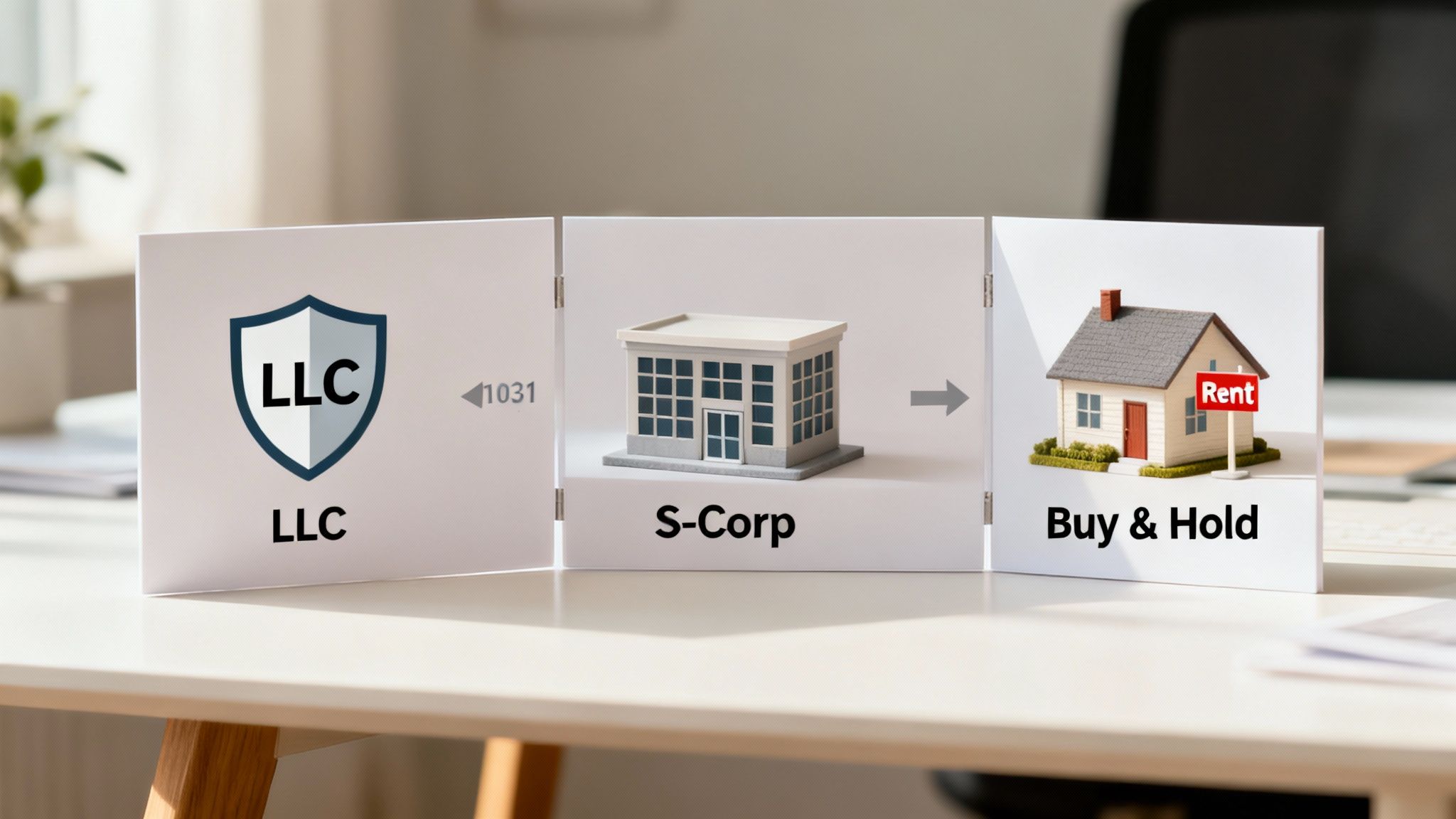
Limited Liability Company (LLC): This is the go-to starting point for most flippers. An LLC acts as a legal wall between your business and personal life, protecting your home, car, and savings from business debts or lawsuits. For tax purposes, a standard LLC is a "pass-through" entity. The profits just pass through to your personal tax return, where you'll still pay both regular income tax and self-employment tax on them.
S Corporation (S-Corp): Now we're talking real tax savings. You can either form an S-Corp from scratch or, more commonly, have your LLC elect to be taxed as one. The magic is in how you get paid. You have to pay yourself a "reasonable salary," which is subject to self-employment taxes. But—and this is the key—any profit beyond that salary can be taken as a distribution, which is not subject to the 15.3% self-employment tax.
That one move can literally save you thousands of dollars on every single flip. It adds a bit more administrative work, but for active flippers, the savings almost always make it worthwhile.
The Buy-and-Hold Pivot Strategy
What if you could turn that high-taxed ordinary income into much friendlier long-term capital gains? That's exactly what the buy-and-hold pivot is designed to do. Instead of selling a house the moment the renovation is done, you change the plan.
Here's how it works: you convert the finished property into a rental and hold it for more than one year. By renting it out, you're building a strong argument with the IRS that the property's purpose changed from being "inventory for sale" to a long-term investment.
The Potential Reward: When you finally sell that property after renting it for over a year, your profit could qualify for the much lower long-term capital gains tax rates (0%, 15%, or 20%). This is a game-changer compared to paying your top ordinary income tax rate. It requires patience and a different cash flow model, but the tax benefits can be massive.
The heavy tax burden on flippers isn’t just a U.S. issue. In England and Wales, for example, property flipping recently hit a 12-year low, partly because profits are taxed as ordinary income at rates up to 45%. It goes to show that strategies offering better tax treatment, like the buy-and-hold pivot, have universal appeal for investors.
When a 1031 Exchange Might Work
The 1031 exchange is an incredibly powerful tool for real estate investors, allowing them to defer capital gains taxes by rolling sale proceeds into a new "like-kind" property. The catch? It's almost impossible for a standard house flipper to use.
The IRS is very clear: property held "primarily for sale"—which is the exact definition of a flipper's inventory—doesn't qualify. Trying to use a 1031 on a quick, six-month flip is practically inviting an audit.
The only real scenario where it might fly is when you combine it with the buy-and-hold pivot strategy we just discussed. If you successfully establish that a property was held for investment (by renting it out for a year or two), you might then be able to use a 1031 exchange to roll the proceeds into your next rental property. This is advanced-level stuff that absolutely demands expert tax and legal advice. To manage cash flow during these longer hold times, you can also look into creative financing; you can learn more about seller notes in real estate in our other guide.
Common Questions from the Trenches
Even after you get the basics down, flipping houses brings up a ton of "what-if" scenarios. The tax rules can feel like a minefield, but knowing how to handle these common situations can save you a world of hurt.
Let's walk through some of the most frequent questions I hear from flippers, breaking them down with clear, practical answers.
Can I Still Be a "Dealer" If I Only Flip One House a Year?
You bet. It’s a common misconception that you need a high volume of deals to be considered a business by the IRS. While the number of flips you do is a factor, it's not the deciding one. The real litmus test is your intent.
If you bought a property with the sole, provable intention of fixing it up for a quick resale, that single deal can absolutely be classified as a business activity. The IRS will look at the whole picture to figure out your intent. They'll ask things like:
- Did you market the property like a professional?
- Were the renovations extensive and business-like, not just personal touch-ups?
- Did you get a business loan or commercial financing?
Think of it this way: if your actions from day one screamed "this is a business deal," then one well-executed flip can be enough to make you a dealer in the eyes of the IRS for that specific transaction.
Can I Use a 1031 Exchange on a Flip?
This is one of the most common questions, and the answer is almost always a hard no. A 1031 exchange is an incredibly powerful tool, but it's specifically for investment properties—assets you plan to hold for rental income or long-term growth. It's not for property you hold as inventory to sell.
Because the IRS usually sees a flipped house as the "inventory" of your business, it's disqualified. The very definition of a flip (buy to sell quickly) is the polar opposite of the "hold for investment" rule that a 1031 exchange requires.
There's a very narrow, high-risk exception. If you change your plan and convert the flip into a legitimate rental property for a significant amount of time (think a year or more), you might be able to argue a change of intent. This is advanced, gray-area territory, and you absolutely should not attempt it without guidance from a seasoned tax expert.
What if I Live in the House While I'm Renovating It?
Now we're talking. This strategy, often called a "live-in flip," can be a complete game-changer for your tax bill, all thanks to the Section 121 principal residence exclusion.
Here’s the deal: If you own and live in the property as your primary home for at least two out of the five years before you sell it, you can exclude a huge chunk of your profit from taxes.
How huge? We're talking up to $250,000 in profit if you're a single filer, and a massive $500,000 if you're married filing jointly.
This is hands-down one of the best tax breaks out there. Of course, it’s not a get-out-of-jail-free card. It requires a much longer time commitment than your average flip, and you'll need airtight records to prove you genuinely lived there for those two years.
Are State Taxes Different from Federal Taxes for Flips?
Yes, and ignoring them is a classic rookie mistake. Your federal tax bill is only half the story. On top of federal income and self-employment taxes, you'll almost certainly owe state income tax on your profit.
Every state plays by its own rules. High-tax states like California or New York can take a serious slice of your earnings. On the flip side, states like Florida or Texas have no state income tax, which can dramatically change your bottom line.
And it doesn't stop there. You might also get hit with local or state real estate transfer taxes, which can either increase your cost basis or directly reduce your net profit. You absolutely have to talk to a local tax pro who knows the specific laws in your state. A surprise state tax bill is the last thing you want after a successful project.
Ready to stop guessing and start making data-driven decisions on your next deal? Property Scout 360 eliminates the guesswork by providing instant financial analysis on any U.S. property. Calculate your potential ROI, cash flow, and break-even points in minutes, so you can move forward with confidence. Find your next profitable investment today.
About the Author
Related Articles
2026 Investor's Guide: Cost of Installing a Sewer Clean Out
Understand the cost of installing a sewer clean out for investment properties in 2026. Get expert advice on prices, ROI, & budgeting for flips. Plan smart!
15 Year vs 30 Year Mortgage: The Investor's Choice
Deciding between a 15 year vs 30 year mortgage for a rental property? Our guide analyzes cash flow, ROI, and equity to help you pick the best loan.
Real Estate Appraisal Software: Features & Limits
Discover what real estate appraisal software is, its core features, and limits. See how it differs from investment tools for profitable deals.
