What Is a Seller Note? A Quick Guide to Creative Real Estate Financing
Curious what is a seller note? Learn how this financing option works, plus its pros, cons, and negotiation tips.
Think of a seller note as a form of creative financing where the property owner essentially steps into the role of a private lender for the buyer. Instead of the buyer getting 100% of their financing from a bank, the seller agrees to carry a portion of the purchase price themselves, creating a direct loan agreement between the two parties. It's a fantastic tool for bridging the gap between a buyer's down payment, their primary bank loan, and the final sale price.
So, What Exactly Is a Seller Note?

Let's use a simple analogy. Imagine you're buying a car, but your bank will only approve a loan for 80% of the sticker price. If the dealership owner says, "No problem, just pay me that remaining 20% in monthly installments over the next few years," they've just offered you a seller note.
In a real estate deal, this agreement is formalized with a legal document called a promissory note. This document spells out all the loan terms—the interest rate, the payment schedule, and what happens if you default.
It’s important to understand that the seller note doesn't replace the primary mortgage from a bank; it works alongside it. The seller note almost always sits in a "second position," which is a fancy way of saying the bank gets paid back first if the buyer defaults on their loans. This structure is what makes deals happen that would otherwise fall apart due to a small financing shortfall.
Key Players in a Seller Note Deal
While we're focused on real estate, this strategy is common in all sorts of transactions. A seller note, often called seller financing, frequently fills that last, critical gap in the capital stack. For instance, a buyer might secure a bank loan for 70% of the purchase price and bring 20% in cash equity, leaving a 10% gap. That's where the seller steps in to carry the final 10%.
This flexibility is often the secret ingredient that gets a deal to the closing table when traditional lenders are being conservative. You can find more examples of how seller notes bridge financing gaps in business acquisitions on Hadley Capital's blog.
To really see the difference, it helps to compare a deal with a seller note to a standard, bank-financed transaction.
Seller Note Transaction vs Conventional Transaction at a Glance
This table breaks down how the roles and cash flow change when a seller note is introduced into a real estate deal.
| Component | Conventional Transaction | Seller Note Transaction |
|---|---|---|
| Primary Lender | A bank or mortgage company provides the main loan. | A bank or mortgage company provides the main loan. |
| Secondary Lender | Does not exist; buyer covers the gap with a down payment. | The property seller provides a second, smaller loan. |
| Seller's Payout | Receives 100% of the net proceeds in cash at closing. | Receives a large portion in cash at closing, plus ongoing monthly payments. |
| Buyer's Obligation | One monthly mortgage payment to the primary lender. | Two monthly payments: one to the bank and one to the seller. |
As you can see, the seller note fundamentally changes the dynamic. The seller gets most of their money upfront but also creates a new income stream for themselves, while the buyer is able to close a deal they might not have qualified for otherwise.
How a Seller Note Works Step by Step

So, how does this actually play out in a real deal? Let’s walk through a common scenario to see a seller note in action.
Imagine an investor named Alex wants to buy a multifamily property with a $1,000,000 price tag. He's got a decent down payment, but his lender caps his loan at $700,000, leaving a $300,000 gap. For many investors, this is where the deal dies. But Alex sees an opportunity and decides to pitch a seller note.
First, he and his agent structure an offer. The purchase agreement lays it all out clearly: Alex will bring $100,000 in cash to the table for a down payment, take on the $700,000 bank loan, and asks the seller to finance the remaining $200,000.
This isn't just a real estate trick; it's a standard tool for getting deals done across industries. In business acquisitions, seller notes are often the key to bridging the gap between what a buyer can pay and what a seller wants. An analysis of 100 M&A deals found that 62% of initial offers included a seller note, and those deals often closed for 10-20% more than all-cash offers. You can dig into the specifics of how seller notes are used in M&A deals on Axial's blog.
Negotiating the Terms
Let's say the seller owns the property free and clear. They're open to the idea, but now the real work begins: negotiating the terms of that $200,000 note. This conversation is all about finding a middle ground that works for both sides.
Here are the core points they'll need to hash out:
- Interest Rate: Alex suggests 6%. This is a great deal for the seller, who gets a much better return than they would from a savings account. For Alex, it's far cheaper than the hard money he might otherwise need.
- Repayment Term: They settle on a 10-year amortization. This keeps the monthly payments low and manageable for Alex, which is crucial for his cash flow.
- Balloon Payment: The seller doesn't want to wait the full 10 years to get their money back. So, they agree to a 5-year balloon payment. This means Alex has five years to make his regular payments before the entire remaining loan balance becomes due.
Finalizing the Legal Documents
With the terms agreed upon, it’s time to call in the attorneys to draft the official paperwork. This is a non-negotiable step. Skipping it is just asking for trouble down the road.
You'll end up with two critical documents: the Promissory Note, which spells out the loan amount, interest rate, and payment schedule, and a Deed of Trust (or Mortgage), which secures the loan against the property itself.
That Deed of Trust is the seller's protection. It gives them the legal right to foreclose if Alex stops paying. Critically, their loan is in a "junior" position, meaning the primary bank loan gets paid off first in a foreclosure.
At the closing table, the seller pockets the $800,000 from Alex's down payment and the bank loan. From that day forward, Alex has two monthly payments to make: one to the bank, and one directly to the seller.
Getting to Grips with Seller Note Terms
When you're structuring a seller note, you need to know the lingo. Think of it like this: you wouldn't play a card game without understanding what a flush or a straight is. Knowing these terms lets you negotiate effectively and, more importantly, protect yourself.
These aren't just fancy words on a legal document; they are the levers that control your cash flow, your level of risk, and the deal's overall success. Let's break down the core components you'll find in nearly every seller financing agreement.
The Financial Nuts and Bolts
First up are the numbers that define the loan itself. These three elements are intertwined, dictating what you'll pay each month and over the entire term of the note.
- Interest Rate: This is simply the cost of the loan—the percentage the seller charges for lending you the money. You’ll typically see rates between 6% and 10%. This usually lands in a sweet spot, a bit higher than a traditional bank mortgage but often cheaper than a hard money or private loan.
- Amortization Period: This is the full timeline over which the loan would be paid off if you made every single payment as scheduled. Spreading the payments out over 15 or 20 years means lower monthly payments, which is fantastic for your property's cash flow.
- Balloon Payment: This is the big one. It's a lump-sum payment of the remaining loan balance that comes due on a specific, much earlier date. For instance, a note could be amortized over 20 years, but require a balloon payment in 5 years. This structure gets the seller their cash back sooner while giving you, the buyer, time to add value and refinance into a traditional loan.
The Bottom Line: A longer amortization keeps your monthly payments down, but a balloon payment means you need an exit strategy. You have to be ready to pay off or refinance that note when the clock runs out.
The Legal Framework: Security and Priority
Beyond the payment schedule, you have to understand how the loan is legally secured and who gets paid first if the deal goes south. This is all about the legal plumbing of the deal.
- Promissory Note: This is the official IOU. It's the signed contract where you, the buyer, formally promise to repay the debt. It lays out the loan amount, interest rate, payment schedule—all the key terms we've discussed.
- Deed of Trust (or Mortgage): This is the document that actually secures the loan to the property itself. It’s what gives the seller the legal right to foreclose and take back the property if you stop making payments.
- Lien Position: This is crucial. It dictates the pecking order for who gets paid if the property has to be sold in a foreclosure. The primary lender (the bank) is always in first (or senior) position. A seller note almost always sits in the second (or subordinated) position. This means the seller only gets their money after the primary bank has been paid back in full.
This hierarchy is exactly why you have to be rock-solid on the property's value. If there isn't enough equity to cover both loans, the seller is taking a massive risk. Before you even think about negotiating, you need to know how to find free real estate comps to make sure the numbers work for everyone. Understanding lien position clarifies the risk for both you and the seller right from the start.
Weighing the Pros and Cons for Buyers and Sellers
A seller note can be an incredibly powerful tool, but it's definitely not the right move for every deal. Like any financial strategy, it has its own set of benefits and risks that look very different depending on which side of the table you're sitting on. Getting a handle on both perspectives is crucial before you decide to jump in.
For a buyer, the upsides are usually pretty clear and immediate. For a seller, the benefits can be more subtle, touching on everything from the final sale price to long-term income. Let's dig into what a seller note really means for both parties involved.
What's in It for the Buyer?
For an investor, a seller note can be the very thing that makes a deal possible. It directly tackles one of the biggest roadblocks in real estate investing: scraping together a massive pile of cash for the down payment and closing costs.
- Less Cash Out of Pocket: This is the big one. When the seller finances even a piece of the deal, it lowers the down payment you need to bring to the table, making the property much more attainable.
- Creative and Flexible Terms: You're not dealing with a traditional bank's rigid rulebook. A seller can be much more flexible on the interest rate, the payment schedule, and other terms, often tailoring them to what the property's cash flow can realistically support.
- A Quicker Path to Closing: Because you’re not waiting on a slow-moving bank to underwrite the entire loan, deals with seller financing can often get to the finish line much faster.
And Why Would a Seller Agree to This?
It’s easy to see the buyer’s motivation, but sellers who offer to carry a note can also come out way ahead. This isn’t just a last-ditch effort to make a sale happen; it’s a strategic move to maximize their return.
- Achieve a Higher Sale Price: It’s a simple trade-off. By offering the convenience and flexibility of financing, sellers can often ask for—and get—a higher price for their property.
- Create a Steady Income Stream: The note itself becomes a new asset, generating a reliable stream of monthly payments for the seller. The interest rate is often far better than what they could get from a CD or a high-yield savings account.
- Smart Tax Planning: This structure can be a game-changer for taxes. By receiving the sale proceeds over several years (an installment sale), the seller can defer capital gains taxes instead of taking a massive one-time hit.
Seller financing isn't just for real estate; it's a huge part of the business world, too. In the US, where 30% of employer firms have formal buy-sell agreements, seller notes are used to finance an estimated 40% of these buyouts when a partner exits. You can learn more about how seller notes facilitate business deals from the experts at Wall Street Prep.
The Other Side of the Coin: Potential Risks
Of course, this strategy isn't a silver bullet. The biggest risk, by far, rests with the seller. What happens if the buyer stops paying? If the buyer defaults, the seller is stuck with the expensive and lengthy process of foreclosure to get the property back.
For the buyer, the monster hiding in the closet is often the balloon payment. Those lower initial monthly payments feel great for your cash flow, but that massive lump-sum payment is always on the horizon. If you can't sell the property or refinance with a traditional lender before the due date, you could lose everything.
This is exactly why you have to know how to properly calculate cash flow on a rental property before you ever sign a note with a balloon payment. Having a rock-solid financial picture is your best defense against future trouble.
Pros and Cons of Seller Financing
To make sense of it all, it helps to see the trade-offs side-by-side. Here’s a quick breakdown of how seller financing impacts both the buyer and the seller.
| Perspective | Pros (Benefits) | Cons (Risks) |
|---|---|---|
| Buyer | Lower Upfront Cash: Less money needed for a down payment. | Balloon Payment Risk: A large lump-sum payment could be hard to make. |
| Flexible Terms: Can negotiate better rates and schedules than a bank. | Higher Interest Rate: The rate might be higher than a traditional mortgage. | |
| Faster Closing: Less reliance on slow bank underwriting speeds up the deal. | Due-on-Sale Clause: The seller's original loan might prevent this structure. | |
| Seller | Higher Sale Price: Can often command a premium for the property. | Buyer Default Risk: The risk that the buyer stops making payments. |
| Steady Income Stream: Creates a reliable source of monthly cash flow. | Foreclosure Hassle: Reclaiming the property is a long and expensive process. | |
| Tax Deferral: Spreads out capital gains taxes over several years. | Tied-Up Capital: Their equity remains in the property instead of being cash. |
Ultimately, a seller note is a negotiation. When both parties understand the other's goals and risks, they can structure a deal that genuinely works for everyone involved.
How to Negotiate a Seller Note Successfully
Alright, let's move from the "what" to the "how." Actually getting a seller to agree to carry a note is part art, part science. It’s not about just asking for a loan; it's about crafting a deal so compelling that the seller sees it as a smart, secure financial move for themselves.
Success really boils down to finding the right person, building genuine rapport, and framing your offer as a solution.
Finding and Approaching the Right Seller
First things first, you need to find a seller who can actually do this. Your best bet is almost always someone who owns their property free and clear. With no mortgage of their own, they don't have to worry about a "due-on-sale" clause, which gives them total freedom to act as the bank.
These are often sellers who are more interested in a hassle-free sale and a steady income stream than getting every last cent in cash on closing day. Think about properties that have been in the same hands for decades or are being sold as part of an estate—these are prime candidates.
When you reach out, your first job is to build a connection. Don't lead with the numbers. Instead, try to understand their story. Why are they selling? Are they looking to retire and want predictable income? Are they terrified of the massive tax hit they'll take on a cash sale?
A seller note isn't just a favor to you; it's a powerful financial tool for them. Frame it that way. You're offering them a potentially higher sale price, a consistent monthly check at a great interest rate, and a way to defer those hefty capital gains taxes. You're turning their dormant equity into a high-performing, income-producing asset.
Structuring a Compelling Offer
Once you've laid that groundwork and built some trust, it's time to talk specifics. A strong offer shows you're a serious, credible buyer, not someone just looking for a handout. It needs to be professional, clear, and anticipate the seller's biggest worries.
Here’s what a solid offer looks like:
- A Significant Down Payment: Come to the table with real cash. Offering 10-20% down proves you have skin in the game and immediately lowers the seller’s risk.
- A Fair Interest Rate: Don't lowball them. Propose an interest rate that’s genuinely attractive, usually somewhere between 6% and 10%. It’s a much better return than they’d get from a CD or a money market account.
- Clear Repayment Terms: Clearly lay out the loan term (amortization) and when the final balloon payment is due. Explain why this structure makes sense for both of you.
- Professional Documentation: Reassure them from the start that everything will be handled by experienced real estate attorneys. This isn't a handshake deal; it's a formal, legally protected transaction.
Taking this approach completely changes the dynamic. You're no longer a buyer who can't get a bank loan; you're a savvy investor presenting a sophisticated business proposal.
And that last point is non-negotiable: get lawyers involved. They’ll draft the promissory note and deed of trust correctly, making sure the deal is ironclad and everyone’s interests are protected. This is how you turn a great negotiation into a successful closing.
How a Seller Note Changes the Math on a Deal
So, how does a seller note actually pencil out? This is where the magic happens. Understanding the direct impact on your returns is what separates savvy investors from the rest. By lowering the amount of cash you have to bring to the table, a seller note can take what looks like a decent deal and make it an absolute home run.
Let’s run the numbers with a simple, real-world example. Say you've got your eye on a property listed at $500,000. After all expenses, it's projected to bring in $30,000 a year in net operating income (NOI).
Scenario 1: The Traditional Route
In a typical deal, you’d head to the bank and get a loan for 80% of the purchase price, which is $400,000. This means your down payment—the cash out of your pocket—is $100,000.
After you make your mortgage payments for the year, you’re left with $10,000 in cash flow. To figure out your Cash-on-Cash Return, you simply divide that cash flow by the cash you invested:
$10,000 / $100,000 = 10% Cash-on-Cash Return
A 10% return isn't bad at all. It's a solid, respectable number. But what if we could do better?
Scenario 2: Bringing in a Seller Note
Now, let's imagine you skillfully negotiated a $50,000 seller note as part of the deal. The bank still gives you the same $400,000 loan, but the seller is essentially covering half of your down payment. You only need to come up with $50,000 in cash.
Of course, that seller note comes with its own monthly payment. Let's say that payment reduces your annual cash flow to $7,000. At first glance, less cash flow might seem like a step back, but look at what it does to your return.
$7,000 (Annual Cash Flow) / $50,000 (Your Cash) = 14% Cash-on-Cash Return
Just like that, you’ve jumped from a 10% to a 14% return. By cutting your required cash in half, the seller note put your capital to work far more efficiently. This is the incredible power of creative financing in action.
Naturally, getting a seller to agree to this kind of structure requires more than just running the numbers—it starts with a smart negotiation strategy.
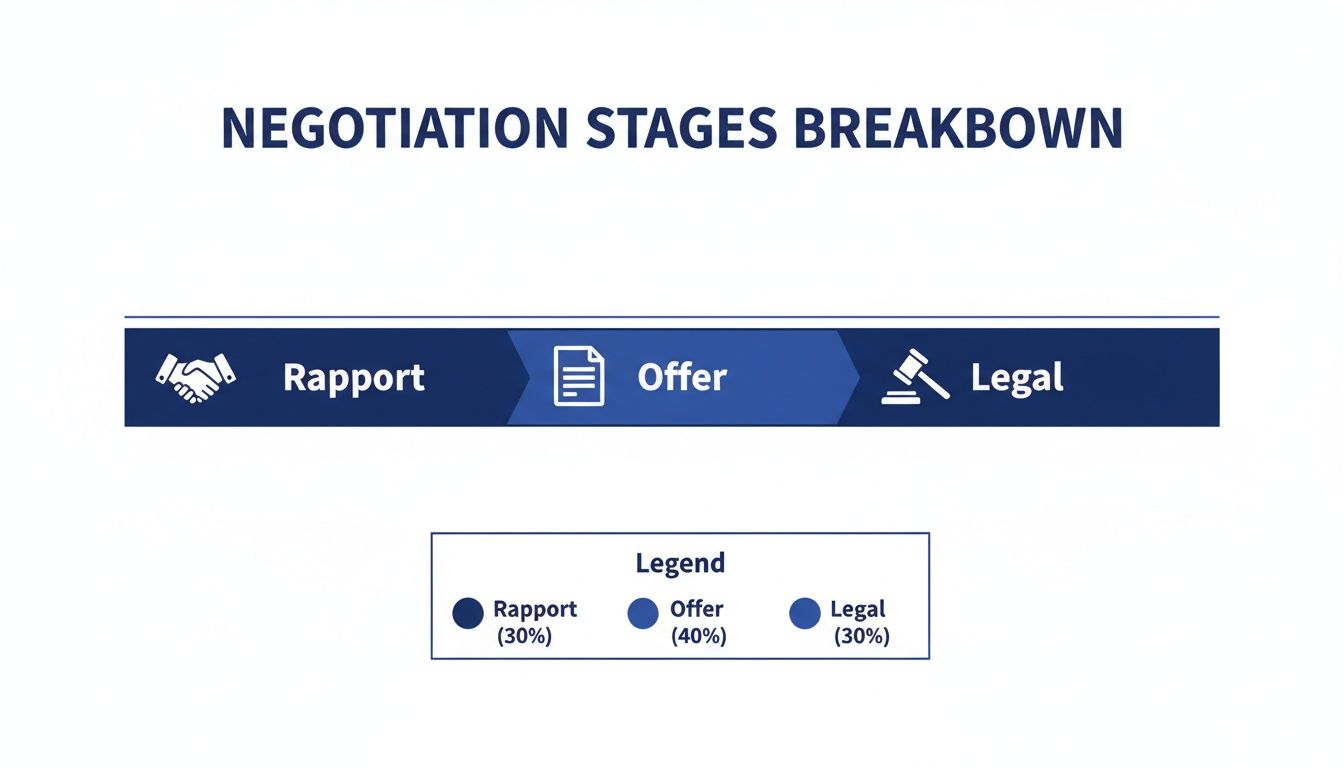
As you can see, the offer itself is just one piece of the puzzle. Building a strong rapport with the seller and buttoning up the legal details are just as important to getting a deal like this across the finish line.
Before you ever make an offer, it’s crucial to model these scenarios yourself. You can plug these exact figures into a good real estate investment calculator to see precisely how different financing terms will play out and affect your long-term wealth.
A Few Common Questions About Seller Notes
Even with a solid grasp of the basics, some practical questions always pop up when you're in the trenches. Let's clear up a couple of the most common points of confusion so you can see the full picture of how seller financing really works.
Is a Seller Note the Same as Rent-to-Own?
Not at all. This is a big one, and the two are worlds apart.
With a seller note, you, the buyer, actually take legal ownership of the property the day you close. You get the deed. A rent-to-own deal is just what it sounds like: a lease agreement that gives you the option to buy the property down the road. You’re a tenant, not an owner, until you officially exercise that option and close the purchase.
What Happens If a Buyer Defaults?
This is the question every seller asks, and for good reason. What happens if the buyer stops paying?
If the buyer defaults on the loan, the seller has the same legal recourse as a traditional bank. The specific steps depend on the loan documents and state laws, but it usually means the seller can initiate foreclosure proceedings to take back the property. This is, without a doubt, the primary risk a seller takes on when offering financing.
It's impossible to overstate how crucial it is to model these different scenarios. A tool like Property Scout 360 lets you plug in various financing structures, including a seller note, and see exactly how it affects your cash flow and returns. It helps ensure your decisions are grounded in solid numbers, not just guesswork. You can find your next deal at https://propertyscout360.com.
About the Author
Related Articles
2026 Investor's Guide: Cost of Installing a Sewer Clean Out
Understand the cost of installing a sewer clean out for investment properties in 2026. Get expert advice on prices, ROI, & budgeting for flips. Plan smart!
15 Year vs 30 Year Mortgage: The Investor's Choice
Deciding between a 15 year vs 30 year mortgage for a rental property? Our guide analyzes cash flow, ROI, and equity to help you pick the best loan.
Real Estate Appraisal Software: Features & Limits
Discover what real estate appraisal software is, its core features, and limits. See how it differs from investment tools for profitable deals.
