How to Estimate Renovation Costs for Real Estate Investing
Learn how to estimate renovation costs with our practical guide. We break down materials, labor, and hidden fees to protect your real estate investments.
Estimating what a renovation will actually cost is part art, part science. For an investor, it's the difference between a profitable deal and a money pit. The key is a solid process: defining exactly what you want to do, pricing out the materials and labor, and—this is crucial—building in a buffer for the inevitable surprises. A good rule of thumb is a 10-20% contingency fund. It’s saved my bacon more times than I can count.
Your Playbook for Accurate Renovation Cost Estimates
Let's be honest, estimating a rehab budget can feel like throwing darts in the dark. Get it right, and you unlock a fantastic ROI. Get it wrong, and a promising flip can quickly become a financial nightmare. This guide is your playbook, moving past the fluff and into the practical methods that seasoned pros use to nail their numbers and protect their capital.
We're going to turn your estimates from wishful thinking into a strategic advantage. This ensures every dollar you put into a property is working to build your wealth. It helps to start with the big picture. In 2024, Americans spent an eye-watering $603 billion on home remodeling. That's a massive market. By combining that kind of national data with local MLS comps, you can get a real feel for what makes sense in your area and avoid over-improving a property.
Start with a Clear Framework
Before you even touch a calculator, you need a plan. Forget scribbling numbers on a napkin; a repeatable process is your best defense against blown budgets. The first step is to create a crystal-clear vision for the project. What's the end goal? This means defining the scope, picking the right estimation method for the job, and thinking through every possible cost.
A structured approach forces you to account for everything, including:
- Hard Costs: The obvious stuff—lumber, paint, flooring, and the people you pay to install it.
- Soft Costs: The often-forgotten expenses like permits, architectural drawings, and city inspections.
- Contingency Funds: Your financial safety net. Trust me, you'll need it.
A well-planned estimate is more than just a budget; it's a risk management tool. It forces you to anticipate challenges, validate your assumptions with real-world data, and ensure your project remains profitable from start to finish.
Three Core Renovation Estimation Methods at a Glance
When it comes to the actual math, investors typically lean on one of three methods. Each has its place, and knowing which one to use for a given situation is a skill you'll develop with experience.
Here’s a quick rundown of the big three:
| Estimation Method | Best For | Pros | Cons |
|---|---|---|---|
| Per Square Foot | Quick, initial screening of properties; cosmetic rehabs. | Fast and simple for initial analysis. | Can be wildly inaccurate; doesn't account for specific finishes. |
| Unit Cost | Common, repeatable projects (e.g., apartments, kitchens). | More accurate than SqFt; good for scaling estimates across multiple units. | Requires a good database of costs (e.g., cost per kitchen, cost per bath). |
| Line-Item / Stick | Detailed, down-to-the-studs renovations; gut jobs. | The most precise method; creates a detailed scope of work for contractors. | Extremely time-consuming; requires deep construction knowledge. |
For a quick "go or no-go" decision, the per-square-foot method is fine. But once you're serious about a property, you need to get more granular with unit costs or a full line-item breakdown.
Tools and Methods for Precision
Once you have a framework, you can lean on some tools to help. For major projects like a kitchen overhaul, it's smart to start with a specialized resource. A dedicated kitchen renovation budget calculator can give you a much clearer picture of costs for one of the most important rooms in any house.
Ultimately, your goal is to plug these detailed rehab numbers into your overall deal analysis. This is where you see the real impact. Our guide on using a rental property analyzer spreadsheet shows you exactly how to model these costs to see how they affect your cash flow, ROI, and long-term returns. It’s the final step that connects your on-the-ground budgeting with your high-level investment goals.
Laying the Groundwork: Scope and Estimation Methods
Before you can even think about running numbers, you need a rock-solid plan. I've seen too many investors get burned because they skipped this step. Without a crystal-clear Scope of Work (SOW), any cost estimate you create is just a guess. This isn't a casual to-do list; it's your project's bible—a detailed, room-by-room breakdown of every single task.
Your SOW is the foundation of your entire budget. It needs to be so specific that any contractor can look at it and know exactly what you expect. Think of it as the blueprint for your rehab.
How to Build a Killer Scope of Work
The best way to start is by walking the property. If you can't be there in person, use detailed photos and videos. Go through each room and list everything that needs doing. Get granular.
"Update kitchen" is useless. "Replace 150 sq. ft. of vinyl flooring with LVP, install five recessed lights, and swap existing laminate countertops with quartz"—now that's a scope item.
A solid SOW must include:
- Demolition: What's coming out? Walls, cabinets, flooring, fixtures? List it all.
- Repairs: Be specific about fixing drywall, subfloors, or old plumbing lines.
- Installations: Write down all the new items—windows, doors, cabinets, appliances.
- Finishes: Detail the type and quality of paint, flooring, tile, and fixtures you've chosen.
The more detail you pack in, the more accurate your estimate will be. This document is what you'll hand to contractors, ensuring everyone is bidding on the exact same job.
This simple workflow shows how a clear scope is the first and most critical domino to fall, directly influencing which estimation method you should use.
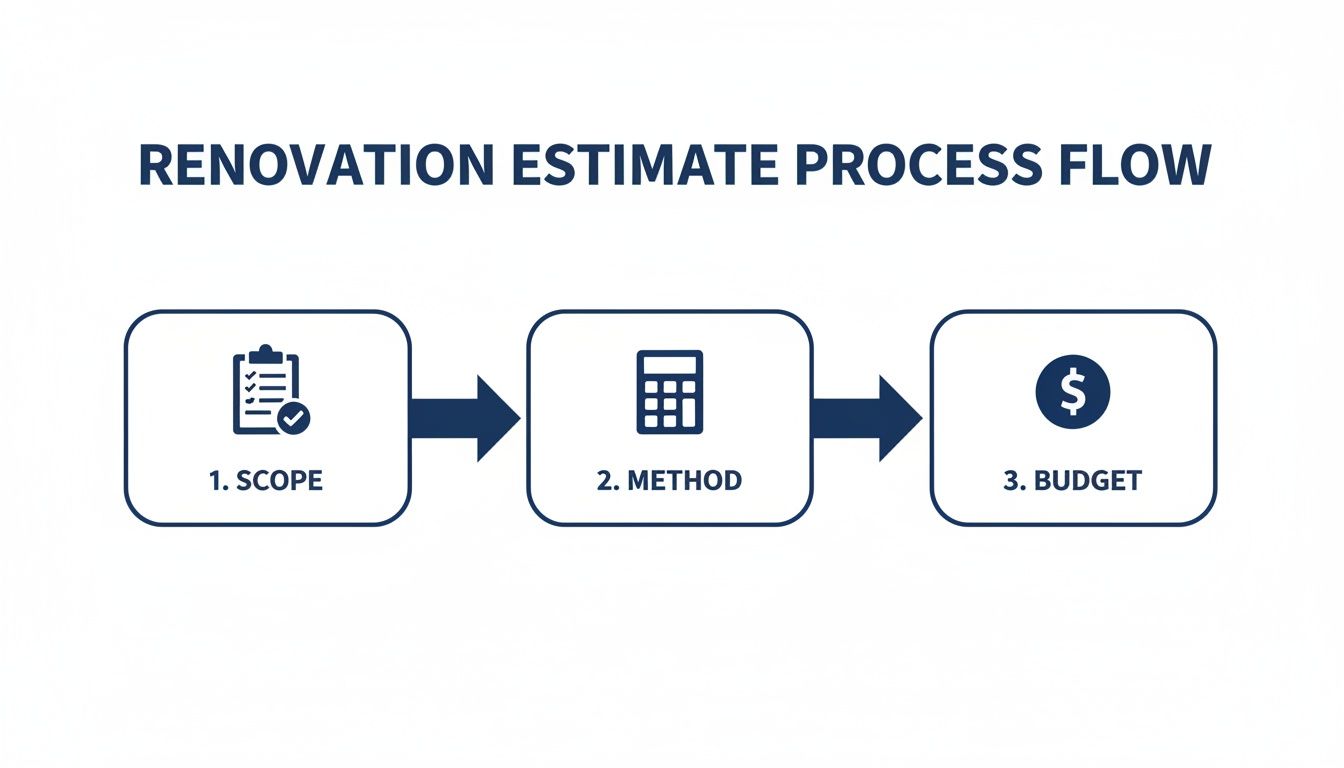
The key takeaway here is that your estimation method is entirely dependent on the detail you've already established in your project scope.
Picking the Right Estimation Method
With your SOW dialed in, it's time to choose how you'll crunch the numbers. There are a few ways to do this, and the right one really depends on how complex your project is and how precise you need to be.
The Quick and Dirty: Cost-Per-Square-Foot
This is my go-to for a quick, "back-of-the-napkin" estimate when I'm first analyzing a deal. If you know a cosmetic rehab in your area typically runs $50 per square foot, you can quickly ballpark a budget for a 1,500 sq. ft. house at $75,000.
It’s fantastic for initial screening but far too broad for a final budget. It doesn't account for different material qualities or major structural work. For a full gut job, those numbers can easily jump to $150-$250 per square foot.
The Experienced Investor's Shortcut: Unit Cost Method
This is a more refined approach where you assign a set price to entire components of the project. From experience, you might know a full bathroom gut and remodel in your market costs $8,000, and a kitchen refresh is $15,000.
This method works incredibly well for investors who do the same type of project over and over, like refreshing rental units. It's much more accurate than the square-foot method but still leans on averages.
The Gold Standard: Detailed Line-Item Estimate
For accuracy, nothing beats a line-item estimate. This is where you break down every single component of your SOW and price it individually. We're talking about the cost of every sheet of drywall, every gallon of paint, and every hour of labor.
For any complex gut renovation or high-end flip, a line-item estimate is non-negotiable. It minimizes surprises, gives your contractor a clear roadmap, and gives you ultimate control over your budget.
To really nail this, you need to quantify everything. Exploring a good construction takeoff software can be a game-changer. These tools help you pull exact material quantities from your plans, which forms the backbone of a precise budget. It's time-consuming, sure, but it's essential for protecting your profit margin on any significant project.
Nailing Down Your Material and Labor Costs

Alright, you've got your scope of work dialed in. Now comes the heavy lifting: figuring out the two biggest line items in any renovation budget—materials and labor.
This is where the rubber meets the road. Getting these numbers right is the single most important part of building an accurate budget. Even small miscalculations here can snowball, quickly eating into your potential profits.
Pricing Your Materials Like a Pro
First things first, create a detailed shopping list directly from your SOW. Don't just write "cabinets" and "countertops." You need to get granular. Think 25 linear feet of shaker-style cabinets and 45 square feet of quartz countertops. That’s the level of detail required for a real estimate.
With your list in hand, it’s time to start pricing. Never rely on just one source.
- Big-Box Stores: Places like Home Depot or Lowe’s are fantastic for getting baseline prices on standard items like drywall, lumber, paint, and basic fixtures. Their online tools can be a real time-saver.
- Local Suppliers: When it comes to things like flooring, tile, and cabinetry, your local suppliers can be a goldmine. They often have better quality options and might offer contractor pricing once you build a relationship.
- Specialty Shops: For high-end finishes, custom windows, or unique hardware, you'll likely need to get quotes from specialty vendors.
I recommend keeping a simple spreadsheet to track everything. List the item, the supplier, and the cost. This makes it easy to compare prices and decide where to splurge and where to save. For example, maybe you go with standard builder-grade interior doors but spend a little extra on high-end kitchen cabinet pulls to elevate the whole look.
Navigating the Tricky World of Labor Costs
Estimating labor is where many investors get tripped up. It’s much less straightforward than materials because rates can swing wildly based on your location, the contractor's skill level, and simple supply and demand. Knowing how to estimate renovation costs means knowing your local labor market.
Start by researching local rates. A quick look at platforms like Thumbtack or Angi can give you a ballpark, but a much better approach is to pick up the phone. Call a few local contractors and ask for their hourly or per-project rates for specific jobs. What's the going rate to install 1,000 square feet of LVP flooring? To paint a 1,500 square foot interior?
Today's market makes getting labor estimates right more critical than ever. Skilled labor shortages and high demand can blow up a budget if you're not prepared. That’s why you have to get solid quotes and build in a healthy contingency fund.
This isn't just a feeling; the data backs it up. A recent Verisk Remodel Index report pointed to a 4% price increase for over 10,000 construction items in Q1 2025, driven largely by wage hikes. With 57% of remodelers reporting larger project sizes, the competition for good tradespeople is fierce. As an investor, you have to account for these trends. You can discover more insights about these economic pressures on renovation costs from AP News to get a better handle on the market.
How to Get Apples-to-Apples Bids
Never, ever rely on a verbal estimate or just a single quote. This is where your detailed SOW becomes your most powerful tool.
Give the exact same document to at least three different qualified, insured contractors. This is crucial for getting bids you can actually compare.
When the quotes come back, check for a detailed breakdown. A single number for "kitchen remodel" is a major red flag. A professional bid should always separate costs for:
- Demolition & Debris Removal: The cost to tear out the old stuff and haul it away.
- Materials: A line-item list of the materials they're providing and what they cost.
- Labor: The hours and rates for each trade (framing, electrical, plumbing, finishing, etc.).
- Permit Fees: If they're pulling permits for you, it should be its own line item.
When you demand this level of detail, you can easily compare bids and spot discrepancies. Why is one plumber so much more expensive? Why is one contractor's drywall labor so low? This allows you to ask smart questions, negotiate from a place of knowledge, and ensure you’re getting a fair price without cutting corners on quality.
Don't Forget the "Soft Costs": Permits, Fees, and Your All-Important Contingency Fund

It’s a classic rookie mistake: building a renovation budget that only accounts for lumber, paint, and labor. But any seasoned investor will tell you that the real budget-killers hide in the "soft costs." These are the expenses that aren't physically nailed down but are absolutely critical to getting the project across the finish line legally and successfully.
Forgetting them is the fastest way to blow your budget before the drywall is even up. If you truly want to master how to estimate renovation costs, you have to account for these items from day one.
Factoring in Permits and Professional Fees
Just about any major renovation work—from moving a wall to updating the electrical panel—is going to require a building permit. The cost for these can be all over the map, depending on your local municipality and the project's complexity.
For instance, one city might charge a flat fee, while another might calculate it as $13.26 for every $1,000 of your project's estimated cost. You might also find separate permits are required for plumbing and electrical work, each with its own fee. Don't guess. The only real way to know is to get on the phone with your local building department. That one quick call can save you a world of financial pain and legal headaches down the road.
And permits are just the start. Your budget might also need to accommodate other professional services:
- Architects or Draftspeople: Essential if you’re altering the floor plan, adding on, or making any structural changes.
- Structural Engineers: You'll need one to sign off on removing load-bearing walls, addressing foundation problems, or adding a second story.
- Dumpster Rentals: A must for any real demolition. Costs can easily run from $300 to $800 a week, depending on the size you need.
The Contingency Fund: Your Project's Safety Net
This might be the single most important line item in your entire budget. Your contingency fund is your strategic reserve, the financial shock absorber for every "uh-oh" moment that inevitably comes with a renovation.
Think of it like project insurance. You really hope you never have to use it, but you’d be a fool not to have it. It’s the buffer that protects your deal when you discover hidden mold behind a wall, find out the HVAC system is shot, or pull up old carpet to find rotted subfloors.
The industry standard is to set aside 10% to 20% of your total estimated material and labor costs. Where you fall in that range depends entirely on the property and the scope of work.
- A 10% Contingency might be fine for a light cosmetic rehab on a newer house (say, built in the last 20 years) with a clean inspection report.
- A 15% Contingency is a much safer bet for most projects, especially full kitchen and bathroom remodels in homes with a bit of age on them.
- A 20%+ Contingency is non-negotiable for older homes (pre-1970s), properties with known structural red flags, or any full-scale gut renovation.
Let me be clear: this isn't a slush fund for upgrading to granite countertops on a whim. This money is exclusively for solving unforeseen problems. So, if your initial rehab budget for a 1960s ranch is $50,000, you should add a $10,000 (20%) contingency, bringing your total planned budget to $60,000. If you're flipping, our detailed house flipping checklist can help you spot potential issues early on that warrant a bigger safety net.
By building in these soft costs and a healthy contingency, you transform your estimate from a hopeful guess into a resilient financial plan that can handle the realities of the renovation world.
Validating Your Numbers and Modeling the Investment
An estimate, no matter how detailed, is still just a hypothesis. The real test comes when you take it to the market. This is where your diligent planning—your detailed scope of work, material lists, and labor research—truly pays off. It’s how you turn a well-researched guess into a bankable number.
The only way to do this right is to get at least three independent bids from qualified, vetted contractors. Don't just give them a rough idea; hand each one the exact same detailed Scope of Work (SOW). This process is non-negotiable. It’s the only way to confirm your cost assumptions, see how they stack up against real-world pricing, and immediately spot any major discrepancies between bids.
From Bids to a Confident Final Budget
When the bids roll in, resist the urge to just look at the bottom-line number. A low bid isn't always the best bid. A professional contractor should give you a clear breakdown of costs, separating materials, labor for each trade, and any included fees.
If one bid is way out of line—either significantly lower or higher than the others—it’s a red flag that warrants a follow-up call. Maybe the low-ball contractor missed a key item in your scope, or the high-end one is using premium materials you didn't ask for. Clarifying these points is essential. Once you've compared the bids and vetted your chosen contractor, you'll have a final, confident renovation budget that’s ready for the next step.
Modeling Your Deal with Property Scout 360
With a solid final budget in hand, it’s time to connect your renovation costs directly to your investment goals. This is where you shift from project management to portfolio strategy. An advanced tool like Property Scout 360 is built for exactly this, letting you model the entire deal from acquisition to long-term returns.
Plugging your final renovation number into the platform instantly shows you the full financial picture. You’ll see exactly how the rehab budget impacts critical metrics:
- Total Cash-to-Close: How much money you truly need to bring to the table.
- Financing Scenarios: How the rehab cost affects your loan amount and monthly payments.
- Key Performance Indicators (KPIs): The numbers that define a good deal, like cash-on-cash return and cap rate.
This final analysis is what separates amateur speculators from professional investors. By modeling the deal, you transform the renovation from a standalone expense into a predictable driver of profit, ensuring the project aligns perfectly with your financial targets before you spend a single dollar.
Connecting Costs to Long-Term ROI
A powerful investment analysis tool doesn’t just show you immediate returns; it projects long-term profitability. By inputting your purchase price, financing details, and your validated renovation budget, Property Scout 360 can calculate your 30-year ROI. This gives you a clear vision of how this single project contributes to your long-term wealth-building strategy.
This is also where you can factor in the strategic value of your improvements. Some renovations, for instance, offer a much better return than others. One key to nailing renovation cost estimates is mastering cost recovery rates, as outlined in NARI's 2025 Remodeling Impact Report. Garage door replacements top the list at 100%+ recovery, followed by steel front doors at 83% and minor kitchen upgrades at 56%. Prioritizing these high-recovery items is crucial for break-even analysis in tools that instantly project cap rates and long-term ROI. You can read the full research about remodeling cost recovery on NARI.org to help guide your decisions.
Ultimately, this modeling step is your final gut check. If the numbers don't work—if the cash-on-cash return is too low or the deal requires too much capital upfront—you can walk away with confidence, knowing you avoided a bad investment. For those doing a fix-and-flip, you can check out our guide on using a fix-and-flip calculator to see how these principles apply to shorter-term projects. This data-driven approach removes the emotion and guesswork, allowing you to make smart, profitable decisions every time.
Answering the Tough Questions on Renovation Costs
Even with a solid plan, estimating renovation costs can feel like guesswork. I've seen both new and seasoned investors get stuck on the same questions time and again. Let's cut through the noise and tackle these common hurdles head-on.
Getting straight answers is the only way to build a budget you can actually trust. This isn't theory; it’s practical advice from the field to help you protect your capital and avoid the pitfalls that turn a great deal sour.
What’s a Good Rule of Thumb for Renovation Costs on a Flip?
While every project has its own quirks, there are a couple of back-of-the-napkin rules that seasoned flippers use to quickly vet a deal.
The most famous one is the “70% Rule.” It’s less of a cost estimator and more of a buying formula, but it’s invaluable for maintaining discipline. The rule says you should never pay more than 70% of a property's After Repair Value (ARV), minus the rehab costs.
Let's walk through an example. Say a house has an ARV of $400,000 and you figure it needs $50,000 in work.
- First, find 70% of the ARV: $400,000 x 0.70 = $280,000
- Next, subtract your estimated repairs: $280,000 - $50,000 = $230,000
Your Maximum Allowable Offer (MAO) is $230,000. This formula is designed to build in a 30% cushion for your profit, closing costs, and carrying costs. It's a gut check that forces you to buy right from the start.
Of course, that's just a starting point. For a more direct cost estimate, some investors use a percentage of the purchase price. A light cosmetic rehab might be 10-15% of what you paid, whereas a full gut job could easily hit 20-40% or more. Just remember to always follow up these quick checks with a detailed, line-item budget specific to your market.
How Much Should I Budget for a Contingency Fund?
A contingency fund is non-negotiable. It’s the financial buffer that separates the pros from the amateurs. The industry standard is to set aside an extra 10% to 20% of your total estimated rehab cost just for surprises.
Think of your contingency fund as your project's insurance policy. It’s not for upgrading the countertops or adding crown molding. It's for the nasty surprises—the hidden mold behind the drywall, the rotted subfloor under the toilet, or the ancient electrical panel that has to be replaced—that would otherwise blow up your entire budget.
How do you know whether to use 10% or 20%? It all comes down to risk.
- 10% Contingency: This is for the straightforward cosmetic jobs on newer homes (think built in the last 20 years) where you have no reason to expect major issues.
- 15% Contingency: A much safer bet for most projects, especially if you're gutting kitchens and baths in a middle-aged home.
- 20% Contingency: This is a must-have for old houses (pre-1970s), properties with known structural red flags, or any complex renovation where you’re almost guaranteed to find something unexpected.
So, if your rehab budget is $60,000 for an older home, you need to add a $12,000 contingency right on top, bringing your real-world budget to $72,000. It's the discipline that lets you handle problems without cutting corners later on.
How Can I Reduce Renovation Costs Without Sacrificing Quality?
Everyone wants to save money, but you have to be smart about it. Slashing costs randomly just leads to shoddy work that tanks your property's value. The real art is finding savings without compromising the final product.
First, put your money where it counts. Focus your budget on high-ROI improvements. As we covered earlier, NARI's Remodeling Impact Report consistently shows that things like a new garage door, an updated front door, and minor kitchen refreshes give you the most bang for your buck at resale.
Next, figure out where you can put in some "sweat equity." If you've got the time and the skills, you can save a ton on labor costs. Demolition, painting, landscaping, and final clean-up are perfect jobs for a DIY investor. Just be honest with yourself and leave the tricky electrical, plumbing, and structural work to the licensed pros.
Finally, get strategic with how you buy materials.
- Shop around. Don't just go to the first big-box store. Get quotes from local suppliers, lumber yards, and online retailers.
- Hunt for deals. I’ve found incredible value in clearance sections, scratch-and-dent appliances, and remnant stone slabs for smaller countertops.
- Buy in bulk. If you're doing multiple units or have another project lined up, buying materials like flooring or paint in larger quantities can unlock some serious discounts.
By combining these strategies—focusing on what matters, doing some work yourself, and sourcing materials wisely—you can trim your costs significantly. It's about being frugal, not cheap. You’ll keep more money in your pocket while delivering a fantastic product that attracts the best buyers or tenants.
Stop guessing and start analyzing. With Property Scout 360, you can model your validated renovation costs to see the immediate impact on your cash-on-cash return, cap rate, and 30-year ROI. Make confident, data-driven investment decisions by visiting https://propertyscout360.com and start your free trial today.
About the Author
Related Articles
2026 Investor's Guide: Cost of Installing a Sewer Clean Out
Understand the cost of installing a sewer clean out for investment properties in 2026. Get expert advice on prices, ROI, & budgeting for flips. Plan smart!
15 Year vs 30 Year Mortgage: The Investor's Choice
Deciding between a 15 year vs 30 year mortgage for a rental property? Our guide analyzes cash flow, ROI, and equity to help you pick the best loan.
Real Estate Appraisal Software: Features & Limits
Discover what real estate appraisal software is, its core features, and limits. See how it differs from investment tools for profitable deals.
