Unlocking Property Value With Pro-Forma Cap Rate Analysis
Master the pro-forma cap rate to uncover the true potential of real estate investments. Learn to calculate, analyze, and apply this essential metric.
Imagine you're looking at two apartment buildings. On paper, they seem almost identical—same size, same neighborhood, same purchase price. But one of them is a potential goldmine, and the other is just... average. The key to spotting the difference? It's the pro-forma cap rate.
This isn't just another piece of jargon. It's the tool that helps you see a property’s future potential, not just its current performance. It’s how savvy investors find hidden value that others completely overlook.
Why Pro-Forma Cap Rate Matters
A standard cap rate gives you a snapshot of how a property is doing right now. It’s based on current income and expenses. Think of it as looking at a car's current MPG and service history. Useful, for sure.
But a pro-forma cap rate is like looking at the car's potential after a professional tune-up, new tires, and a high-performance engine upgrade. It’s a forward-looking metric, and it’s absolutely essential for anyone hunting for value-add deals.
Before we get into the "what-if" scenarios, it’s a good idea to have a solid handle on what a cap rate is at its core. A traditional cap rate is straightforward: you divide the current Net Operating Income (NOI) by the property's price. This works great for stable, turnkey properties but tells you very little about an asset that’s underperforming.
Seeing a Property's Future Value
This is where the pro-forma cap rate really shines. It projects a property’s performance after you’ve made specific improvements. Maybe you're planning to renovate units to get higher rents, bring in professional management to cut wasteful spending, or lease up a few vacant apartments.
The pro-forma helps answer the most important question for any value-add investor: "What will this property be worth once my business plan is complete?"
This forward-looking calculation is a game-changer for:
- Value-Add Investors: It's how you spot underperforming assets where smart improvements can create a serious boost in cash flow and equity.
- BRRRR Method: You can't accurately forecast the After Repair Value (ARV) and stabilized income without it.
- Flippers and Developers: It helps project the profitability of a project after all the work is done.
The formula itself adjusts for this future vision. Instead of just looking at the purchase price, it accounts for your total investment. The formula is: Projected Net Operating Income (NOI) / (Purchase Price + Renovation Costs).
By looking past the "as-is" numbers, you start to uncover deals with real, achievable upside. To dive deeper into the basics of this metric, check out our complete guide on the essentials of rental property cap rate.
How to Calculate the Pro-Forma Cap Rate Step by Step
Figuring out the pro-forma cap rate is where you shift from looking at a property's past to mapping out its future. The formula itself is simple, but its real power comes from the thoughtful assumptions you bake into it.
At its core, the formula is: Pro-Forma NOI / Total Project Cost.
Let's unpack what each of those pieces really means when you're kicking the tires on a potential deal.
Step 1: Determine the Pro-Forma Net Operating Income
First things first, you need to project the Pro-Forma Net Operating Income (NOI). This isn't the NOI the property is generating today. It's the stabilized annual income you genuinely expect to see once your renovations are done, new tenants are in place, and the property is humming along efficiently.
To get to that number, you'll need to forecast two key things:
- Potential Gross Income: This is your "top line" revenue projection. It should include anticipated rent bumps based on market comps for similar updated units. Don't forget to add in any new income streams you plan to introduce, like coin-laundry, paid parking, or billing back utilities.
- Stabilized Operating Expenses: You also need to estimate what your costs will look like after the upgrades. This means getting quotes for new insurance policies, figuring out updated property taxes, factoring in professional management fees, and setting aside realistic reserves for future repairs.
Step 2: Calculate the Total Project Cost
Next up is nailing down the Total Project Cost. This goes way beyond the property's asking price—a mistake I see a lot of new investors make. You have to account for every dollar needed to bring your vision to life.
Your total project cost must include:
- Purchase Price: The number on the contract. Simple enough.
- Closing Costs: All those extra fees that pop up at closing—title insurance, attorney fees, loan origination, and appraisal costs. These typically run between 2-5% of the purchase price.
- Full Renovation Budget: This needs to be a detailed, line-item budget for every single planned improvement. We're talking everything from new countertops and LVP flooring to big-ticket items like a new roof or HVAC systems.
The whole point here is to capture every single dollar you’ll invest to get the property from its "as-is" condition to its future, stabilized state. This complete financial picture is what gives the pro-forma cap rate its teeth as an underwriting tool.
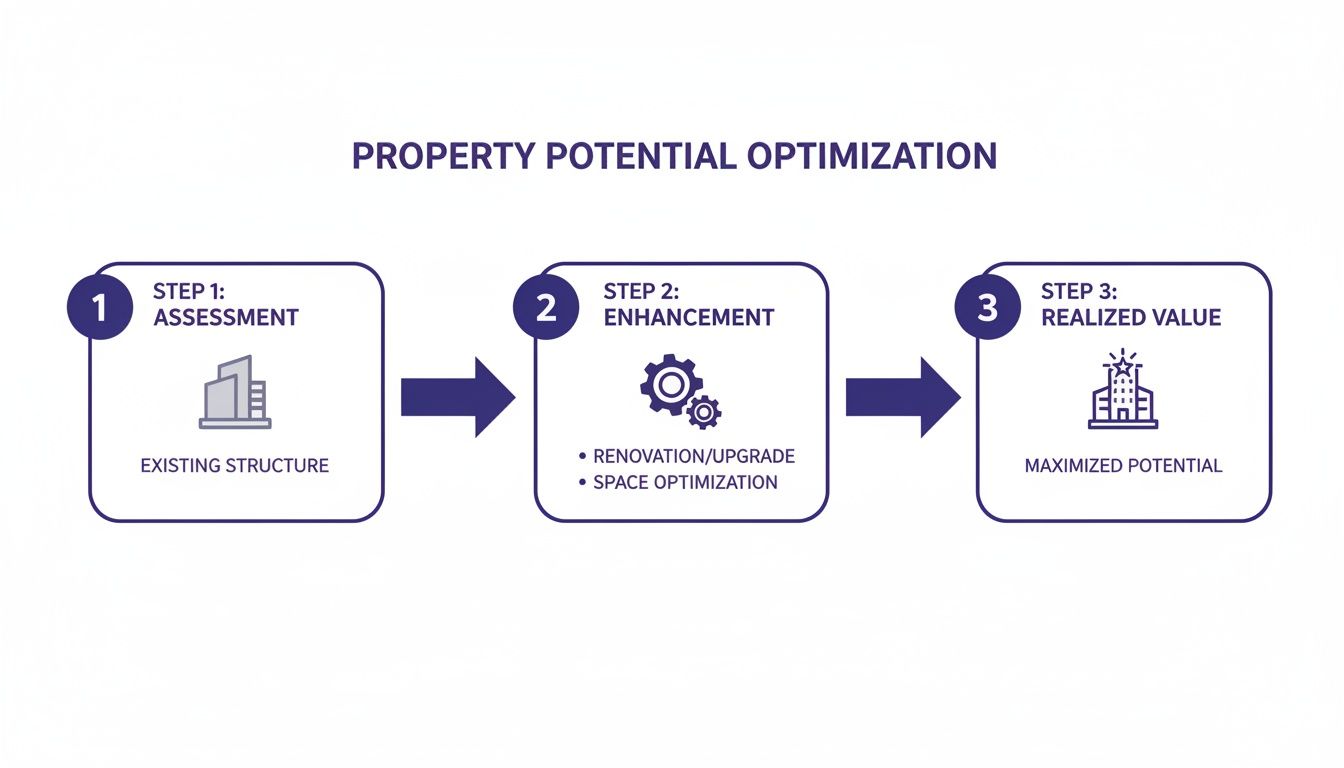
This journey—from an underperforming asset to a stabilized, cash-flowing one—is exactly what a pro-forma analysis is designed to evaluate. You're calculating the return based on the "after" state and your total, all-in investment.
Putting It All Together: A Practical Example
Let's walk through a quick scenario.
Imagine you're eyeing a multifamily building with a $5,000,000 price tag. Your due diligence shows it needs about $1,000,000 in renovations to get the rents up to market rates. Once the dust settles, you project a stabilized NOI of $550,000 per year.
Your total project cost is $6,000,000 (the $5M purchase plus the $1M reno budget).
Here’s the calculation: $550,000 (Pro-Forma NOI) / $6,000,000 (Total Project Cost) = 9.17%.
That 9.17% pro-forma cap rate tells a much more useful story about the deal's potential than a cap rate based on the property's current, tired performance.
For a refresher on the basics, check out our guide on how to calculate cap rate for any rental property.
The Art of Making Realistic Pro-Forma Assumptions
A pro-forma cap rate is a powerful tool, but its accuracy hinges entirely on the quality of your assumptions. This is where the real work—and the real risk—lies. An overly optimistic projection can make a bad deal look like a home run, while being too conservative might cause you to pass on a genuine winner.
The whole game is about grounding your forecast in reality, not wishful thinking.
This process starts with projecting your future rental income. Don't just pull numbers out of thin air or, even worse, rely on the seller's rosy projections. Smart investors dig into the market data to find truly comparable properties. I’m not talking about the run-down building next door; I mean finding comps that have already been renovated to the standard you’re planning. These are your proof points. Following some solid comparative market analysis (CMA) tips is essential here, as it shows you exactly what tenants are actually willing to pay for an updated unit in that specific neighborhood.
Forecasting Expenses With Precision
Just as important is getting your stabilized operating expenses right. So many investors—even experienced ones—make the critical mistake of underestimating costs, which can completely torpedo a project's profitability. A disciplined underwriting process means you need to verify every single major expense line item.
Here are the big ones to really scrutinize:
- Property Taxes: Never, ever rely on the current tax bill. A sale almost always triggers a reassessment. Your first call should be to the local assessor's office to find out how your purchase price will impact future taxes.
- Insurance: Don't guess. Get actual quotes from an insurance broker based on the property's condition and your specific business plan.
- Vacancy Loss: A common rule of thumb is 5-8%, but that can be wildly off depending on your market. Check the local submarket vacancy rates to set a realistic buffer for tenant turnover.
- Property Management: If you’re not managing it yourself, you have to factor in the fee. This typically runs 8-10% of your effective gross income, and it's a real cost that eats into your bottom line.
A pro-forma isn't just a best-case scenario; it's a financial model that must be tested against reality. The most successful investors are often the most conservative estimators, building in contingencies for unexpected costs and market shifts.
Stress-Testing Your Pro-Forma Analysis
Once you've built your initial projection, the real work begins. Stress-testing your numbers is what separates amateur analysis from professional underwriting. It’s all about asking the tough "what if" questions to see how resilient your deal really is.
For example, what happens to your returns if the renovation goes 15% over budget? How does your cash flow hold up if vacancy spikes to 10% for six months straight?
Running these different scenarios helps you identify the break-even points for your investment and truly understand its risk profile. By pushing your assumptions to their reasonable limits, you build a pro-forma cap rate that not only projects potential but also prepares you for the inevitable challenges. This is how you become a more disciplined and successful investor.
Spotting Red Flags in Seller Pro-Forma Statements
When a broker hands you a glossy marketing package, remember what the seller’s pro-forma statement really is: a story. It’s a carefully crafted narrative designed to showcase the property's absolute best-case scenario, painting a picture of what it could become. Your job, as a sharp investor, is to play detective and figure out where that story crosses the line from a realistic future into an overly optimistic fantasy.
Sellers use pro-forma projections to justify their asking price, and it’s a powerful tool. For instance, a property bringing in $1,000 per month in Net Operating Income (NOI) in a 7% cap rate market is realistically worth about $171,429. But if the seller projects a future NOI of $1,200 per month, they can slap a $205,714 price tag on it. That’s a 20% premium built entirely on assumptions that haven't happened yet.
This is exactly why you need to approach every seller’s pro-forma with a healthy dose of skepticism.

Common Pro-Forma Inflation Tactics
Some line items are just magnets for "creative" accounting. When you start your due diligence, zero in on these common problem areas, as they can completely warp the real pro-forma cap rate.
Keep an eye out for these classic moves:
- Aggressive Rent Growth: The seller pencils in future rents that are way above what similar renovated units in the area are actually getting, often without any real data to back it up.
- Understated Expenses: You might see suspiciously low numbers for property management, maintenance, or utilities. A frequent offender is using the current owner's low property tax bill, which is almost guaranteed to be reassessed and jump up after you buy the place.
- Ignoring Capital Expenditures (CapEx): The numbers conveniently forget to account for big-ticket items looming on the horizon. A new roof, aging HVAC units, or a crumbling parking lot are often left out, making the cash flow look much rosier than reality.
The seller's pro-forma is a sales document, not an audit. Your own independent underwriting is the only analysis that truly matters when making an investment decision.
Let's look at how a seller's vision can clash with an investor's reality.
Seller Pro-Forma vs. Reality-Based Underwriting
The table below shows a side-by-side comparison of how a seller might present a property versus how a prudent investor should analyze it. Notice how small, optimistic assumptions can snowball into a significant valuation difference.
| Line Item | Seller's Pro-Forma | Investor's Underwriting | Impact |
|---|---|---|---|
| Gross Potential Rent | $120,000 | $115,000 | Seller assumes aggressive rent bumps. Investor uses current market comps. |
| Vacancy Loss | 3% ($3,600) | 7% ($8,050) | Seller uses an unusually low vacancy rate. Investor uses a more realistic market average. |
| Property Taxes | $8,000 | $12,000 | Seller uses pre-sale tax basis. Investor projects post-sale reassessment. |
| Maintenance | $5,000 | $8,000 | Seller minimizes routine costs. Investor budgets for actual wear and tear. |
| CapEx Reserve | $0 | $5,750 (5% of EGI) | Seller omits reserves entirely. Investor sets aside funds for future big-ticket items. |
| Pro-Forma NOI | $85,400 | $66,200 | The investor's projected NOI is 22.5% lower than the seller's. |
| Value @ 6% Cap Rate | $1,423,333 | $1,103,333 | A $320,000 difference in valuation based on realistic underwriting. |
As you can see, the seller’s story and the investor’s analysis lead to two very different conclusions. Your job is to focus on the latter.
How to Verify a Seller's Claims
The old saying "trust, but verify" is the golden rule of real estate underwriting. Don't just tweak the seller's numbers; you need to build your own pro-forma from scratch using conservative assumptions you can prove.
First, verify every income assumption yourself. Pull your own rental comps from the local market—don't just accept the ones in the marketing flyer. Then, get actual quotes for insurance and bids from contractors for any planned repairs.
Finally, stress-test their expense ratios. If the seller claims expenses run at 35% of income, but you know similar buildings in the area typically operate closer to 45%, that’s a massive red flag demanding a deeper dive.
This independent verification isn't just a box to check; it’s the bedrock of a sound investment. To make sure you cover all your bases, our comprehensive real estate due diligence checklist is a great resource to guide your process.
Using Pro-Forma Cap Rates to Find Better Investments
Alright, so you know how to calculate it. But the real magic of the pro-forma cap rate isn't in the math—it's in using it as a compass to guide your investment decisions. This is the metric that lets you finally compare completely different opportunities on a level playing field.
Think of it this way: you’re looking at two deals. Deal A is a beautiful, fully renovated building, 100% occupied, and chugging along at a solid 5% trailing cap rate. It's safe, but maybe a little boring.
Then there's Deal B. It’s a tired, mismanaged property limping by with a sad 3% trailing cap rate. But you’ve run the numbers, and you see a clear path to an 8% pro-forma cap rate after you work your magic.
The pro-forma cap rate is what puts a number on that hidden potential. It helps you weigh the low-risk, immediate cash flow of Deal A against the higher return—and higher effort—of Deal B. Suddenly, your decision isn't just a gut feeling; it’s a strategic choice backed by data.
Interpreting Cap Rates Across Markets
Now, here’s where experience comes in. A "good" pro-forma cap rate isn't a universal number; it changes dramatically depending on where you're investing and what you're buying.
A projected 7% pro-forma cap rate might be a grand slam in a hot primary market like Austin. But in a smaller town, where investors expect a bigger reward for taking on more risk, that same 7% might just be average. You have to know your sandbox.
A pro-forma cap rate isn't just a number; it's a story about risk and reward. Higher projected cap rates can signal an amazing value-add opportunity, but they can also be a red flag for a riskier market that demands you dig a lot deeper.
Benchmarks for Different Property Types
Just like markets, different types of properties come with their own risk profiles, and their pro-forma cap rates will reflect that. In the multifamily world, for example, the potential returns are all over the map depending on how much work a property needs. You can find some great real estate analysis breakdowns that show how a building's condition directly shapes its potential return.
To give you a rough idea, here are some general ranges you might see out in the wild:
- Multifamily: For properties needing a serious facelift, investors are often targeting a pro-forma cap rate somewhere between 5% to 9%.
- Single-Family Rentals: A portfolio needing just a light refresh might pencil out to 6-7%. The heavy-duty fix-and-flips? Those could show pro-forma returns of 8-12% or more.
Knowing these benchmarks helps you sanity-check a deal. When you see a pro-forma, you can instantly gauge if the numbers feel realistic for that type of property, giving you the confidence to spot the real opportunities.
Frequently Asked Questions About Pro-Forma Cap Rates
Even investors who’ve been around the block can get tripped up by pro-forma analysis. It’s a powerful, forward-looking tool, but the details matter. Let's tackle some of the most common questions to clear up any confusion about how and when to use the pro-forma cap rate.
What Is a Good Pro-Forma Cap Rate?
That's the million-dollar question, isn't it? The most honest answer is: it completely depends on the context.
A "good" pro-forma cap rate in a super competitive market like San Francisco might be 6%. But if you saw that same number in a smaller, secondary market, you'd probably pass—investors there expect higher returns to compensate for the higher risk.
Instead of hunting for a specific number, ask yourself a better question: "Does this pro-forma cap rate give me enough of a premium over current market cap rates to justify the risk, time, and money I'm about to sink into this project?" The difference between the market cap and your pro-forma cap is often called the "spread," and the bigger it is, the more you're getting paid for your effort.
How Is It Different From a Stabilized Cap Rate?
This is a subtle but crucial difference. Both metrics look to the future, but they capture two very different moments in a property's journey.
- Pro-Forma Cap Rate: This is what you calculate before you even start the project. It’s your best guess based on the total all-in cost (purchase price plus all renovation costs) and your forecast of what the income will look like once everything is shiny and new.
- Stabilized Cap Rate: This is the cap rate the property actually hits after all the work is done and the building is leased up. It's the real, tangible return on your total investment, calculated with the new, higher Net Operating Income.
Think of it this way: the pro-forma is the goal you set at the beginning. The stabilized cap rate is the final score on the board. The whole point of the exercise is to make sure your final score meets—or hopefully beats—your initial projection.
When Should I Rely on a Pro-Forma Analysis?
You absolutely need a pro-forma analysis when you’re looking at a value-add deal. If you're sizing up a building that’s struggling with high vacancy, needs a ton of repairs, or has rents way below market, the current cap rate is basically meaningless. All it tells you is the story of its messy past, not its profitable future.
The pro-forma cap rate is the tool that lets you put a number on that future potential. Any solid financial model will focus on the projected, stabilized NOI rather than what the property did last year. After all, investors pay for future earnings, not past performance.
When using sophisticated analysis tools, you can run multiple scenarios with different loan terms to see if the property's projected pro-forma cap rate really justifies the strategy. You can dive deeper into this topic and learn how to model future property performance on YouTube.
Key Takeaway: Always use a pro-forma cap rate for any deal where you plan to actively change the property's income or expenses. If you're buying a stable, turnkey asset, the existing trailing cap rate is a much more relevant number.
Ready to stop guessing and start making data-driven investment decisions? Property Scout 360 eliminates weeks of manual spreadsheet work by delivering instant ROI, cash-flow, and pro-forma cap rate calculations for any U.S. property. Find and analyze your next profitable investment in minutes. Explore Property Scout 360 today.
About the Author
Related Articles
2026 Investor's Guide: Cost of Installing a Sewer Clean Out
Understand the cost of installing a sewer clean out for investment properties in 2026. Get expert advice on prices, ROI, & budgeting for flips. Plan smart!
15 Year vs 30 Year Mortgage: The Investor's Choice
Deciding between a 15 year vs 30 year mortgage for a rental property? Our guide analyzes cash flow, ROI, and equity to help you pick the best loan.
Real Estate Appraisal Software: Features & Limits
Discover what real estate appraisal software is, its core features, and limits. See how it differs from investment tools for profitable deals.
