A Practical Guide to Real Estate Buy and Hold Investing
Learn the real estate buy and hold strategy with our guide. We cover key metrics, deal analysis, and financing to help you build lasting wealth.
If you're looking for a get-rich-quick scheme, this isn't it. The real estate buy and hold strategy is a long-game approach. You purchase a property with the intention of holding onto it for years—often decades—to build real, lasting wealth.
The goal isn't a fast flip. Instead, you're focused on generating steady rental income and letting the property's value grow over time.
Understanding Real Estate Buy and Hold Investing

Think of it like planting a financial tree. It takes some work upfront and a good dose of patience, but over the years, that tree can grow into a massive asset that bears fruit, providing for your financial future.
This method isn't about perfectly timing the market for a quick profit. It’s about time in the market. The fundamental concept is simple: buy a property, find reliable tenants, and manage it well to create a dependable stream of income.
The Four Pillars of Wealth Creation
The real magic of the buy-and-hold strategy comes from four different financial forces all working in your favor at the same time. Once you grasp how these pillars support each other, you'll see why so many seasoned investors swear by this method.
- Consistent Cash Flow: This is the money left in your pocket each month after collecting rent and paying all the bills—mortgage, taxes, insurance, repairs, you name it. It's the lifeblood of your investment, giving you predictable income month after month.
- Loan Amortization: Every time your tenant pays rent, they're helping you pay down your mortgage. A piece of that payment chips away at the loan's principal balance. In short, your tenants are buying the asset for you, building your equity with every check they write.
- Property Appreciation: While no one has a crystal ball, real estate has historically trended upwards in value over the long haul. As time passes, the property itself becomes a more valuable asset, giving a serious boost to your net worth.
- Tax Advantages: This is a big one. As an investor, you can deduct a whole host of expenses: mortgage interest, property taxes, insurance, and even depreciation (an allowance for wear and tear). These deductions can dramatically lower your taxable income.
The real estate buy and hold strategy is fundamentally a business model. You are acquiring an asset with the goal of producing income and long-term capital growth, not just speculating on short-term price movements.
This patient, strategic mindset is what truly separates successful long-term investors from people just chasing the latest market craze. It’s a method that rewards discipline, sharp analysis, and a forward-thinking perspective.
To dig deeper into the property market and expand your knowledge, you can find additional resources in our comprehensive real estate category. Your journey starts by mastering these core ideas.
Why Buy and Hold Is One of the Best Ways to Build Wealth
When you hear people talk about building real, lasting wealth in real estate, they're usually talking about the buy-and-hold strategy. It’s not about quick flips or trying to time the market. Instead, it’s a deliberate, methodical approach that turns a single property into a powerful financial engine that works for you over the long haul.
Think of it this way: a buy-and-hold property is a wealth-building machine with several gears working at once. It’s also one of the best ways to protect your money from inflation. As the cost of everything else goes up, so do property values and, more importantly, the rent you can charge. This keeps your investment from losing its buying power and actually helps it grow, keeping you ahead of the curve.
The Power of Predictable Cash Flow
Let's be honest, watching the stock market can feel like a rollercoaster. The daily ups and downs are enough to give anyone whiplash. Rental properties offer something much more calming: a steady, predictable stream of income that hits your bank account every single month.
This consistent cash flow is the bedrock of your investment. It covers your mortgage and expenses, gives you money to reinvest into the property, and builds a reliable income source completely separate from the whims of Wall Street. It’s this predictability that lets you sleep at night and plan your financial future with real confidence.
Using Leverage to Amplify Your Returns
If there’s one "secret sauce" in real estate, it’s leverage. Where else can you control a $300,000 asset with just $60,000 of your own money? That’s the magic of using the bank's money to buy something you couldn't afford on your own.
And here’s the best part: you get to keep 100% of the appreciation on the entire asset, not just on your down payment.
Let’s break it down. Say that $300,000 property goes up in value by just 5% in one year. That's a $15,000 gain. But since you only put in $60,000, your actual return on that initial investment is a massive 25%. Good luck finding that kind of return safely anywhere else. This is how a relatively small amount of starting capital can explode into serious wealth over time.
Compounding Growth in Action
When you look at the long-term numbers, buy-and-hold real estate absolutely holds its own against the stock market. Since 1965, residential real estate has historically delivered a compounded annual return of 10.6%. One real-world example from Phoenix really brings this to life: a rental property bought in 2000 grew its equity by an incredible 1,240% by 2025, from about $34,000 to $460,000. Even after adjusting for inflation, its real return was about 5.0%, right on par with the S&P 500's 5.1% real return over that same quarter-century. If you want to dive deeper, you can explore this comparison of real estate vs. stock returns.
This shows the two-punch power of the strategy. You’re collecting rent checks every month while the property itself is gaining value. Plus, every mortgage payment your tenant makes is basically a forced savings plan, building your equity automatically. When you combine that with market appreciation, cash flow, and tax advantages, you create a self-sustaining cycle of wealth that’s incredibly hard to beat.
How To Master Key Rental Property Financial Metrics
If you want to succeed with a real estate buy and hold strategy, you absolutely have to speak the language of numbers. Gut feelings and falling in love with a property's curb appeal won't cut it. The real story—the one that determines profit or loss—is always in the data.
Learning a handful of key financial metrics is what separates the pros from the amateurs. These numbers are your compass, pointing you toward deals that build real wealth and helping you dodge the ones that only look good on paper. They give you a standardized way to size up different properties, understand your risk, and see how an investment is really performing.
The best part? When you find a property where the numbers work, the benefits are powerful.
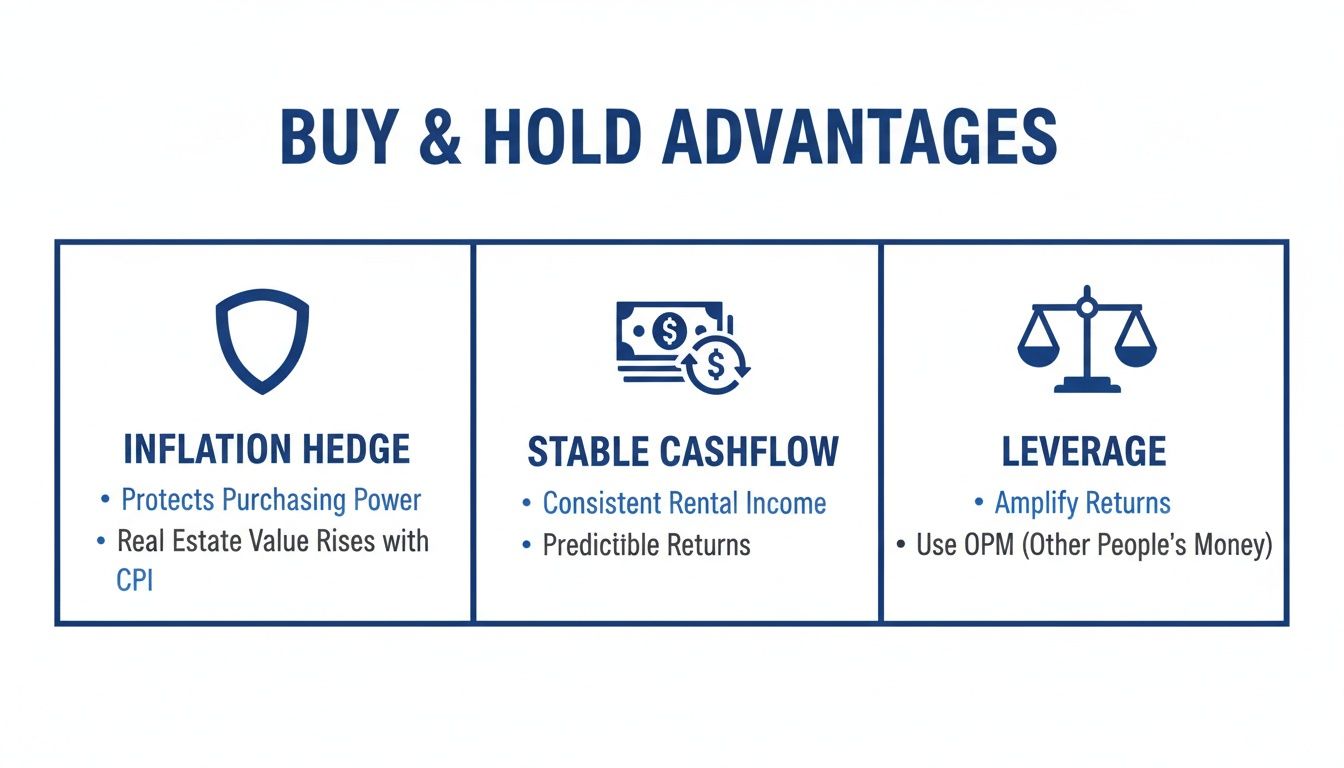
As you can see, a solid buy-and-hold property doesn't just put money in your pocket. It also acts as a hedge against inflation and lets you use leverage to amplify your returns over time.
To truly understand what you're buying, you need to get comfortable with a few core calculations. The table below offers a quick snapshot of the essential metrics every buy-and-hold investor should know.
Key Financial Metrics for Buy and Hold Investors
| Metric | What It Measures | Simple Formula |
|---|---|---|
| Cash Flow | Your actual monthly take-home profit after all expenses are paid. | Gross Rental Income - All Operating Expenses & Mortgage |
| Cap Rate | The property's potential return if purchased with all cash, ignoring financing. | Net Operating Income (NOI) / Property Purchase Price |
| Cash-on-Cash Return | The return on your actual out-of-pocket investment, including leverage. | Annual Pre-Tax Cash Flow / Total Cash Invested |
| Break-Even Ratio | The occupancy level needed to cover all expenses and debt payments. | (Operating Expenses + Debt Service) / Gross Potential Income |
| Amortization | The portion of your loan principal paid down by tenants over time. | Part of your monthly mortgage payment (increases over the loan term) |
Let's break down why each of these is so important for making smart decisions.
Understanding Your Monthly Cash Flow
Cash flow is the lifeblood of any rental property. It’s the money left in your pocket each month after you’ve collected the rent and paid all the bills—the mortgage, taxes, insurance, repairs, you name it. This is your actual profit.
Positive cash flow means the property pays for itself and pays you. Negative cash flow means you’re feeding it money out of your own wallet every single month just to keep it. The goal is always positive cash flow.
Think of cash flow as the heartbeat of your investment. A strong, steady beat means a healthy property. A weak or negative one is a sign of serious trouble.
Getting this number right is the most critical first step in analyzing any deal. For a detailed guide on nailing this calculation, check out our complete walkthrough on rental property cash flow analysis.
Using Cap Rate to Compare Investments
The Capitalization Rate, or Cap Rate, is a quick way to evaluate a property's profitability without financing getting in the way. It shows you the return you’d get if you bought the property with all cash.
The formula is straightforward: Cap Rate = Net Operating Income (NOI) / Property Purchase Price.
A higher cap rate often signals a higher potential return, but it can also mean higher risk. It's the perfect tool for an apples-to-apples comparison between different properties or even different cities. For instance, a property in a small midwestern town might have an 8% cap rate, while a similar building in a hot coastal market might only offer a 4% cap rate, reflecting different risk profiles and growth expectations.
Calculating Your Cash-on-Cash Return
While Cap Rate pretends financing doesn't exist, Cash-on-Cash Return puts it front and center. This is the metric that tells you how hard your actual invested dollars are working for you.
Here’s the formula: Cash-on-Cash Return = Annual Pre-Tax Cash Flow / Total Cash Invested.
If you put $50,000 down (including closing costs) to buy a property and it generates $5,000 in positive cash flow that first year, your cash-on-cash return is a healthy 10%. This number is vital because it reveals the true power of leverage—showing you the direct return on your out-of-pocket cash.
Gauging Risk With the Break-Even Ratio
Think of the Break-Even Ratio (BER) as your financial safety net. It tells you exactly how much vacancy your property can handle before it starts losing money and you have to dip into your own funds. A lower BER is always better.
- How it Works: You simply add up your total operating expenses and your full mortgage payment, then divide that by your property's gross potential income.
- Why It Matters: A property with a BER of 70% means you break even as long as it's occupied 70% of the time. Anything above that is profit. A property with a high BER is fragile and far more vulnerable to a market dip or a few unexpected vacancies.
The Hidden Power of Loan Amortization
Finally, never forget the quiet wealth-builder working for you in the background: loan amortization. Every month, a piece of your mortgage payment goes to interest, but another—and growing—piece pays down your loan principal.
Essentially, your tenants are buying the asset for you over time.
This forced savings plan doesn't appear in your monthly cash flow report, but it steadily increases your net worth. Over the 15 or 30 years of your loan, this becomes a massive contributor to your total return in a buy-and-hold strategy.
Trying to run all these numbers manually for every potential deal is a recipe for headaches and mistakes. That's why a tool like Property Scout 360 is so valuable—it automates these calculations in an instant, giving you the clarity and confidence to make the right call.
Finding and Analyzing Profitable Deals Like a Pro

This is where the rubber meets the road. Moving from theory to action is what brings a real estate buy and hold strategy to life. Success isn't about blind luck; it’s about building a repeatable system for finding and vetting investment properties. You have to know where to look and, more importantly, how to analyze a deal with a critical, unbiased eye.
The sharpest investors I know all have a deal "funnel"—a consistent process they use to source potential properties and quickly toss out the duds. This system saves an incredible amount of time, keeps emotional decisions at bay, and lets you focus your energy on the deals that actually have a shot at making you money.
Where to Source Potential Deals
Finding good deals is both an art and a science. Anyone can scroll through the major real estate portals, but the truly profitable properties are often found down the less-traveled paths. If you diversify how you find deals, you give yourself a massive competitive advantage.
Here are the most effective channels for finding your next rental property:
- The Multiple Listing Service (MLS): This is the massive database that feeds most real estate websites. Teaming up with an investor-friendly agent can get you a direct line to on-market properties that match your criteria, sometimes even before they hit the mainstream.
- Real Estate Agents: A great agent is so much more than a door-opener. They're your eyes and ears on the ground, offering market insights, neighborhood intel, and a network of professionals like lenders and contractors.
- Off-Market Deals: These are the hidden gems that never get a public listing. You can unearth them by networking with wholesalers, attorneys, and other investors, or even by running direct mail campaigns to homeowners who might be motivated to sell. These often offer the best value, but they take more legwork to find.
The Underwriting Process: A Step-by-Step Guide
Once you have a potential property in your sights, the real work begins. Underwriting is just a fancy term for rigorously analyzing a deal's financials to see how it will perform and if it meets your goals. This is where you separate the hard facts from the seller's hopeful fiction.
A proper analysis means you have to become a detective, digging into every potential cost and double-checking every assumption. It’s a disciplined approach that stops you from falling for a property that looks great on the surface but is a financial disaster underneath.
To underwrite a deal properly, you have to account for these key expenses:
- Estimate Realistic Rental Income: Never just take the seller's word for it. Use tools like local rent comparison sites or the built-in rent estimators in Property Scout 360 to see what similar units are actually getting in that area.
- Calculate PITI: This is your main monthly housing cost: Principal, Interest, Taxes, and Insurance. Your lender will give you the P&I figure, while you can find tax records and get insurance quotes to fill in the rest.
- Account for Vacancy: No property stays rented 100% of the time. A safe bet for vacancy is usually between 5-8% of the gross annual rent, depending on your local market.
- Budget for Repairs and Maintenance: Things will break. A good rule of thumb is to set aside 5-10% of the gross rent for all the routine stuff—leaky faucets, appliance fixes, and small updates.
- Factor in Capital Expenditures (CapEx): These are the big, expensive items with a long lifespan, like a new roof, HVAC system, or water heater. A smart move is to save another 5-10% of gross rent specifically for these inevitable replacements.
- Include Property Management Fees: Even if you plan to manage it yourself, always include this cost (typically 8-12% of gross rent) in your numbers. This makes sure the deal still works if you hire a pro later, and it effectively pays you for your own time.
Underwriting isn’t about making the numbers fit your hopes; it’s about discovering what the numbers truly are. A conservative, thorough analysis is your best defense against a bad investment.
Streamlining Your Analysis With Technology
Trying to underwrite even one property by hand with a spreadsheet is tedious and full of opportunities to make a mistake. Analyzing dozens of them this way? It’s practically impossible and leads to missed deals and "analysis paralysis."
This is exactly where a platform like Property Scout 360 becomes a game-changer. The tool’s advanced filters let you scan over 800 MLS regions for properties that fit your exact criteria, from cash flow targets down to specific neighborhoods.
When you spot a promising property, the platform automates the entire underwriting process. It helps you validate income with its rent estimators and instantly crunches all the key metrics—cash flow, cap rate, cash-on-cash return, and long-term ROI. You can model different financing scenarios in seconds, seeing exactly how a larger down payment or a different loan term changes your bottom line.
This kind of efficiency lets you analyze dozens of deals in the time it used to take to do one, which dramatically increases your chances of finding a truly profitable real estate buy and hold investment. To really nail this crucial skill, you can learn more about how to analyze a rental property in our detailed guide.
How to Finance and Scale Your Rental Portfolio
Getting the keys to your first rental is a huge milestone. But the real wealth-building starts when you turn that one property into a thriving portfolio. Scaling your real estate buy and hold strategy is all about smart financing and creating a repeatable system. It’s a mindset shift—you’re no longer just buying a property; you’re building a business.
The path from one rental to ten isn't about saving up a new 20% down payment for each purchase. That's the slow road. Smart investors figure out how to use leverage and proven methods to speed things up, turning the equity in one property into the seed money for the next. This is how a single investment can snowball into a financial legacy.
Tapping Into Powerful Financing Tools
Your standard conventional loan is a great starting point, but it's just one tool in the toolbox. There are several other ways to finance a deal, many of which are designed to help new investors get in the game without a massive pile of cash. Thinking outside the traditional mortgage box is your first step toward serious growth.
Here are a few powerful alternatives to consider:
- FHA Loans: Backed by the Federal Housing Administration, these loans are fantastic for house-hackers. You can buy a duplex, triplex, or even a four-unit building with as little as 3.5% down. The catch? You have to live in one of the units. The rent from your neighbors helps you qualify and gets your investment journey started on the right foot.
- VA Loans: If you're a veteran or active-duty service member, you have access to one of the best financing options out there. VA loans let you buy owner-occupied properties (up to four units) with 0% down. It's an incredible advantage.
- Creative Financing: This is where you get resourceful. Think seller financing, where the current owner essentially acts as your bank, or partnering with someone who has the capital while you bring the deal-finding expertise.
To get a full rundown of your options, check out our comprehensive guide on how to finance a rental property.
The BRRRR Method: A System for Infinite Growth
One of the most popular and effective strategies for scaling a portfolio is the BRRRR method. It’s not just a catchy acronym; it’s a powerful cycle that lets you reuse your initial investment capital again and again. Instead of saving up for years between deals, you can roll your money from one project to the next.
Here’s how the five steps work:
- Buy: Find and purchase a property that needs some work, ideally below its market value.
- Rehab: Renovate the property to force appreciation and get it ready for a tenant.
- Rent: Place a great tenant to get the cash flow started.
- Refinance: Go to a bank and do a "cash-out" refinance based on the property's new, higher value.
- Repeat: Take the cash you pulled out from the refinance and use it as the down payment on your next property. Rinse and repeat.
The BRRRR method is a powerful engine for portfolio growth because it turns one pot of money into a renewable resource for acquiring more assets. It transforms your capital from a one-time purchase tool into a perpetual investment fund.
Building a Diversified and Resilient Portfolio
As your portfolio grows, it’s a good idea to start thinking about diversification. Owning properties in different neighborhoods, cities, or even states can insulate you from local market slumps. If one area sees rents go flat, another might be booming, which helps smooth out your overall returns and build a more resilient business.
The data backs up this long-term strategy. Investors are consistently net buyers in the U.S. housing market, building their portfolios through thick and thin. Recently, investors bought 13% of all homes sold, up slightly from 12.7% the previous year. And while small investors did sell a near-record 270,000 homes, they still bought more than they sold. Overall, investors added 101,300 more homes to their portfolios than they offloaded.
This trend underscores the staying power of the buy-and-hold approach for the exact types of properties—single-family homes, condos, and small multi-families—that Property Scout 360 helps you analyze across more than 800 MLS regions. As you grow, managing everything efficiently becomes key. It's worth exploring the best software for property managers to help streamline your operations.
Got Questions About Buy and Hold Investing? We've Got Answers.
Jumping into buy-and-hold real estate is exciting, but it’s natural to have a ton of questions. Moving from browsing listings online to actually making an offer can feel like a massive leap. Let's break down the common questions that trip up new investors and give you the straightforward, practical answers you need to move forward with confidence.
How Much Money Do I Really Need to Start?
This is the big one, isn't it? The true cost of getting started is more than just the down payment. You have to think about the total "all-in" number, which includes closing costs, inspection fees, and a cushion for any immediate repairs or updates the property needs.
Most people assume you need a massive 20-25% down payment for a conventional investment loan, but there are other ways to get in the game with less cash.
- House Hacking with an FHA Loan: This is a game-changer. If you're willing to live in one unit of a multi-family property (like a duplex or triplex), you can often get an FHA loan with as little as 3.5% down. The rent from your neighbors helps pay your mortgage, dramatically lowering your living expenses.
- Don't Forget Your "Oh Sh*t" Fund: Beyond the purchase price, you absolutely must have cash reserves. A good rule of thumb is to have 3-6 months worth of total property expenses—mortgage, taxes, insurance, and estimated repairs—stashed away in a separate account. This fund is what saves you when a tenant moves out unexpectedly or the water heater dies.
The goal isn't just having enough money to buy the property; it's having enough to comfortably hold it through the inevitable bumps in the road. Think of your cash reserves as your business's insurance policy.
This is where running the numbers becomes critical. A tool like Property Scout 360 lets you quickly see how a 5% down payment versus a 20% down payment changes everything—from your monthly cash flow to your long-term returns. It helps you find the right entry point for your budget.
What Are the Biggest Mistakes New Investors Make?
One of the smartest things you can do is learn from the mistakes of others. New buy-and-hold investors tend to fall into the same few, completely avoidable, traps. Knowing what they are is your best defense.
The most common blunders I see are:
- Forgetting the Real Expenses: It’s so easy to just look at the mortgage payment and the rent. But that's not the whole story. Forgetting to budget for vacancies, ongoing maintenance, and major future costs (like a new roof in 10 years) is how you end up with a property that loses money. Always run your numbers with a healthy dose of pessimism.
- Buying with Your Heart, Not Your Head: Falling in love with the cute porch or the charming kitchen while completely ignoring the ugly numbers is a classic rookie move. This is a business decision. Your analysis should be driven by cold, hard data, not a warm, fuzzy feeling.
- Skipping Real Due Diligence: Never, ever take the seller's word for it on income and expenses. A professional home inspection is non-negotiable, and you need to get your own proof of the rental income and operating costs to make sure the deal is what it seems.
Should I Invest Close to Home or Out of State?
This is a huge strategic decision. Do you stick to your own backyard, or do you chase better deals in other markets? There's no single right answer, but each path has its own pros and cons.
Investing Locally is great because you know the area. You understand which neighborhoods are on the upswing, you can drive by the property easily, and you can manage it yourself if you want to. The downside? Your local market might be too expensive or just not have the returns you’re looking for.
Investing Out-of-State can open up a world of opportunity. You can find markets with much higher cash flow, lower property prices, and more room for growth. The big challenge, of course, is the distance. Success depends entirely on building a rock-solid team on the ground: a fantastic real estate agent, a top-notch property manager, and a handful of reliable contractors. This used to be a huge barrier, but modern tools have made it easier and safer than ever before.
How Should I Handle Property Management?
Once you own the property, you have two choices: do it yourself or hire a professional. Your decision really comes down to how much time you have, what skills you bring to the table, and how close you live to your rental.
- Self-Management: This is the hands-on approach. You'll be the one screening tenants, collecting rent checks, fielding late-night calls about leaky faucets, and making sure you're following all the local laws. You save on the management fee, but you pay for it with your time.
- Hiring a Pro: A good property manager will typically charge 8-12% of the monthly rent. For that fee, they handle everything. They become the buffer between you and the tenants, freeing you up to live your life and focus on finding the next deal. For most people, especially those investing out-of-state, this is a no-brainer that transforms your property into a genuinely passive investment.
Trying to juggle all these factors for every single property you look at can feel like a full-time job. Property Scout 360 is designed to cut through that noise. It gives you the data and calculators to answer these questions confidently, letting you model cash flow, ROI, and future growth in just a few minutes. It helps you make the right call, every single time. Learn more and start your free trial at propertyscout360.com.
About the Author
Related Articles
2026 Investor's Guide: Cost of Installing a Sewer Clean Out
Understand the cost of installing a sewer clean out for investment properties in 2026. Get expert advice on prices, ROI, & budgeting for flips. Plan smart!
15 Year vs 30 Year Mortgage: The Investor's Choice
Deciding between a 15 year vs 30 year mortgage for a rental property? Our guide analyzes cash flow, ROI, and equity to help you pick the best loan.
Real Estate Appraisal Software: Features & Limits
Discover what real estate appraisal software is, its core features, and limits. See how it differs from investment tools for profitable deals.
