Real Estate irr calculator: Your Quick Guide to Smarter Deals
Real estate irr calculator guide: master IRR modeling, compare deals, and make data-driven investment decisions with confidence.
A real estate IRR calculator is a powerful tool for figuring out the true annualized rate of return on a property investment. It goes beyond simple metrics by looking at every dollar that comes in and goes out over the entire time you own the property—from the initial purchase and rental income to all expenses and the final sale.
Why IRR Is Your Most Powerful Real Estate Metric

When you're analyzing deals, it’s easy to get fixated on simple numbers like cash-on-cash return or the cap rate. While they have their place, those metrics are just snapshots. They tell you how a property looks today but completely miss the story of how that investment will perform over its entire lifecycle.
This is where the Internal Rate of Return (IRR) really shines. It’s the metric the pros lean on because it accounts for the time value of money—the fundamental idea that a dollar today is worth more than a dollar five years from now. A real estate IRR calculator doesn't just look at a single year; it maps out the entire investment journey.
Beyond Simple Metrics
Unlike those snapshot calculations, IRR weaves together every single financial event from the day you buy to the day you sell.
This includes things like:
- The initial down payment and all your closing costs.
- The net cash flow you collect each year (rent minus all operating expenses).
- The effect of paying down your mortgage and building equity.
- Your net profit when you eventually sell the property.
By factoring all of this in, IRR gives you a single, annualized rate of return. You can then compare this apples-to-apples with other investments, whether it’s another property, stocks, or bonds.
For perspective, data over the last 20 years shows that leveraged single-family rentals have produced an 11.7% annual IRR. That’s a powerful combination of rental income and appreciation that has outpaced many other asset classes.
The true power of IRR is its ability to put different investment timelines and cash flow patterns on a level playing field. A property with modest annual cash flow but significant appreciation can be accurately compared to a high-cash-flow property with slower growth.
IRR vs Other Real Estate Metrics At a Glance
It helps to see how IRR stacks up against other common metrics investors use. While each has its purpose, you'll notice IRR provides the most complete picture of total return.
| Metric | What It Measures | Key Limitation |
|---|---|---|
| IRR (Internal Rate of Return) | The total, time-adjusted annualized return over the entire investment hold period. | Can be complex to calculate manually; assumes cash flows are reinvested at the IRR rate. |
| Cash-on-Cash Return | The annual pre-tax cash flow as a percentage of the total cash invested. | Ignores appreciation, loan paydown, tax benefits, and future performance. A single-year snapshot. |
| Cap Rate | The potential annual rate of return based on the property's Net Operating Income (NOI). | Doesn't account for financing (debt service) or the time value of money. |
| ROI (Return on Investment) | Measures the total gain or loss on an investment relative to its cost. | Often calculated at the end of an investment; doesn't account for the time it took to earn the return. |
As you can see, metrics like Cash-on-Cash and Cap Rate are great for a quick first look, but IRR tells the full story of your investment's long-term performance.
An Essential Tool for Comparison
Ultimately, a real estate IRR calculator cuts through the noise. It answers the most important question for any serious investor: "What is the total, time-adjusted return on my investment?" While it’s a critical number, you should still understand other financial tools, like Cap Rate calculations, to build a complete analysis.
Platforms like Property Scout 360 make these once-daunting calculations instant, so you can run scenarios and make decisions with confidence. For a deeper look at the numbers behind smart investing, check out our guide on comprehensive real estate investment analysis.
Getting Your Numbers Straight for an Accurate IRR
Any IRR calculation is only as reliable as the numbers you plug into it. It’s the classic “garbage in, garbage out” scenario. Even the most sophisticated real estate IRR calculator can't rescue a deal based on flimsy or overly optimistic assumptions. Think of this as your pre-flight check; every single input needs to be grounded in reality.
The heart of the entire analysis is a detailed, multi-year cash flow schedule. This isn't just a back-of-the-napkin list of income and expenses. It’s a complete financial story of your investment, from the day you buy it to the day you sell it. Nailing this part is everything.
Nail Down Your Initial Investment Costs
Your first entry is always for Year 0. This is the total cash you need to close the deal, and it's always a negative number because it's cash flowing out of your pocket. It's so much more than just the down payment.
To get an accurate starting point, you have to account for every single upfront cost. Miss one, and your IRR will be artificially inflated from the get-go.
- Purchase Price: The number on the contract.
- Closing Costs: Plan for 2% to 5% of the purchase price. This bucket includes everything from lender fees and title insurance to appraisals and transfer taxes.
- Initial Repairs & Renovations: What's your budget for getting the property rent-ready? This could be a simple coat of paint or a full-blown kitchen remodel.
- Furnishing Costs: For a short-term rental, this is a major expense that absolutely must be part of your initial outlay.
- Initial Reserves: Smart investors always set aside a cash buffer for that surprise A/C failure or an unexpected vacancy right after closing.
Projecting Your Operating Cash Flows
With your starting point locked in, the next step is to project the net cash flow for every year you plan to hold the property. This is where brutal honesty and conservative estimates become your best friends.
Rental Income Projections
Start with the property's gross potential rent—what it could theoretically earn if it were occupied 100% of the time. Now, immediately bring that number back down to earth with a realistic vacancy factor. For most long-term rentals, assuming a 5% to 10% vacancy rate is a safe bet. Never, ever assume your property will be full all the time. It won't be.
A rookie mistake is to just accept the current tenant's rent as gospel. You need to research comparable rentals in the neighborhood. Is the current rent at, above, or below the market rate? The answer tells you a lot about your future rent growth potential.
Estimating Operating Expenses
These are all the ongoing costs to keep the property running, and they don't include your mortgage payment. The 50% Rule is a decent quick-and-dirty estimate (it suggests half your gross rent goes to expenses), but for a serious analysis, you need to get granular.
Your expense sheet should have line items for:
- Property Taxes: Don't guess. Look up the property's actual tax history.
- Insurance: Call an agent and get a real quote for a landlord policy.
- Repairs & Maintenance: Budgeting 5% to 10% of gross rent is a solid starting point for the small stuff.
- Capital Expenditures (CapEx): This is the big one that sinks many investors. You must set aside money for the big-ticket items. That roof will need replacing in 15 years, and the HVAC system has a 10-year lifespan. Set aside another 5% to 10% of gross rent for these future monsters.
- Property Management Fees: Planning to self-manage? Your time isn't free, so account for it. If you're hiring a pro, expect to pay 8% to 12% of the collected rent.
- Utilities, HOA Fees, and Landscaping: Mop up any other recurring costs tied to the property.
The Final Piece: The Exit Strategy
The very last cash flow in your projection is the big one: the sale. This is a large, positive cash inflow representing your net proceeds after paying off the loan and all selling costs.
First, you have to estimate the future sale price. A conservative, and wise, approach is to apply a modest annual appreciation rate—maybe 2% to 3%—to your initial purchase price. Resist the temptation to plug in wild appreciation rates that aren't backed by long-term market data.
From that projected sale price, you then have to subtract two major items:
- Selling Costs: Figure on 6% to 8% of the sale price to cover agent commissions and closing costs.
- Remaining Loan Balance: The principal you still owe on your mortgage when you sell.
What's left is your net profit on the sale. This becomes the final positive number in your cash flow schedule. With all these components carefully pieced together, you're finally ready to open that real estate IRR calculator and get a result you can actually trust.
A Practical Walkthrough of Your First IRR Calculation
Alright, let's put some rubber on the road. We've covered the theory, but the real power of IRR comes from seeing it in action. Let's walk through the numbers on a classic single-family rental deal to see how a real estate IRR calculator truly illuminates the entire investment.
We’ll build our cash flow timeline from the ground up, starting with day one and projecting out over a five-year hold.
For our example, we're looking at a three-bedroom, two-bathroom house with a purchase price of $350,000. The game plan is to hold it for five years and then sell.
Nailing Down the Initial Investment (Year 0)
First thing's first: what's our total cash out-of-pocket to get this deal done? This is our "Year 0" cash flow, and it’s always a negative number. Remember, it's a lot more than just the down payment.
- Purchase Price: $350,000
- Down Payment (20%): $70,000
- Closing Costs (3%): $10,500
- Initial Repairs (make-ready): $5,000
When you add it all up, our total cash needed at closing is $85,500. That's the first critical number for our calculation: -$85,500.
Projecting Annual Operating Cash Flows (Years 1-5)
Now, we need to forecast the net cash flow for each year we plan to own the property. This is where getting realistic with your numbers—both income and expenses—is absolutely crucial.
Income Projections
Let's say this house can realistically rent for $2,800 per month. That gives us a gross potential income of $33,600 for the year. But no property is occupied 100% of the time. We'll build in a conservative 7% vacancy and credit loss buffer, which brings our effective gross income down to $31,248.
Operating Expenses
Here’s a look at what it will cost to run the place annually:
- Property Taxes: $4,200
- Insurance: $1,500
- Repairs & Maintenance (5% of rent): $1,562
- CapEx Reserves (5% of rent): $1,562
- Property Management (8% of rent): $2,500
Our total operating expenses come to $11,324 per year. Subtracting that from our income gives us a Net Operating Income (NOI) of $19,924.
But we're not done. We have a mortgage to pay. On a $280,000 loan at 6.5% interest over 30 years, our annual debt service (principal and interest) is $21,238.
This means our pre-tax cash flow each year is actually -$1,314 ($19,924 NOI - $21,238 Debt Service). That's right, this property is cash-flow negative on paper. This is a very common scenario, especially in markets where you're banking on appreciation as a major part of your return.
Don't panic when you see a negative cash flow. This is precisely why IRR is so valuable. It forces you to look beyond the monthly check and consider the entire return, including the equity you're building and the property's appreciation.
Factoring in the Final Sale (Year 5)
The final piece of the puzzle is the big payday: the cash we get from selling at the end of Year 5. This one event has a massive impact on your final IRR.
Let's start by projecting the future sale price. Assuming a modest 3% annual appreciation, our $350,000 property should be worth around $405,800 in five years.
From there, we have to subtract the costs of selling:
- Selling Costs (7%): $28,406
- Remaining Loan Balance: After five years of payments, we’ll still owe about $266,200 on the mortgage.
After paying off the bank and the agents, our net proceeds from the sale will be $111,194.
Assembling the Complete Cash Flow Timeline
We now have every number we need to map out the investment's financial life.
- Year 0: -$85,500 (Initial Investment)
- Year 1: -$1,314 (Operating Cash Flow)
- Year 2: -$1,314 (Operating Cash Flow)
- Year 3: -$1,314 (Operating Cash Flow)
- Year 4: -$1,314 (Operating Cash Flow)
- Year 5: $109,880 (Final Year's Cash Flow + Net Sale Proceeds of $111,194)
Visually, the entire process breaks down into the three key stages of any real estate investment.
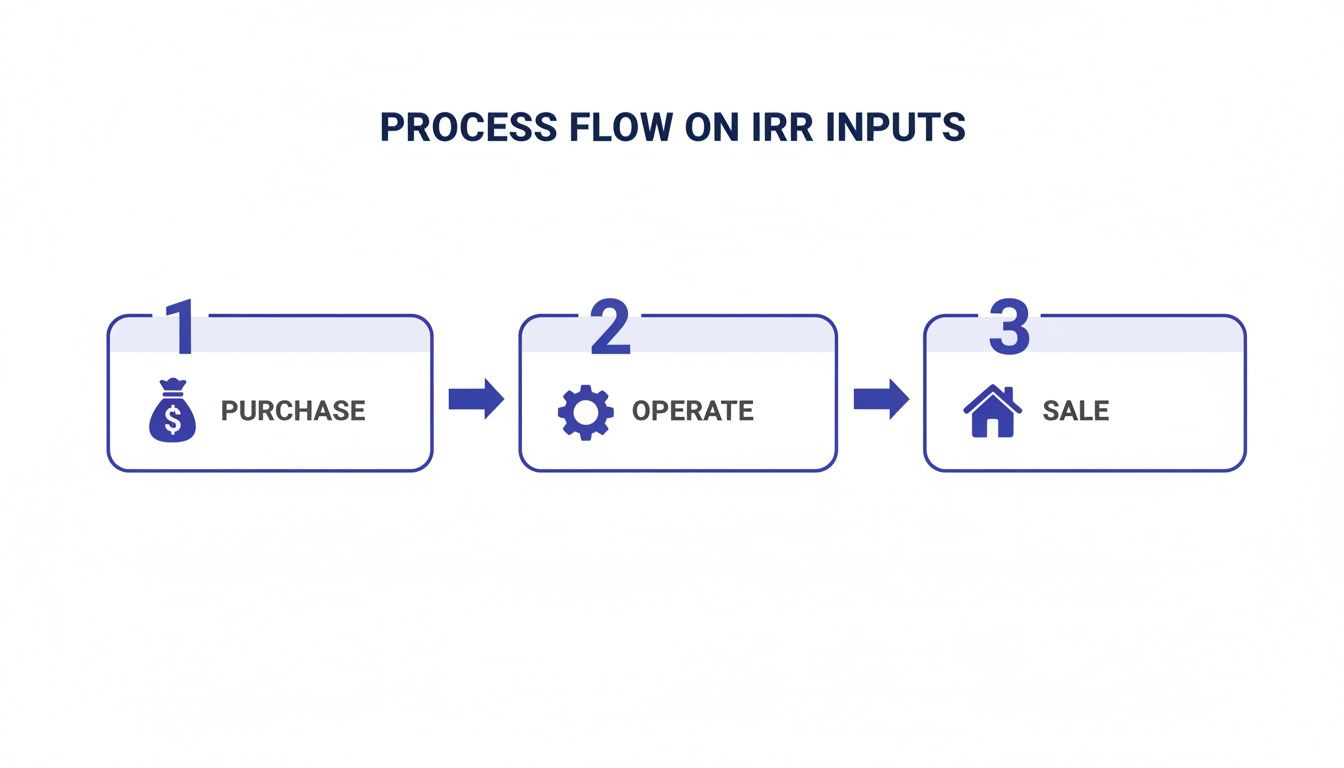
This simple flow shows how IRR connects the dots between your initial investment, the year-to-year performance, and your final exit.
When we plug this series of cash flows into any IRR function—whether in a spreadsheet or a tool like Property Scout 360—we get our answer. For a deeper dive and a template to play with, check out our guide on building a rental property calculator in Excel.
For this deal, the calculated Internal Rate of Return is 8.21%. This single number tells the whole story, accounting for the small annual losses, the silent wealth-building from loan paydown, and the final profit from appreciation. Now you can take that 8.21% and stack it up against your investment goals or other deals to make a truly informed decision.
How to Interpret Your IRR and Make Smarter Decisions
So, you’ve run the numbers through a real estate IRR calculator and it spits out a single, powerful percentage. Let’s say the result is 14%. That number feels solid, but what does it actually mean? Is it a green light to sign the contract, or a warning to walk away?
The truth is, an IRR figure is pretty useless on its own. The real skill is turning that data point into a confident decision, and that all comes down to comparing the calculated return against your own personal investment criteria.
Defining Your Personal Hurdle Rate
Before you even look at a deal, you need to know your hurdle rate. Think of this as the minimum rate of return you're willing to accept for a certain level of risk. It’s your personal benchmark for saying "yes" or "no."
How do you set one? A great starting point is to look at your other options. If you could park that same cash in a relatively safe S&P 500 index fund and historically expect an 8-10% annual return, any real estate deal—with all its hands-on work and potential headaches—should offer a significantly higher IRR to be worthwhile.
Your hurdle rate should also scale with the risk of the project itself.
- Low-Risk Turnkey Property: A stable, occupied rental in a great location might only need to clear a 7-10% IRR to be a fantastic deal.
- Moderate-Risk Value-Add: A property that needs cosmetic updates and better management brings more risk. For that, you might set your hurdle rate at 12-15%.
- High-Risk Gut Rehab: A major renovation or a ground-up development project is full of uncertainty. For this level of risk, you should be demanding a much higher return, maybe 18% or more.
Your hurdle rate isn’t just a number; it’s a reflection of your investment philosophy. It aligns your capital with your risk tolerance and financial goals, ensuring you only pursue deals that truly move the needle for you.
Why There Is No Single “Good” IRR
Context is everything in real estate. The idea of a universal "good" IRR is a total myth because every property, market, and strategy carries a different risk profile. Some institutional investors are thrilled with a 6% IRR on a core asset, while opportunistic developers won't touch a deal for less than 20%.
Imagine you’re looking at two different opportunities:
- A fully-leased duplex in a top-rated school district with a projected 9% IRR.
- A vacant, distressed fourplex in a transitioning neighborhood with a projected 19% IRR.
Which is the better investment? There's no right answer. An investor focused on stable, low-effort cash flow might jump on the duplex. On the other hand, a seasoned investor with a construction background might see the fourplex as a home run. The IRR simply quantifies the potential reward; you’re the one who has to decide if that reward is worth the risk involved. Mastering this is all about practicing data-driven decision making.
Using IRR for Smart Comparisons
The real magic of the IRR is its ability to put wildly different deals on a level playing field. It helps you compare apples to oranges by boiling everything down to a single, time-adjusted performance metric.
Let’s say you're weighing a short-term flip against a long-term rental hold. The flip might promise a quick 25% return in six months, while the rental projects a 12% IRR over a ten-year hold. IRR helps you see that the steady 12% annualized return from the rental could be a far more powerful wealth-building tool over the long run than a one-time pop from a flip.
It also helps you refine your strategy. If a deal’s IRR comes in just shy of your hurdle rate, you can start tweaking the variables. Could you negotiate a lower purchase price? Plan a more modest renovation? This is where you move from just running numbers to actively structuring a winning investment. To get really good at this, make sure your fundamentals are solid—our guide on rental property cash flow analysis is a great place to start.
Advanced Analysis and Common Pitfalls to Avoid

Getting that first IRR number feels great, but a single projection is just a starting point. Experienced investors know that a static forecast is brittle—it’s just one version of the future. The real magic happens when you start to stress-test your numbers to see how they hold up when reality inevitably throws a curveball.
This is where sensitivity analysis comes into play. It’s simply the process of asking a series of "what if" questions to see how sensitive your IRR is to changes in your key assumptions. This isn't about being negative; it's about building a rock-solid understanding of the deal's risk profile.
Performing a Basic Sensitivity Analysis
Think of it as a financial fire drill. A good real estate IRR calculator or a well-built spreadsheet lets you easily tweak one variable at a time to see the ripple effect on your final IRR.
I always recommend starting with the assumptions that have the biggest financial impact and the most uncertainty.
- What if vacancy is higher? Your base case might assume 5% vacancy, but what happens if it hits 10% or even 15% for a year? Does the deal still pencil out?
- What if appreciation grinds to a halt? That 3% annual appreciation looks nice, but what if the market goes flat at 0%? Or just creeps up at 1%?
- What if a major system fails? Let's say you get hit with an unexpected $10,000 HVAC replacement in Year 3. How much does that one event drag down your total return?
Running these scenarios takes you from a single data point to a more realistic range of outcomes. You might discover your deal has a 12% IRR in the base case, but the plausible range is anywhere from 7% (pessimistic) to 16% (optimistic). That range gives you a much clearer picture of what you're getting into than the single number ever could.
The Most Common Pitfalls Investors Face
Even with the best tools, it’s shockingly easy to fall into common traps that produce a misleadingly high IRR. I’ve seen it happen countless times. Avoiding these mistakes is what separates a spreadsheet fantasy from a genuinely profitable investment.
One of the biggest culprits is being too bullish on rent growth. It's tempting to plug in 5% annual increases, but unless you have rock-solid market data to back that up, a more conservative 2-3% is far more realistic for most long-term holds.
Another classic is underestimating—or completely forgetting—about capital expenditures (CapEx). That roof, furnace, and water heater won't last forever. If you don't budget for their eventual replacement, your cash flow will look amazing on paper until you're hit with a massive, un-budgeted expense that craters your returns.
The IRR calculation is only as honest as the inputs you provide. Inflated rent growth and ignored capital expenses are the two fastest ways to create a fantasy projection that will never materialize.
Common IRR Calculation Mistakes and How to Fix Them
I've put together a quick guide to some of the most frequent errors I see investors make when calculating IRR. Knowing what to look for is half the battle.
Here’s a look at those mistakes and, more importantly, how to get them right.
| Common Mistake | Why It's a Problem | How to Correct It |
|---|---|---|
| Forgetting Selling Costs | It inflates the final cash flow from the sale, which dramatically and artificially boosts the calculated IRR. | Always subtract 6-8% from the projected future sale price to account for commissions, transfer taxes, and other closing costs. |
| Ignoring the Holding Period | IRR is extremely sensitive to the hold period. A short hold often shows a higher IRR due to quick appreciation, which can be misleading. | Run your analysis for multiple holding periods (e.g., 5, 7, and 10 years) to see how the return profile changes over time. |
| Using Unrealistic Appreciation | Projecting high appreciation rates that aren't supported by historical data creates a rosy scenario that is unlikely to happen. | Use a conservative appreciation rate, typically 2-3% annually, that aligns with long-term, inflation-adjusted market trends. |
| Miscalculating Initial Investment | Forgetting items like closing costs, lender fees, or immediate repairs makes your initial investment seem smaller, which inflates the IRR. | Create a detailed checklist of all upfront capital, including the down payment, closing costs, and a buffer for day-one renovation funds. |
Ultimately, a truly reliable IRR analysis is about discipline. By actively stress-testing your assumptions and sidestepping these common pitfalls, you turn a simple calculation into a powerful decision-making framework. This rigorous approach is what separates hopeful speculators from successful, long-term real estate investors.
Digging Deeper: Your Real Estate IRR Questions Answered
Even after you've run the numbers, some questions about IRR can linger. It's a powerful metric, but it definitely has its quirks. Let's break down some of the most common questions I hear from investors, so you can use your real estate IRR calculator with total confidence.
What’s a Good IRR for a Rental Property?
This is, without a doubt, the number one question. And the honest answer from anyone with real experience is: it depends. There's no single magic number. A "good" IRR is all about the context of the deal and, just as importantly, your own goals and risk appetite.
For instance, a stable, turnkey property in a great neighborhood might throw off an 8-10% IRR. For an investor looking for predictable, lower-risk returns, that's a fantastic deal. But what about a heavy value-add project? If you're taking on the risk of a major renovation and lease-up, you'd better be targeting a much higher return—something in the 12-18% range—to make all that extra work and uncertainty worthwhile. For truly opportunistic, high-risk deals, seasoned pros won't even look twice unless the pro forma shows an IRR of 20% or more.
My advice? Set your own personal "hurdle rate." This is the minimum acceptable return for a deal, based on its risk profile. A solid benchmark is the historical average of the stock market, around 8-10%. If a real estate deal, with all the hands-on effort it requires, can't beat that, you have to ask yourself if it's really worth it.
How Is IRR Different From Cash-on-Cash Return?
It's easy to mix these two up, but they're telling you completely different things about an investment's performance. The simplest way I've found to explain it is this: Cash-on-Cash is a snapshot; IRR is the whole movie.
- Cash-on-Cash (CoC) Return: This is a simple, "in-the-moment" metric. It tells you what percentage of your initial cash investment you get back in your pocket from rental income in a single year. It’s perfect for answering, "How much cash will this property generate for me this year?"
- Internal Rate of Return (IRR): This is the entire story, from the day you buy to the day you sell. It factors in every single dollar that moves in or out—your down payment, all the annual cash flows (positive or negative), and your final profit from the sale. Most importantly, it understands that a dollar today is worth more than a dollar ten years from now.
CoC is great for gauging immediate returns, but IRR gives you the full, unvarnished picture of an investment's total profitability over time.
Can a Real Estate IRR Calculator Be Wrong?
The math inside the calculator is solid. It's not going to make a simple calculation error. But the tool is only as smart as the assumptions you feed it. This is the classic "garbage in, garbage out" problem.
Your real estate IRR calculator is a powerful processor for your assumptions, not a crystal ball. If you plug in overly rosy projections, it will spit out a beautifully high IRR that is dangerously disconnected from reality.
Here are the most common mistakes I see that lead to a "wrong" IRR:
- Unrealistic Rent Growth: Budgeting for 5% annual rent bumps in a market where 2% is the historical norm.
- Forgetting Big-Ticket Expenses: It’s easy to overlook major capital expenditures. That new roof in year 7 or the HVAC replacement in year 10 can crush an otherwise great-looking return.
- Overly Aggressive Sale Price: Assuming the property will appreciate at a rate that far outpaces what the local market has ever sustained.
The secret to a reliable IRR is building your analysis on a foundation of conservative, well-researched numbers. The best investors I know always run a sensitivity analysis. They test a best-case, worst-case, and most-likely scenario to see how the IRR holds up. This gives you a much healthier understanding of a deal’s true potential—and its hidden risks.
Ready to stop wrestling with spreadsheets and start analyzing deals with speed and confidence? Property Scout 360 automates the entire IRR calculation process, visualizing returns and running scenarios in seconds. Find your next profitable investment today.
About the Author
Related Articles
2026 Investor's Guide: Cost of Installing a Sewer Clean Out
Understand the cost of installing a sewer clean out for investment properties in 2026. Get expert advice on prices, ROI, & budgeting for flips. Plan smart!
15 Year vs 30 Year Mortgage: The Investor's Choice
Deciding between a 15 year vs 30 year mortgage for a rental property? Our guide analyzes cash flow, ROI, and equity to help you pick the best loan.
Real Estate Appraisal Software: Features & Limits
Discover what real estate appraisal software is, its core features, and limits. See how it differs from investment tools for profitable deals.
