Calculating rental property value: A Proven Guide to Profitable Deals
Master calculating rental property value with our practical methods and pro tips to spot profitable deals and avoid costly mistakes.
Figuring out what a rental property is really worth goes way beyond its listing price. It's a deep dive into its potential to make you money, measured against what it costs to own. We're talking about using proven methods like the Cap Rate, Gross Rent Multiplier, and Discounted Cash Flow to see a property for what it is: a financial asset. Get this right, and you set yourself up for a profitable investment from the get-go.
Why Nailing Your Numbers Is Non-Negotiable
Before we jump into the formulas, let's be clear about what’s at stake here. A solid, accurate valuation is the foundation of any successful real estate portfolio. It’s your best defense against making a very expensive mistake.
When you get your numbers right, you shield yourself from overpaying in a hot market. It also gives you the concrete data you need to walk into a lender's office and secure good financing terms. This shift in thinking—from just 'finding a property' to strategically 'acquiring a financially sound asset'—is what separates experienced investors from gamblers.
The Foundation of Smart Investing
Think about it this way: two investors are eyeing similar duplexes. The first one glances at the numbers, guesstimates a few costs, and assumes an optimistic rental income. The second investor, however, pulls actual rental comps from the neighborhood, gets real insurance quotes, and builds in a buffer for vacancies.
The second investor’s offer might come in a little lower, but it’s grounded in reality, not wishful thinking. That small bit of diligence is what prevents a surprise negative cash flow situation a year down the road.
A property that looks great on paper can quickly become a financial drain if the initial valuation ignores realistic operating expenses. The goal isn't just to buy real estate; it's to buy predictable returns.
Avoiding Common Valuation Pitfalls
So many new investors trip up by plugging numbers into generic online calculators or using national averages for distinctly local expenses. A winning strategy requires a much sharper focus.
Here are a few things I see all the time:
- Ignoring Market-Specific Data: Never assume property taxes or insurance costs in one town are the same as the next one over. You have to pull local figures. Always.
- Unrealistic Vacancy Rates: A 5% vacancy rate is a common rule of thumb, but if you're in a college town with high turnover, budgeting for 8-10% is a much safer bet.
- Forgetting Capital Expenditures: This is a big one. It's easy to overlook the major expenses that don't happen every month. A new roof or an HVAC replacement can completely wipe out years of profit if you haven't planned for it from the start.
Ultimately, when you master how to calculate rental property value, you gain control. It gives you the confidence to walk away from bad deals and negotiate from a position of strength on the good ones, making sure every property you buy is a step toward your financial goals.
The Cap Rate Method for Valuing Income

When you're an investor focused on cash flow, the capitalization rate—or cap rate—is your North Star. It’s the metric that cuts through all the fluff and gets straight to the point: What’s the potential annual return on this property, before my mortgage is even considered?
This method is so powerful because it directly links a property's income-generating ability to its market value. It gives you a clean, simple way to compare different investment opportunities side-by-side. The entire calculation boils down to one critical number: the Net Operating Income (NOI).
First, You Need to Find Your Net Operating Income
Before you can even think about the cap rate, you have to nail down your NOI. This isn't just the total rent you collect. NOI is the property's total income after you've paid all the bills required to keep it running. Think of it as the pure, unadulterated profit the building itself generates each year.
To get an accurate NOI, you'll need to work through a few numbers.
Start with your Gross Scheduled Income (GSI). This is the absolute best-case scenario—the total annual rent you'd collect if the property was 100% occupied all year long.
Next, you have to account for reality by subtracting vacancy costs. No property stays full forever. Reduce your GSI by a realistic vacancy rate for your specific market (usually somewhere between 5% and 10%) to find your Effective Gross Income (EGI).
Finally, and this is where many investors get tripped up, you subtract all operating expenses. This means every single cost associated with running the property, except for your mortgage payment.
Common operating expenses you can't forget include:
- Property Taxes
- Landlord Insurance
- Property Management Fees
- Repairs & Maintenance Budget
- Utilities (if you're paying them)
- Landscaping and Pest Control
What you’re left with is your Net Operating Income. This figure is the true engine of your investment, and getting it right is non-negotiable. For a deeper look into the finer points of this calculation, check out our guide on understanding the pro forma cap rate.
Applying the Cap Rate Formula
Once you have a solid NOI, the rest is pretty straightforward. The cap rate formula is a core concept in real estate that determines a property's value by dividing its annual income by the prevailing rate of return for similar local properties.
The formula looks like this:
Property Value = Net Operating Income (NOI) / Capitalization Rate (Cap Rate)
Let's walk through a real-world example. Say a rental property brings in an annual NOI of $9,720. After doing your homework, you find that comparable properties in the neighborhood are selling at a 6% cap rate.
Using the formula, the estimated value would be $162,000 ($9,720 / 0.06). It’s a clean, market-driven way to value stable rental properties.
This brings us to the million-dollar question: where do you get the cap rate from?
Finding a Realistic Market Cap Rate
This is where your diligence as an investor truly pays off. Using the wrong cap rate can cause you to drastically overpay for a property or miss out on a great deal. A generic national average is useless; you need a cap rate that reflects your specific neighborhood and property type.
The best way to find a reliable cap rate is to analyze recent, comparable sales (or "comps"). Look for similar properties that have sold in your target area within the last six months. For each one, do your best to calculate its NOI and then divide that by its final sale price.
After running the numbers on three to five solid comps, you'll have a realistic cap rate range to work with. To really get this down, a detailed guide on the Cap rate calculation rental property is an invaluable resource.
The Gross Rent Multiplier: Your Go-To for Quick Screening
While diving deep into cap rates gives you a precise financial picture, sometimes you just need a quick gut check. When you’re scrolling through dozens of listings, you need a way to rapidly weed out the duds and flag the potential gems. That's where the Gross Rent Multiplier (GRM) comes in—it's an essential tool for that first-pass analysis.
Think of the GRM as a back-of-the-envelope calculation. It’s a straightforward metric that tells you if a property's asking price is in the right ballpark based on the rent it brings in. It deliberately ignores the nitty-gritty details of operating expenses, trading precision for pure speed.
How to Calculate and Use the GRM
The formula couldn't be simpler. You just take the property's price and divide it by its total annual rent.
Market Value / Gross Annual Rent = Gross Rent Multiplier (GRM)
Let’s say you’re looking at a townhouse listed for $300,000 that could generate $30,000 in rent per year. The math is easy: $300,000 / $30,000 = a GRM of 10.
Now, a GRM of 10 is meaningless in a vacuum. Its real value comes from comparison. You need to find out the typical GRM for similar townhouses in that specific neighborhood.
If other local townhouses are selling at a GRM of 12, that property with a GRM of 10 suddenly looks like a potential bargain that deserves a closer look. On the flip side, if the market average is closer to 8, the property is probably overpriced, and you can move on.
The Major Limitation You Must Respect
Here’s the big catch with the GRM: it completely ignores operating expenses. This is what makes it so fast, but it’s also its biggest blind spot.
Two side-by-side properties might look identical on paper but have vastly different bottom lines. One could have sky-high property taxes and a 20-year-old HVAC system that’s about to die, while the other is newer and far more efficient. The GRM wouldn't tell you any of this.
Because of this crucial omission, you should never use the GRM to make a final buying decision. Treat it as a screening tool—a way to quickly build a shortlist of properties that warrant a deeper dive with more robust methods like the cap rate.
To get a better handle on how this metric fits into your overall evaluation process, you can learn more about what GRM means in real estate in our complete guide.
A Practical Look at Discounted Cash Flow Analysis
When you're in it for the long haul, the Discounted Cash Flow (DCF) analysis is your best friend. It’s the most comprehensive way to value a rental property. While other methods give you a quick snapshot of what a property is worth today, DCF projects its value based on all the money it’s expected to generate over its entire life in your portfolio.
Essentially, DCF answers one critical question: "What is the total future profit from this property worth in today's dollars?" After all, a dollar you'll get ten years from now isn't the same as a dollar in your pocket today. This method accounts for that.
The Key Inputs for a DCF Model
Running a solid DCF analysis means you have to make some educated guesses about the future. The quality of your valuation hinges entirely on how realistic these assumptions are.
Here’s what you’ll need to forecast:
- Projected Rent Growth: Rents rarely stay flat. You need to look at the historical data for the area. A conservative but realistic estimate is often around 2-3% per year.
- Expense Inflation: Your costs are going to creep up, too. Property taxes, insurance, and maintenance always seem to find a way to increase. I usually start by factoring in a 2% annual bump to be safe.
- Future Sales Price: This is what we call the "terminal value." You'll have to estimate what you think the property could sell for at the end of your holding period. A common way to do this is by applying a future cap rate to the property's final year NOI.
But the most critical piece of the puzzle is the discount rate. This number represents the return you could expect from another investment with a similar level of risk. A higher discount rate signals higher risk (or better opportunities elsewhere), making future cash less valuable today. For real estate, a discount rate between 8% and 12% is a pretty standard range.
Before diving deep into a complex DCF model, it's wise to have a screening process to narrow down your options.
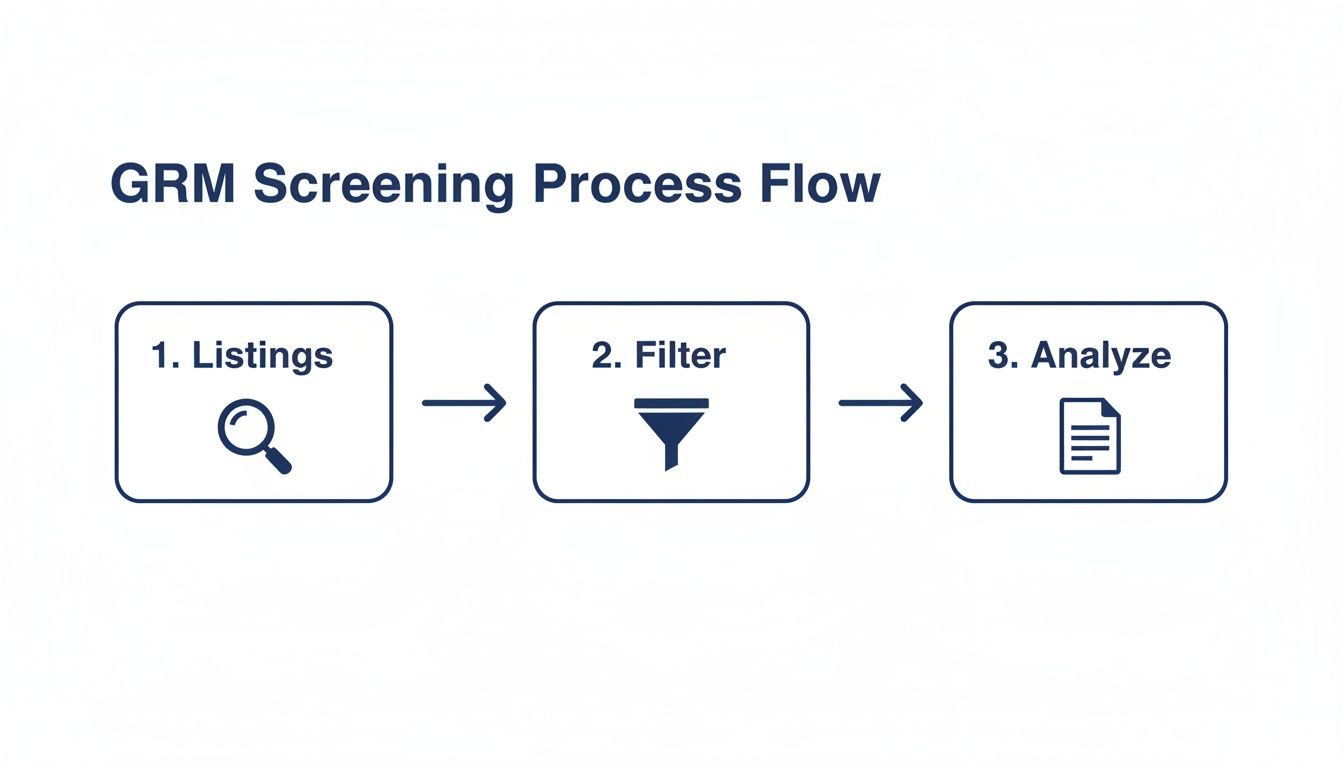
This kind of initial filter helps you weed out the duds and focus your time on the properties that truly deserve a detailed financial workup.
A Simplified 5-Year DCF Example
Let's walk through a quick example. Imagine you're looking at a property that you expect to generate a net cash flow of $5,000 in its first year. You project this cash flow will grow by a modest 3% each year.
The projected annual cash flows would look something like this:
- Year 1: $5,000
- Year 2: $5,150
- Year 3: $5,305
- Year 4: $5,464
- Year 5: $5,628
Now, let's bring those future earnings back to the present using a 10% discount rate. That $5,150 you're expecting in year two is actually only worth $4,256 in today's money. You repeat this calculation for each year's cash flow and also for the estimated proceeds from the final sale.
By adding up the present value of each year's cash flow and the present value of the final sale, you arrive at the property's intrinsic value according to your DCF model. If this number is higher than the asking price, you've likely found a solid long-term investment.
Yes, DCF is more work than the other valuation methods. There’s no question about it. But it forces you to think critically about every single variable that can impact your investment, from local rent trends to long-term market shifts. That depth gives you a level of confidence that simpler metrics just can't match when it's time to pull the trigger on a deal.
Comparing Valuation Methods at a Glance
Each valuation method we've covered has its own strengths and is suited for different situations. No single method tells the whole story, which is why seasoned investors often use a combination to get a well-rounded view of a property's potential.
The table below breaks down the four primary methods, highlighting what they're best for and how a tool like Property Scout 360 can streamline the process.
| Valuation Method | Best For | Key Consideration | Property Scout 360 Feature |
|---|---|---|---|
| NOI & Cap Rate | Quick comparison of similar commercial or multi-family properties in a specific market. | Highly dependent on accurate, current market cap rate data. | Automatically calculates NOI and provides real-time market cap rate comparisons. |
| Gross Rent Multiplier (GRM) | Fast, initial screening of a large number of single-family or small multi-family listings. | Ignores property expenses, which can vary widely. | Instantly calculates GRM for any listing, allowing for rapid filtering of deals. |
| Discounted Cash Flow (DCF) | In-depth analysis for long-term, buy-and-hold investors who want a complete financial picture. | The valuation is only as good as your future assumptions (growth, inflation, etc.). | Pro DCF Calculator lets you model multiple scenarios with adjustable growth and discount rates. |
| Comparable Rents | Determining the market rent for a potential property to ensure cash flow projections are realistic. | Relies on finding truly comparable properties in the immediate vicinity. | Provides a Rent Comps Analysis using verified, up-to-date rental data from the local area. |
Ultimately, using these methods together gives you a much clearer, more reliable picture of a property's true value. Relying on just one is like trying to build a house with only a hammer—you need the full toolbox to get the job done right.
How to Automate and Streamline Your Analysis
Let's be honest. Running all these calculations by hand for every single property you look at is a killer. It's not just tedious—it's how you get burned out and make expensive mistakes. Spreadsheets are great, but they're also notorious for human error. One bad formula or an old property tax figure can completely wreck your valuation, turning what looked like a great deal into a money pit.
This is where you graduate from theory to efficient, real-world execution. Modern analysis tools are built to do the heavy lifting, shifting your focus from hours of data entry to minutes of smart decision-making.
Moving Beyond the Manual Spreadsheet
Think about what it takes to analyze just one property. You're hunting down local rent comps, digging through county records for tax history, calling around for insurance quotes, and trying to find accurate vacancy rates. Now, try doing that for ten or twenty properties a week. It’s just not realistic if you want to grow.
This is exactly the problem platforms like Property Scout 360 were designed to solve. They tap into verified data from local markets across the country, pulling in everything you need instantly.
- Current Rental Rates: Get accurate rent estimates based on what’s happening right now, not on stale listings.
- Property Tax History: Pull actual tax data straight from county records so your expense numbers are spot-on.
- Insurance Estimates: See what insurance will likely cost based on the property’s location and type.
- HOA Fees: Automatically include any homeowners' association dues in your calculations.
With all this information populated in seconds, your NOI, cap rate, and cash-on-cash return are calculated before you can even open a new spreadsheet tab. For any investor serious about scaling, that speed is a huge advantage. You can analyze more deals, submit offers faster, and operate with a confidence that manual number-crunching just can't match.
If you're still building your own system, our guide on creating a better rental property analyzer spreadsheet can show you which metrics are essential to track.
The Power of Instant Scenario Modeling
Beyond just saving time, automation gives you a much deeper understanding of a deal. What happens to your cash flow if you put 25% down instead of 20%? How does a 15-year mortgage change your long-term equity compared to a 30-year loan? Answering these questions manually is a chore.
The dashboard below is a perfect example of how a platform can visualize key metrics, giving you a quick financial health check on a property.
This immediate feedback lets you stress-test your investment against different scenarios, showing you exactly how sensitive your returns are to certain changes.
This shift from data entry to strategic analysis is what separates successful investors from those who get stuck in the weeds. Automation doesn't just save time; it elevates the quality of your decisions.
This level of precision is critical. Experienced investors consistently aim for 8–15% annual returns, and it's not by accident. They get there through meticulous cash flow calculations that account for every variable before they buy.
Ultimately, automating your analysis means you spend less time acting like a data clerk and more time thinking like an investor. To take it a step further, you can even explore Excel AI tools for smarter spreadsheets to enhance your workflow. This frees you up to focus on what really matters: finding the right markets, negotiating better deals, and building a portfolio that will last.
Your Top Rental Property Valuation Questions, Answered
Even when you have the formulas down, real-world valuation always brings up new questions. It's totally normal. Getting a handle on these common sticking points is what separates a confident investor from one who makes costly mistakes. Let's tackle some of the most frequent questions I hear from both new and seasoned investors.
What Is a Good Cap Rate for a Rental Property?
This is the classic question, and the honest answer is: it depends. There's no magic number that works for every property in every city.
A lower cap rate, maybe around 4-6%, might actually be fantastic in a hot market like San Diego or Austin where you're banking on appreciation. It signals stability and high demand. On the other hand, if you're looking at a property in a smaller, up-and-coming town, you’d want to see a much higher cap rate, say 7-10%, to make the risk worthwhile.
My advice? Stop worrying about the national average. Instead, focus on what's normal for that specific neighborhood. A cap rate is just a snapshot of risk versus return, and what matters is how your potential deal stacks up against similar properties that recently sold right down the street.
Key Takeaway: A "good" cap rate is one that makes sense for the local market and fits your personal investment strategy. It’s not a universal benchmark but a local data point that helps you make a smarter decision.
How Do I Accurately Estimate Operating Expenses?
You’ve probably heard of the "50% Rule," where you assume half your rent goes to expenses. It's a fine rule of thumb for a quick back-of-the-napkin calculation, but you should never make an offer based on it. For a real analysis, you need to get your hands on real numbers.
Here’s how you do it, step-by-step:
- Property Taxes: Don't estimate. Go directly to the county assessor’s website and look up the property's actual tax history. It’s public information.
- Insurance: Pick up the phone and call a local insurance agent. Getting a real quote for a landlord policy is free and only takes a few minutes.
- Maintenance & Repairs: I always budget at least 1% of the property’s value per year for this. If the place has an older roof or an aging HVAC system, you might want to bump that up.
- Vacancy: A safe bet is 5-10% of your gross rent. If you're in a college town where apartments sit empty all summer, you'll want to lean toward the higher end of that range.
- Property Management: If you plan on hiring a pro, expect to pay 8-12% of the monthly rent. Don't forget to factor this in, even if you plan to self-manage at first—you may want the option later.
Which Valuation Method Is the Most Reliable?
The truth is, no single method is perfect. The smartest investors don’t just pick one; they use several together to get a complete 360-degree view of the deal.
Think of it as a funnel. You start broad and get progressively more detailed.
- Gross Rent Multiplier (GRM): This is your first-pass filter. When you're looking at a dozen potential properties, the GRM helps you quickly weed out the obviously overpriced ones.
- Cap Rate Method: Once you have a shortlist, the cap rate is perfect for comparing the day-one profitability of your top two or three contenders.
- Discounted Cash Flow (DCF): This is the final boss. You save this deep-dive analysis for the one property you're serious about. It tells you the story of its long-term financial health, projecting performance years into the future. It’s what confirms you’ve found a winner before you sign on the dotted line.
Ready to stop guessing and start making data-driven decisions? Property Scout 360 automates these calculations for you, pulling real-time market data to deliver instant ROI, cash flow, and cap rate analysis on any U.S. property. Find your next profitable investment in minutes at https://propertyscout360.com.
About the Author
Related Articles
2026 Investor's Guide: Cost of Installing a Sewer Clean Out
Understand the cost of installing a sewer clean out for investment properties in 2026. Get expert advice on prices, ROI, & budgeting for flips. Plan smart!
15 Year vs 30 Year Mortgage: The Investor's Choice
Deciding between a 15 year vs 30 year mortgage for a rental property? Our guide analyzes cash flow, ROI, and equity to help you pick the best loan.
Real Estate Appraisal Software: Features & Limits
Discover what real estate appraisal software is, its core features, and limits. See how it differs from investment tools for profitable deals.
