Debt Coverage Ratio Real Estate: A Practical Guide for Investors
Discover the debt coverage ratio real estate and how to calculate DSCR, interpret results, and secure better financing terms.
You've found the perfect investment property. It looks like a winner. But when you apply for a loan, you get a flat-out "no." What happened? More often than not, the culprit is a single, crucial number: the debt coverage ratio real estate investors live and die by.
Think of it as a financial stress test. It tells a lender, in no uncertain terms, whether your property’s income can handle the mortgage payments—with a comfortable margin for error.
The Single Metric Lenders Care About Most

As an investor, you're probably zeroed in on metrics like cash-on-cash return or cap rate. But lenders? They have a one-track mind. They need to answer one question above all else: can this property produce enough cash to pay us back, even if things get a little bumpy?
The Debt Service Coverage Ratio (DSCR) gives them that answer, loud and clear. It’s the universal language of real estate finance, cutting through the noise to provide a standardized snapshot of a property’s financial health from the lender's perspective. A solid DSCR isn't just a ticket to getting your loan approved; it's a signal of a low-risk deal, often opening the door to better interest rates and more attractive loan terms.
Why This Ratio Is a Non-Negotiable
For a bank, underwriting an investment property loan is purely a game of risk management. They aren't betting on appreciation or future potential. They are focused on one thing: ensuring the asset can pay for itself and cover its debt obligations, month after month.
The DSCR is their go-to tool because it directly addresses their biggest worries:
- It Demands a Cash Flow Buffer: A DSCR above 1.0 shows that a property brings in more cash than it needs to pay the mortgage. This surplus acts as a vital cushion against surprise vacancies or unexpected maintenance costs.
- It Standardizes Risk: This simple ratio allows a lender to compare apples to oranges—a small duplex versus a sprawling apartment complex—using the exact same objective yardstick.
- It Predicts Default Risk: History shows that properties with a consistently low DSCR are far more likely to default on their loans. For a lender, that’s a red flag they simply can't ignore.
The DSCR is the gatekeeper to financing. It’s not just a number on a spreadsheet; it’s the proof a lender needs to see that your investment is sound and capable of weathering economic fluctuations without missing a payment.
DSCR and Your Investment Strategy
Learning to master the debt coverage ratio in real estate gives you a massive advantage: you start seeing deals through a lender’s eyes. This shift in perspective is a game-changer. It helps you instantly weed out properties that will never get financed and lets you focus your energy on deals with solid fundamentals.
It forces you to be disciplined, moving your focus from hopeful appreciation to proven, income-generating performance. Getting a handle on metrics like DSCR is just as critical as understanding how concepts like what debt yield is can provide another layer of risk analysis for commercial lenders. When you build this skill, you’re no longer just an investor; you become a bankable partner, ready to build a strong and scalable portfolio.
Understanding the Debt Coverage Ratio Formula
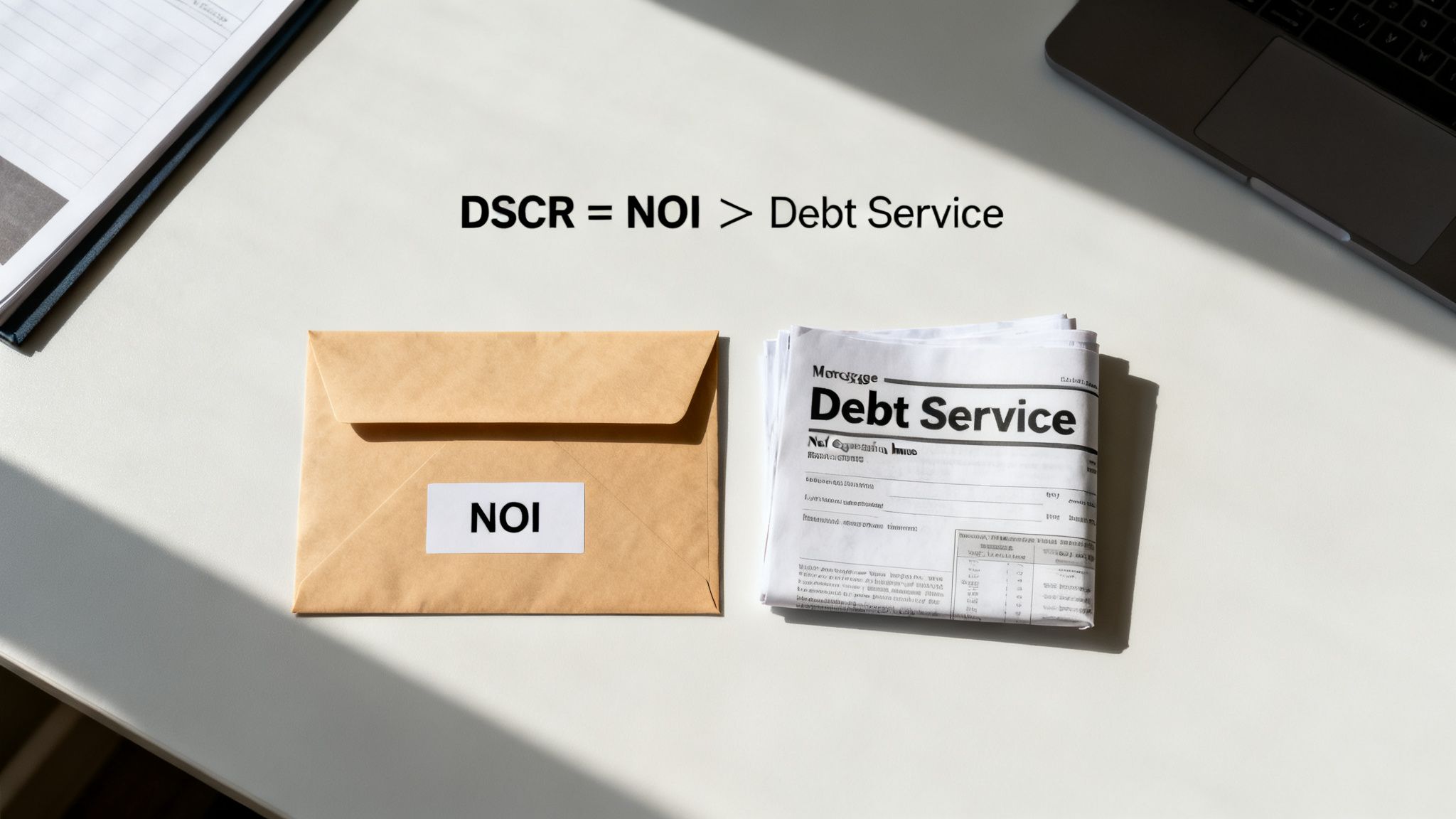
You don't need an MBA to get a handle on the debt coverage ratio in real estate. At its core, it's a simple and powerful concept that cuts right to the chase. The formula is just a direct comparison between the money a property brings in and the money it owes on its mortgage.
Think of it like your personal finances. Your property's income is the paycheck, and the mortgage is your biggest monthly bill. The DSCR formula answers a crucial question: "How many times over can my property's paycheck cover its biggest bill?" Lenders need to see a healthy surplus—a safety cushion for when things don't go exactly as planned.
The Two Ingredients of DSCR
The DSCR formula is surprisingly simple, built from just two key numbers. Getting these right is the whole game. Once you understand them, you start seeing a property the way a lender does.
1. Net Operating Income (NOI)
This is the property's pure profit before you even think about the loan payment. To find your NOI, you take all the money the property generates and subtract all the costs of running it day-to-day.
- What goes in: Start with your gross rental income. Then, add any other revenue you collect, like fees for parking, laundry, or storage units.
- What comes out: Subtract all your operating expenses—the necessary costs to keep the lights on. This includes property taxes, insurance, management fees, maintenance, repairs, utilities, and a set-aside for potential vacancies.
The most important thing to remember is that NOI does not include the mortgage payment. We keep that separate because the whole point is to see if this profit figure is big enough to cover that specific debt.
2. Total Debt Service
This one is much more straightforward. Your Total Debt Service is simply the grand total of all principal and interest payments you have to make on the loan over a full year.
So, if your monthly mortgage payment is $2,000, your annual Total Debt Service is $24,000. That's it.
The Magic Formula
With those two pieces, the formula for the debt coverage ratio snaps into place:
DSCR = Net Operating Income (NOI) / Total Debt Service
Let's plug in some real numbers. Say your property's NOI is $30,000 for the year, and its annual Total Debt Service is $24,000.
Your DSCR would be 1.25 ($30,000 / $24,000). This simple number tells a powerful story: your property generates 25% more cash than it needs to cover the mortgage. That's a healthy financial buffer.
Why Lenders Obsess Over This Ratio
For a lender, the debt coverage ratio for real estate is their number one risk-assessment tool. It's not just about whether you can pay the mortgage this month. It's about whether you can still pay it if things go sideways.
A property with a DSCR of 1.0 is treading water. Every dollar of profit goes straight to the bank. This is a terrifying position for a lender. What if a tenant leaves unexpectedly or the roof starts leaking? The property immediately goes into the red, and the risk of default goes through the ceiling.
On the other hand, a property with a strong DSCR—say, 1.35 or higher—is a picture of financial health. It tells the lender that the investment is resilient. It can absorb a vacancy, a dip in rental rates, or a sudden big repair bill and still make its loan payments on time. That financial cushion is exactly what gives a lender the confidence to say yes.
How to Calculate DSCR Step by Step
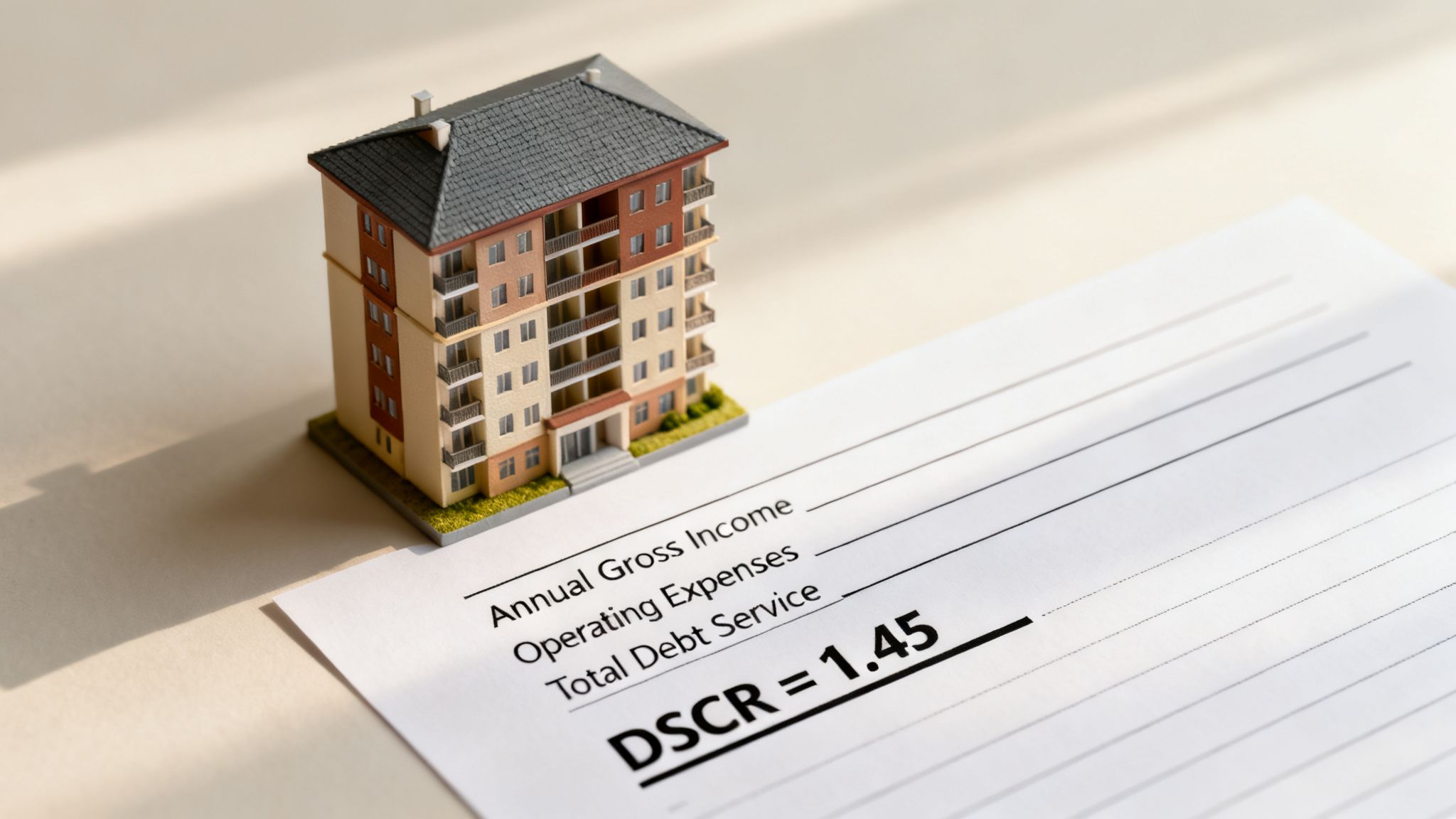
Calculating the debt coverage ratio in real estate might feel a bit intimidating at first, but it really boils down to a logical, four-step process. Once you get the hang of it, you’ll be able to confidently analyze any deal and see it through a lender's critical eyes.
The formula itself is pretty simple, but the real key is finding the right numbers to plug in. That's where precision matters.
DSCR = Net Operating Income (NOI) / Total Annual Debt Service
Let’s bring this formula to life with a practical example. We'll walk through the numbers for a small duplex to see if it would meet a lender’s typical standards. This way, you'll see exactly where each number comes from and how they all fit together.
Step 1 Find the Net Operating Income
First things first, you need to nail down the property's Net Operating Income (NOI). Think of NOI as the property's pure, unadulterated annual profit before you've paid the mortgage. It's the most critical piece of the debt coverage ratio real estate puzzle because it tells you how well the asset is actually performing.
To get your NOI, you just need two things: the property’s total income and its total operating expenses.
Calculate Annual Gross Income: Start by adding up every single dollar the property brings in over a year. This obviously includes rent, but don't forget other potential income streams.
- Rental Income: Unit 1 rents for $1,600/month and Unit 2 rents for $1,600/month.
- Other Income: The building also has coin-operated laundry that brings in $100/month.
- Total Annual Gross Income: ($1,600 + $1,600 + $100) x 12 = $39,600.
Calculate Annual Operating Expenses: Next, you subtract all the costs of running the place. It's crucial to be thorough here—forgotten expenses can sink a deal. And remember, the mortgage payment (principal and interest) is not an operating expense.
- Property Taxes: $4,500 per year.
- Insurance: $1,200 per year.
- Repairs & Maintenance (5% of Gross Income): $39,600 x 0.05 = $1,980.
- Vacancy Allowance (5% of Gross Income): $39,600 x 0.05 = $1,980.
- Property Management (8% of Gross Income): $39,600 x 0.08 = $3,168.
- Total Annual Operating Expenses: $4,500 + $1,200 + $1,980 + $1,980 + $3,168 = $12,828.
With your income and expenses tallied, finding the NOI is simple subtraction. A strong NOI is the engine of a healthy investment, a topic we dive into in our guide on rental property cash flow analysis.
Net Operating Income (NOI) = $39,600 - $12,828 = $26,772
Step 2 Determine the Total Annual Debt Service
This next part is much easier. Your Total Annual Debt Service is simply the grand total of all principal and interest payments on your loan for the entire year.
For our duplex example, let's say the proposed new mortgage payment (principal and interest only) is $1,650 per month.
To get the yearly total, just multiply that by 12.
Total Annual Debt Service = $1,650 x 12 = $19,800
This number is what the property must pay the bank each year to stay in good standing. No more, no less.
Step 3 Calculate the Final DSCR
Okay, you’ve done the heavy lifting. You have the property's profit engine (NOI) and its main financial obligation (Debt Service). Now it’s time to put them together and see what the numbers tell us.
Using the formula DSCR = NOI / Total Annual Debt Service:
DSCR = $26,772 / $19,800 = 1.35
This single number tells a powerful story. A DSCR of 1.35 means this duplex generates 35% more income than it needs to cover its mortgage payments. That extra cushion is a safety net for unexpected repairs or a temporary vacancy, which is exactly what makes a deal like this so attractive to a lender.
Sample DSCR Calculation for a Duplex
Here’s a table that lays out the entire calculation from our duplex example, step by step. It’s a great way to visualize how the numbers flow from gross income all the way down to the final ratio.
| Metric | Calculation/Value | Notes |
|---|---|---|
| Gross Rental Income | ($1,600/mo x 2 units) x 12 | $38,400 |
| Other Income | $100/mo x 12 | $1,200 |
| Total Annual Gross Income | $38,400 + $1,200 | $39,600 |
| Total Annual Operating Expenses | Sum of all costs (excl. mortgage) | $12,828 |
| Net Operating Income (NOI) | $39,600 - $12,828 | $26,772 |
| Monthly Debt Service | Principal + Interest Payment | $1,650 |
| Total Annual Debt Service | $1,650 x 12 | $19,800 |
| DSCR | $26,772 / $19,800 | 1.35 |
Breaking it down like this removes the guesswork and gives you a clear, lender-friendly snapshot of the property's financial health.
What Lenders Consider a Good DSCR

So, you've run the numbers and have a DSCR for your target property. Now for the million-dollar question: what does that number actually mean to the person on the other side of the desk? To a lender, your DSCR isn't just a pass/fail grade; it's a detailed report card on your property's financial health.
Lenders use this single metric as their primary tool to sort deals into risk categories, and it directly impacts your ability to get financing. A strong debt coverage ratio in real estate shows them your investment can comfortably handle its debt, even if things don't go exactly as planned. Let's break down how lenders see these numbers.
The DSCR Risk Zones
Think of DSCR like a traffic light. Lenders use it to quickly gauge the risk level of a potential loan, and each "color" tells them exactly what they need to know.
The Red Zone (Below 1.0x): A DSCR under 1.0 is an immediate, non-negotiable deal-breaker. It means the property’s Net Operating Income isn't even enough to cover the mortgage payment. From day one, you'd be feeding the property cash just to keep the lights on. No conventional lender will touch a deal like this.
The Gray Area (1.0x to 1.20x): This range is a financial tightrope. Sure, the property technically makes enough to pay its debt, but there's virtually no margin for error. One unexpected vacancy, a broken water heater, or a surprise tax increase could immediately push you into the red. Most banks will pass on these deals, seeing them as far too risky.
The Green Zone (1.25x and Above): This is where you want to be. A DSCR of 1.25x is the widely accepted industry minimum for most commercial and residential investment properties. It tells a lender that your property generates 25% more cash than it needs to cover the mortgage. That’s a healthy cushion to absorb the inevitable bumps in the road.
A strong DSCR isn't just about getting approved; it's a powerful negotiating tool. When you bring a deal with a DSCR of 1.35x or higher, you're in the driver's seat. Lenders see you as a lower-risk borrower, which often unlocks better interest rates and more favorable loan terms.
Why Lenders Demand a Higher DSCR for Certain Properties
While 1.25x is a great rule of thumb, it's not set in stone. The required debt coverage ratio for real estate can creep up depending on the property type. A lender’s job is to manage risk, and they adjust their DSCR minimums to do just that.
A standard multifamily apartment building, for instance, is considered a stable and predictable asset. Tenants sign year-long leases, creating a steady, reliable income stream. But properties with more volatile cash flow will face much stricter scrutiny.
Lenders will almost always demand a higher DSCR for assets like:
- Hotels and Motels: Their income is based on nightly stays, making them incredibly sensitive to economic swings, seasonality, and local competition. For these, a lender might require a DSCR of 1.40x or higher.
- Special-Purpose Properties: Think restaurants, gas stations, or car washes. These buildings have limited alternative uses. If the business fails, finding a new tenant to fill that specific space is tough. The added risk means lenders often look for a DSCR of 1.50x or more.
This focus on a healthy cash flow buffer is central to today’s real estate investment climate. A recent survey found that over 70% of North American investors plan to keep their current debt levels, with 49% even willing to tolerate short-term negative leverage because they believe in stabilizing rates and strong rental demand. This strategy only works if the property has a strong initial DSCR to weather those fluctuations. You can learn more about this investor sentiment in the full CBRE investor survey.
At the end of the day, a lender's logic is simple: the higher the perceived risk, the bigger the financial safety net they need to see.
How to Fix a Low DSCR (and Save the Deal)
So you ran the numbers on a promising property, only to find the Debt Service Coverage Ratio (DSCR) is in the red zone. Don't walk away just yet. A low DSCR isn't necessarily a deal-killer; it's a signal to sharpen your pencil and find the hidden potential.
Think of a subpar debt coverage ratio in real estate as a problem with two possible solutions. You can either make the property earn more money or find a way to pay less on the loan. It all comes back to the core formula: DSCR = Net Operating Income (NOI) / Total Debt Service. To make that final number bigger, you have to increase the top part (NOI) or shrink the bottom part (Debt Service).
Let’s get into how you can actually do that.
Boost the Net Operating Income (NOI)
Your first move should always be to figure out how to squeeze more cash out of the property. Driving up the NOI doesn’t just solve your immediate DSCR problem—it directly increases the asset's overall value. It’s a win-win.
Here are three reliable ways to make it happen:
Increase Rents: This is the most obvious lever to pull. Look for value-add opportunities. Can you modernize the kitchens and bathrooms to justify charging what other updated units in the area get? Sometimes, even simple cosmetic touches like new paint and modern light fixtures can command a $50-$100 monthly rent premium.
Add New Income Streams: Get creative and find revenue the current owner is leaving on the table. Are there unused parking spots you could charge for? Is there a common area or basement perfect for adding coin-operated laundry or tenant storage lockers? These small additions can generate thousands in extra income each year with minimal upfront cost.
Slash Operating Expenses: Put the property's spending under a microscope. Shop around for better insurance quotes. See if you can appeal the property taxes. Swapping out old light fixtures for LEDs or installing low-flow toilets can trim utility costs, and every dollar you save drops straight to your bottom line.
A higher NOI is the gift that keeps on giving. It helps you get the loan you need today, but it also builds serious long-term equity by making the property worth more when it's time to sell or refinance.
Lower the Total Debt Service
If you've maxed out the income potential and still need a better DSCR, it's time to work on the other side of the equation: the loan itself. Tweaking your financing can have a massive impact on your debt coverage ratio in real estate.
Try these financing strategies:
Make a Larger Down Payment: This is the simplest fix. The more cash you bring to the table, the smaller your loan will be. A smaller loan means a smaller monthly payment, which instantly improves your ratio.
Hunt for a Better Interest Rate: Never take the first offer from a lender. A rate difference of just 0.25% can save you a surprising amount of money over the years and give your DSCR an immediate lift.
Stretch Out the Amortization Period: A 15-year loan builds equity fast, but a 30-year loan gives your cash flow much more breathing room. A longer amortization period means a lower monthly payment, directly reducing your annual debt service. You can always pay extra principal later on if you want.
By pulling these different levers, you can often transform a deal that looks "un-financeable" on paper into a solid investment. For more ideas, check out our guide on how to finance a rental property. Often, a small rent bump combined with a slightly better loan is all it takes to get your DSCR well over the lender's finish line.
Common Questions About the Debt Coverage Ratio
As you start working with the debt service coverage ratio, you'll find a few questions pop up time and time again. Getting clear on these answers is key to understanding why this metric is so foundational to smart real estate investing, no matter what your strategy is.
Let's dig into a few of the most common things that trip investors up when they move from theory to practice. Nailing these nuances can help you dodge costly mistakes and analyze deals with a lot more confidence.
DSCR vs. Loan-to-Value: Which Is More Important?
This is a classic one. Investors often try to pit the Debt Service Coverage Ratio (DSCR) against the Loan-to-Value (LTV) ratio, wondering which one carries more weight. The truth is, they're both essential, but they tell a lender two completely different stories about the deal. Think of it like a doctor's visit: one is your vital signs (cash flow), and the other is your weight and height (leverage). The doctor needs both to assess your health.
Loan-to-Value (LTV) is all about leverage. It's a simple comparison of the loan amount to the property's appraised value. If you have an 80% LTV, it just means the bank is putting up 80% of the money, and you're bringing the other 20% to the table. LTV protects the lender if property values fall.
Debt Service Coverage Ratio (DSCR) is all about cash flow. It completely ignores what the property is worth and focuses on one simple question: does the income cover the mortgage? DSCR protects the lender if the property's income takes a hit.
So, which one wins? Neither. They're a team. A stellar 1.50 DSCR won't do you much good if you're asking for a 95% LTV—most lenders will run from that kind of leverage. On the flip side, putting down 50% (a fantastic LTV) won't get you a loan if the property's DSCR is below 1.0.
Can You Get a Loan with a DSCR Under 1.0?
With a traditional bank? Almost never. A DSCR below 1.0 is a giant red flag that screams the property is losing money each month before you even pay the mortgage. It’s a cash-flow-negative deal from day one, and no standard underwriter is going to touch that.
That said, there are some niche situations where it can happen.
Private money and hard money lenders might consider financing a deal with a sub-1.0 DSCR, but they'll need to see a very compelling story. This usually happens on short-term, value-add projects. The investor needs a rock-solid, believable plan to quickly boost rents or slash expenses to get that DSCR well into healthy territory after a renovation.
Why DSCR Matters Even for All-Cash Purchases
This one seems a bit strange at first, right? If you're buying with cash, there's no debt service, so why would the debt coverage ratio in real estate even matter?
Think of it as a stress test. Calculating a hypothetical DSCR on a cash purchase tells you how the property would perform if you decided to finance it down the road. This is absolutely critical for anyone using the BRRRR (Buy, Rehab, Rent, Refinance, Repeat) strategy or for investors who want the flexibility to pull their capital out later with a cash-out refinance.
A property that can't support a mortgage with its own income is a dead end for your capital. It limits your strategic options and ties up your cash indefinitely.
Ready to stop wrestling with spreadsheets and start analyzing deals like a pro? Property Scout 360 gives you instant DSCR calculations, cash flow projections, and market insights so you can find profitable properties in minutes, not weeks. Learn more about Property Scout 360.
About the Author
Related Articles
2026 Investor's Guide: Cost of Installing a Sewer Clean Out
Understand the cost of installing a sewer clean out for investment properties in 2026. Get expert advice on prices, ROI, & budgeting for flips. Plan smart!
15 Year vs 30 Year Mortgage: The Investor's Choice
Deciding between a 15 year vs 30 year mortgage for a rental property? Our guide analyzes cash flow, ROI, and equity to help you pick the best loan.
Real Estate Appraisal Software: Features & Limits
Discover what real estate appraisal software is, its core features, and limits. See how it differs from investment tools for profitable deals.
