How to Determine Rental Property Value for Smart Investing
Learn how to determine rental property value with proven methods. This guide covers income analysis, market comps, and key financial metrics for investors.
Before you even think about making an offer, you have to know what a rental property is really worth. This goes way beyond the asking price. You need to dig into its income potential, see how it stacks up against the competition, and figure out the true, all-in costs of owning it.
Getting this right is a mix of art and science. It’s about running the numbers, but also having a feel for the market. Nailing this process is the absolute foundation of building a real estate portfolio that actually makes you money.
Why Accurate Property Valuation Is Your Smartest Move
Of all the skills a real estate investor needs, learning how to properly value a property is the most important. I can't stress this enough. It’s not just about making sure you don't overpay—it’s about spotting the deals others miss and building a portfolio that can handle whatever the market throws at it.
A solid valuation is the bedrock of your entire investment strategy. It directly impacts your cash flow, your potential for appreciation, and ultimately, your return on investment (ROI). Going with your gut or relying on flimsy data is how investors get burned. You have to treat this like a business decision, driven by hard numbers. That mindset will save you, especially when the market gets shaky.
The Foundation of Profitability
When you can accurately value a property, you're putting yourself in the driver's seat. It's your best defense against risk and your clearest path to profit.
Here’s what it allows you to do:
- Negotiate from a Position of Strength: Walk into a negotiation armed with data, and you're no longer just haggling. You can make confident offers and counter-offers knowing exactly what the property is worth.
- Forecast Cash Flow Realistically: A proper valuation is tied directly to rental income and expenses. It lets you project your numbers with much better accuracy, so you can be sure the property will be cash-flow positive.
- Secure Favorable Financing: Banks live and die by appraisals, which are just a formal type of valuation. When your own analysis lines up with the bank's, the financing process becomes a whole lot smoother.
- Identify Value-Add Opportunities: Sometimes, a property is priced low for a reason, but that reason is fixable. A deep-dive valuation can uncover opportunities to boost its worth, whether through smart renovations or by bringing rents up to market rate.
The secret to a great real estate deal isn’t finding a cheap property. It’s about finding a property priced below its intrinsic value. Your ability to calculate that value is what separates a savvy investor from a gambler.
Moving Beyond Basic Estimates
Those free online valuation tools? They're a starting point, at best. They give you a quick, ballpark figure but often miss the details that matter—the property's actual condition, recent upgrades, or the subtle differences between one block and the next. This is where you have to do the real work.
Fortunately, you don't have to do it all in a spreadsheet anymore. Modern platforms like Property Scout 360 have closed the gap. They pull in automated data but also let you run detailed financial models. Instead of spending a week building a spreadsheet, you can get instant calculations for cash flow, cap rate, and ROI.
These tools make the complex parts of valuation much more manageable, turning a mountain of data into insights you can actually use. In this guide, we’ll walk through the exact methods you need to master, step by step.
Running the Comps: A Real-World Guide to Market Analysis
If there's one skill every real estate investor needs to master, it's how to accurately run the "comps." This process, formally known as a Comparable Market Analysis (CMA), is the bedrock of property valuation. It’s how you figure out what a property is really worth by comparing it to similar properties that have recently been rented or sold nearby.
The idea is to create a true apples-to-apples comparison. It’s not enough to just find another three-bedroom house in the same city. We have to dig deeper to account for the subtle—but critical—differences that impact value. Nailing this process is what separates a savvy investment from a costly mistake. It helps you avoid overpaying and, just as importantly, spot a genuinely good deal.
Finding Genuinely Comparable Properties
Your first task is to find a handful of properties that are truly similar to the one you're analyzing. A 3-bed, 2-bath house clear across town isn’t a helpful data point. You have to get granular.
Here's what to zero in on when searching for comps:
- Property Type: Always compare like with like. Single-family homes get compared to other single-family homes, and duplexes to other duplexes.
- Location: Stay hyper-local—within the same neighborhood, or even just a few blocks away. Value can shift dramatically just by crossing a major road or school district line.
- Size and Layout: Look for properties with a similar square footage (ideally within 10-15%) and the same number of bedrooms and bathrooms.
- Age and Condition: A freshly renovated home will always fetch more than a tired, dated one, even if they're identical on paper. Try to find comps built around the same time and in a similar state of repair.
A common mistake I see is investors using comps that are too old. In a market that's moving quickly, a sale from six months ago might as well be from another era. For the most reliable valuation, stick to properties sold or rented within the last 90 days.
Sourcing Reliable Data for Your Analysis
Knowing what to look for is half the battle; the other half is knowing where to find it. While consumer-facing sites like Zillow or Redfin can give you a quick snapshot, serious investors need to rely on more professional-grade data.
The Multiple Listing Service (MLS) is the gold standard here. It's the most accurate, up-to-the-minute database of property listings and sales. Access is typically restricted to licensed agents, but partnering with an investor-friendly realtor is a great way to get your hands on this information.
For investors who prefer to hunt for deals on their own, tools like Property Scout 360 are a game-changer. These platforms tap directly into MLS feeds from all over the country, giving you the same high-quality data the pros use. You can filter for comps based on your exact criteria without needing to go through an agent. If you're new to this, it's worth learning how to pull free real estate comps using the right software.
This entire process, from running comps to calculating returns, is what separates guessing from investing.
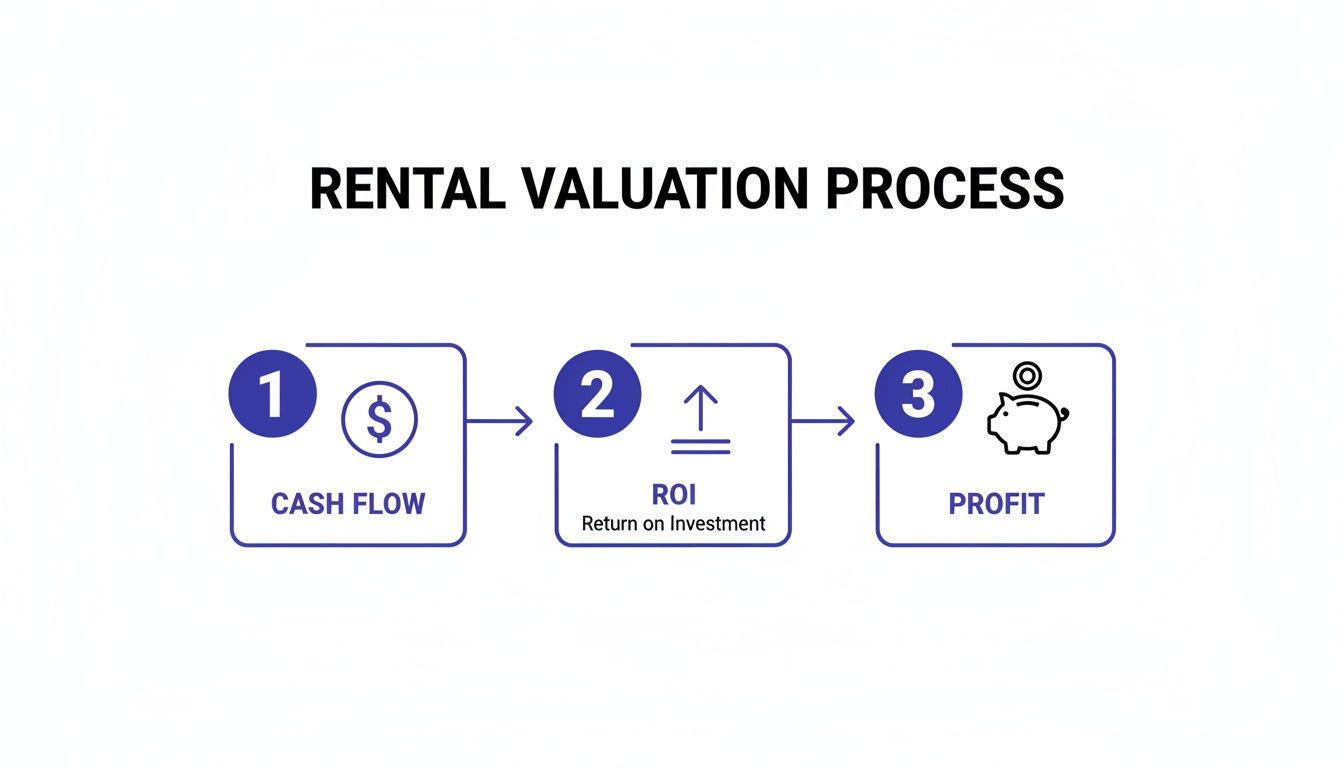
As you can see, a solid valuation is the starting point for everything that follows—cash flow, ROI, and ultimately, your profit.
Making Smart Adjustments for Key Differences
Let's be realistic: no two properties are ever 100% identical. This is where the real art of valuation comes in—making adjustments for the differences between your property and the comps.
You have to assign a dollar value to features that add or subtract from a property's appeal. For instance, if your target property has a two-car garage but a comparable only has one, you'll need to adjust the comparable's price upward to level the playing field.
Let's walk through a quick example:
- Your Subject Property: A 3-bed, 2-bath, 1,500 sq ft home in decent shape.
- Comparable A: Sold last month for $300,000. It's almost identical, but it boasts a brand-new, high-end kitchen, whereas yours is dated.
- The Adjustment: You figure that fancy kitchen adds about $20,000 in value. So, you'd adjust its sale price down to $280,000 to make it comparable to your property.
- Comparable B: Sold two months ago for $275,000. It's the same size and layout, but it only has one bathroom.
- The Adjustment: In your market, an extra full bathroom is easily worth $15,000. So, you'd adjust this comp's price up to $290,000.
After making these adjustments, you have a much tighter and more defensible value range for your property—somewhere between $280,000 and $290,000.
This table gives you an idea of what a simple adjustment worksheet might look like.
Rental Comps Adjustment Guide
| Feature | Subject Property | Comparable A | Adjustment (+/-) | Comparable B | Adjustment (+/-) | Comparable C | Adjustment (+/-) |
|---|---|---|---|---|---|---|---|
| Sale Price | - | $315,000 | - | $295,000 | - | $305,000 | - |
| Sq. Footage | 1,800 | 1,900 | -$5,000 | 1,800 | $0 | 1,750 | +$2,500 |
| Bedrooms | 4 | 4 | $0 | 4 | $0 | 3 | +$10,000 |
| Bathrooms | 2 | 2.5 | -$4,000 | 2 | $0 | 2 | $0 |
| Garage | 2-car | 2-car | $0 | 1-car | +$8,000 | 2-car | $0 |
| Condition | Good | Excellent | -$10,000 | Good | $0 | Fair | +$12,000 |
| Adjusted Value | $296,000 | $303,000 | $329,500 |
By methodically adding and subtracting value for each key difference, you move from a rough guess to a data-backed valuation you can confidently use to make an offer.
Valuing a Property Based on Its Income Potential
While checking out the neighborhood comps gives you a solid starting point, for a serious investor, that's only half the story. The real worth of a rental property is tied directly to its ability to generate cold, hard cash. This is where we stop thinking like a homebuyer and start thinking like a business owner, learning how to determine rental property value based purely on its income.
This approach cuts through the noise and zeroes in on the numbers. It answers the single most important question you should be asking: "How much money will this asset actually put in my pocket?" Let's walk through three powerful methods to figure that out, starting with the absolute bedrock of real estate investing.
Mastering NOI and the Cap Rate
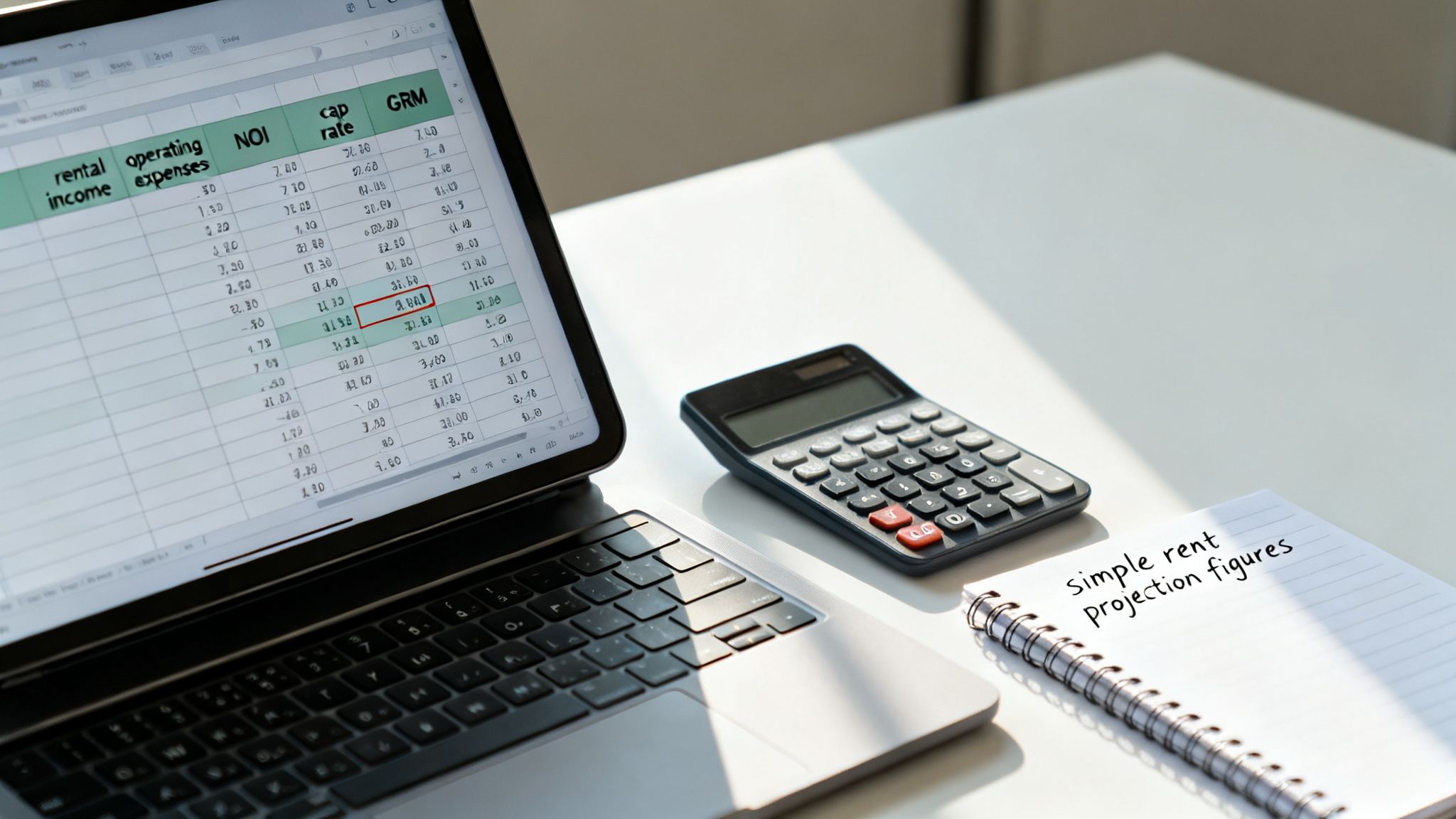
At the heart of any income-based valuation are two metrics you absolutely have to know: Net Operating Income (NOI) and the Capitalization Rate (Cap Rate). Getting a grip on these is non-negotiable if you want to make smart deals.
NOI is simply the total income a property brings in over a year after you’ve paid all the necessary operating expenses. Think of it as the property's annual profit before you factor in your mortgage or income taxes.
The formula is pretty straightforward:
Gross Rental Income - Operating Expenses = Net Operating Income (NOI)
Let's plug in some real numbers to see this in action. Imagine a duplex we're looking at:
- Gross Rental Income: Each unit rents for $2,000 a month, giving us a total of $48,000 per year.
- Operating Expenses: We know property taxes are $5,000 a year, insurance is $1,500, and we’ll pay $2,400 for property management (a standard 5% of gross rent). It's also smart to budget for maintenance, so we'll set aside $3,840 (8% of gross rent). That brings our total expenses to $12,740.
- NOI Calculation: $48,000 (Income) - $12,740 (Expenses) = $35,260 in NOI.
Once you know the NOI, you can find the cap rate. This little number tells you the rate of return you’d get on your investment if you bought the property with all cash.
The formula looks like this:
NOI / Property Value = Cap Rate
But what we really want to do is figure out the value. So, we just flip the formula around:
NOI / Market Cap Rate = Property Value
If other duplexes in that area are trading at a 6% cap rate, we can get a pretty good idea of our property's value: $35,260 / 0.06 = $587,667. This is a fantastic way to check if a seller's asking price is grounded in financial reality. To see how things like market shifts can affect this number, you might want to read our guide on the pro forma cap rate.
Using the Gross Rent Multiplier for Quick Checks
Sometimes you just need a fast, back-of-the-napkin way to size up a property, especially when you're sifting through dozens of listings online. That's where the Gross Rent Multiplier (GRM) comes in handy. It’s a much simpler metric because it completely ignores operating expenses.
The GRM just compares the property’s price to its gross annual rent.
Property Price / Gross Annual Rent = Gross Rent Multiplier (GRM)
So, if a property is listed for $400,000 and pulls in $40,000 in gross rent, the GRM is 10 ($400,000 / $40,000).
To use this to find value, you first need to figure out the typical GRM for your market by looking at recent, similar sales. Let's say you find that comparable properties are selling at a GRM of 9. If your target property generates $42,000 a year in rent, you can do a quick estimate:
- Value Estimate: $42,000 (Gross Rent) x 9 (Market GRM) = $378,000.
If the seller is asking $450,000, your quick GRM check is waving a red flag—it might be overpriced.
Just be careful. The GRM has its limits. Because it doesn't account for expenses like taxes, insurance, or maintenance, it can be really misleading. A property with a low GRM might look like a steal, but it could have crazy high operating costs that will absolutely crush your cash flow. It’s a great screening tool, but never your final decision-maker.
Forecasting with Discounted Cash Flow Analysis
For investors who are in it for the long haul, Discounted Cash Flow (DCF) analysis offers a much more sophisticated picture. This method is more complex, no doubt, but it's a powerful way to determine rental property value by projecting its performance years into the future.
The big idea behind DCF is that a dollar today is worth more than a dollar tomorrow. DCF analysis forecasts all the money a property will generate over your entire holding period (say, 10 years) and then "discounts" those future earnings back to what they're worth in today's money.
Here’s a simplified rundown of how it works:
- Project Annual NOI: You’ll estimate the NOI for every year you plan to own the property, factoring in things like annual rent bumps (maybe 3%) and rising expenses (say, 2%).
- Estimate Sale Price: You also have to project what you think you can sell the property for at the end of that 10-year period.
- Choose a Discount Rate: This is your personal required rate of return, based on the risk you're willing to take.
- Calculate Present Value: Finally, you run the numbers to discount all those future cash flows—the yearly NOI plus the final sale price—back to their present-day value.
This method really forces you to think critically about the future, from rent growth and vacancy rates to big-ticket repairs down the road. It’s the most thorough way to understand a property’s true value based on its long-term potential.
The focus on stable, predictable income is more important now than ever. With the global real estate market reaching USD 4.34 trillion in 2025 and projected to clear USD 7 trillion by 2034, savvy investors are doubling down on assets with solid income and occupancy. This confirms that properties with predictable cash flow will always command a premium. You can dig into more about these global real estate investment trends to see why this kind of income analysis is so critical.
Factoring in the True Costs of Ownership
That big gross rent number looks great on paper, but it’s just the starting line. The real secret to figuring out a property's worth—and whether it will actually make you money—lies in digging into the expenses.
Getting this part right is what separates seasoned investors from rookies. If you miss a few key costs, a deal that looks like a home run can quickly turn into a money pit. To get an accurate valuation, you have to be relentless in uncovering every single cost that will hit your bottom line.

Estimating Vacancy and Credit Loss
Let's get one thing straight: no property stays occupied 100% of the time. It’s just not realistic. Tenants leave, and finding a new one takes time. That gap between renters is called vacancy, and it's a direct hit to your income.
Many investors use a standard 5% of gross rent for their vacancy estimate, but honestly, that’s just a guess. You have to look at the local market. In a high-demand area, you might only see a 2-3% vacancy rate. But if you're in a slower market or the property isn't as appealing, that number could easily jump to 8-10% or even higher.
The best approach? Talk to local property managers. They live and breathe this data. A vacancy rate grounded in local reality makes your entire analysis far more trustworthy.
Building a Comprehensive Operating Expense List
Operating expenses are all the regular costs you'll pay just to keep the lights on and the property running smoothly. Think of it as the cost of doing business as a landlord. Forgetting to account for these is a fast track to negative cash flow.
Your expense checklist needs to be thorough. At a minimum, it should include:
- Property Taxes: Often your biggest expense. Don't guess—look up the actual tax records.
- Insurance: Landlord insurance is an absolute must-have.
- Utilities: Even if tenants pay most, you might be on the hook for water, sewer, or trash.
- Property Management Fees: If you hire a pro, budget 8-10% of the rent they collect.
- Repairs and Maintenance: From a running toilet to a faulty garbage disposal, things will break.
- Landscaping/Snow Removal: Curb appeal and safety aren't free.
- Pest Control: Proactive treatment is always cheaper than dealing with a full-blown infestation.
- HOA Fees: A mandatory cost if the property is part of a homeowners' association.
Here's a pro tip: Whenever possible, work with real numbers, not estimates. Ask the current owner for copies of their recent tax and utility bills. For insurance and management, get actual quotes. Hard data beats a generic percentage every single time.
Planning for Major Capital Expenditures
This is the big one. Capital Expenditures, or CapEx, are the large, infrequent, and gut-wrenchingly expensive replacements that every building needs over time. We're not talking about fixing a leaky faucet; we're talking about major surgery on the property.
These are the items that can wipe out your cash flow for years if you're not prepared:
- A new roof ($8,000 - $15,000+)
- An HVAC system replacement ($5,000 - $12,000)
- New siding or a full set of windows
- Repaving a cracked driveway
A good rule of thumb for budgeting is the "1% Rule," where you set aside 1% of the property's purchase price each year for these big-ticket items. So for a $300,000 property, you'd save $3,000 annually, or $250 a month. For an older property with aging systems, you should probably bump that up to 1.5% or 2%. Ignoring CapEx is a gamble you'll eventually lose.
To keep all these numbers straight, it helps to use a system. You can learn more by checking out our guide on setting up a rental income and expenses spreadsheet.
Putting It All Together: From Numbers to a Final Value
So, you've run the numbers. The Comparable Market Analysis points to $310,000, the Cap Rate calculation suggests $325,000, and the Gross Rent Multiplier is hovering around $295,000. Now what? This is where the real analysis begins—turning those disparate figures into a single, defensible valuation.
Leaning on just one metric is a classic rookie mistake. Every seasoned investor knows that each method offers a unique lens through which to view the property. The real skill lies in "triangulating" these results to see where they align and, more importantly, to understand why they differ.
Think of this process as your final quality check. If all your valuation methods land in a tight cluster, you can proceed with a high degree of confidence. But if the numbers are all over the place, don't panic. That discrepancy is actually a signal, telling you to dig a little deeper.
What to Do When the Valuations Don't Agree
A significant gap between your numbers is often more revealing than a perfect match. Let's say your income-based methods (Cap Rate or DCF) spit out a much higher value than what the recent sales comps suggest. This is a potential green flag.
It could mean you've stumbled upon an underperforming asset with some serious upside. Perhaps the current owner hasn't raised rents in years, leaving them well below the market rate. A simple adjustment to bring those rents in line could dramatically boost the property's Net Operating Income (NOI) and, consequently, its real value.
On the flip side, what if the comps suggest a high price, but your income analysis shows weak returns? That’s a major red flag. You could be looking at an overvalued property in a "hot" neighborhood where speculation and emotion are driving prices, not solid cash flow fundamentals.
A property's true worth is a blend of what the market says it's worth (comps) and what its financial performance says it's worth (income). Your job is to weigh both and determine a final value that you can defend with hard data.
Don't Forget the Real-World Context
Hard data is your foundation, but it's not the whole story. The final step is to layer in the qualitative factors—the on-the-ground realities that can influence a property’s future.
You need to be asking questions like:
- What’s happening in the neighborhood? Is it on an upward trend with new cafes and businesses, or is it stagnating? Are new public transit lines or parks planned?
- Any major developments on the horizon? A quick check of the city planning website can reveal upcoming projects that could either boost or hurt values.
- How’s the local economy? A strong job market directly impacts tenant demand and your ability to raise rents over time.
This forward-looking perspective is especially critical today. After a few wild years, the rental market is stabilizing. The national rent growth is projected to settle around 2.0% by 2026, but that average hides huge regional differences. For instance, the Northeast is expected to see robust 4–5% annual growth, while the Sun Belt might cool to just 1–2%. You can get a better feel for these trends by reviewing the 2026 apartment housing outlook projections to see where your target market fits.
This is where you can see the power of synthesizing all this data in one place. Platforms like Property Scout 360 are designed to do just that, combining market comps, rent estimates, and expense breakdowns into a single, clear financial snapshot.
Instead of wrestling with multiple spreadsheets, a good tool automates this synthesis for you. It helps you accurately determine a rental property's value by weighing all these quantitative and qualitative factors, allowing you to make smarter decisions without getting lost in the weeds.
Answering Your Lingering Questions
Even with the best formulas, valuing a rental property always brings up a few tricky "what if" scenarios. Let's dig into some of the most common questions that pop up when you're trying to pin down a property's true worth.
Do Renovations Actually Add Dollar-for-Dollar Value?
This is a big one, and the short answer is almost never. Spending $30,000 on a gourmet kitchen doesn't magically boost the property's value by the same $30,000. The real question is, what does the local market actually care about?
You'll get the best bang for your buck on practical updates. Minor kitchen and bathroom refreshes often recoup 70-80% of their cost because they appeal to nearly every potential renter. On the flip side, luxury additions like a swimming pool can be a money pit, sometimes returning only 40-50% of the investment. They narrow your pool of interested renters and add maintenance headaches.
Before you knock down a single wall, look at your comps. If every other rental in the neighborhood has granite countertops, you’re not adding a premium feature—you’re just catching up to the baseline.
Your goal isn't to build your personal dream home. It's to strategically upgrade the property to match what local renters and buyers are proven to pay more for. Anything more is just a vanity project with diminishing returns.
Should I Trust Zillow's "Zestimate" and Other Automated Valuations?
Automated Valuation Models (AVMs) are great for one thing: a quick, first-glance reality check. They pull public records and recent sales data to give you a ballpark figure, which can help you sift through dozens of listings.
But that's where their usefulness ends. An AVM has huge blind spots. It can't see the water stain on the ceiling, the brand-new HVAC system, or hear the train that roars by every hour. These are the details that can swing a property's real value by tens of thousands of dollars.
Think of AVMs as a screening tool, not a decision-making one. Use them to weed out the obvious duds, but never, ever rely on them to make a final call.
How Do I Adjust My Numbers for a Hot or Cold Market?
A property’s value isn't a fixed number—it's a moving target that shifts with the market's mood. The same exact duplex is worth something different in a buyer’s market than it is in a seller’s market.
Here’s a practical way to think about it:
- Seller's Market (Low Inventory, High Demand): When bidding wars are common, your comparable sales analysis (CMA) is king. Recent sale prices are the most powerful indicator of what a desperate buyer is willing to pay. Your valuation should lean heavily on what the house next door just sold for.
- Buyer's Market (High Inventory, Low Demand): When properties are sitting for months, buyers get picky. Here, the numbers have to make sense on their own. Income-based methods like the cap rate become your anchor. A property’s ability to churn out steady cash flow is its best defense against a stagnant market.
These dynamics play out on a global scale, too. A recent Savills report noted that 78% of global investors expect rent growth in multifamily and student housing by 2026. In a market like India, massive population growth is a huge driver of rental demand, which would make an income-based valuation far more compelling. You can dive into these global occupier outlook trends to see how macroeconomic forces can influence your local analysis.
This is exactly why having a tool that can adapt is so critical. It helps you blend the hard data with the softer, but equally important, market intelligence to land on a number you can actually trust.
Ready to stop guessing and start making data-driven investment decisions? Property Scout 360 gives you the power to analyze deals in minutes, not weeks. Get instant calculations for cash flow, ROI, and cap rate, plus access to real-time market data to find your next profitable rental property. Start analyzing deals with confidence today.
About the Author
Related Articles
2026 Investor's Guide: Cost of Installing a Sewer Clean Out
Understand the cost of installing a sewer clean out for investment properties in 2026. Get expert advice on prices, ROI, & budgeting for flips. Plan smart!
15 Year vs 30 Year Mortgage: The Investor's Choice
Deciding between a 15 year vs 30 year mortgage for a rental property? Our guide analyzes cash flow, ROI, and equity to help you pick the best loan.
Real Estate Appraisal Software: Features & Limits
Discover what real estate appraisal software is, its core features, and limits. See how it differs from investment tools for profitable deals.
