How to Build a Real Estate Portfolio That Actually Creates Wealth
Discover how to build a real estate portfolio with a data-driven approach. Learn proven strategies for financing, deal analysis, and scaling your investments.
A successful real estate portfolio isn't built by accident or by chasing random hot deals. It starts with a solid plan. You need to clearly define your financial goals, get honest about your comfort with risk, and then—and only then—start picking properties that fit that blueprint for building long-term wealth.
Defining Your Investor DNA Before You Buy
Before you even think about scrolling through listings or running numbers on a property, the real work starts with a look in the mirror. So many new investors skip this part, treating real estate like a shopping spree instead of a serious business. The result? A messy collection of properties that don't work together and create more headaches than income.
Building a portfolio that lasts means buying the right properties—the ones that directly support your specific vision for the future.
This first step is all about creating your personal investment thesis. Think of it as the business plan for your wealth. Without it, it’s easy to get distracted by the latest "it" market or a trendy strategy that doesn't actually align with your financial reality or what you truly want to achieve.
Set Tangible Financial Goals
Saying "I want to be rich" is a nice thought, but it's not a plan. To make real progress, your goals need to be specific, measurable, and have a deadline. What does real estate success actually look like to you?
Get concrete with targets like these:
- Monthly Cash Flow Goal: "I want to generate $5,000 per month in net passive income from my rentals within seven years." This immediately tells you that you need to hunt for cash-flowing properties, not gamble on appreciation.
- Net Worth Goal: "My objective is to build a portfolio with a net worth of $2 million in the next 10 years." This goal shifts the focus to building equity, which might lead you to value-add projects or markets with strong growth potential.
- Property Count Goal: "I aim to acquire 10 single-family rentals in the next five years." This gives you a clear acquisition target and sets the pace for your deal-finding.
When you have these numbers written down, everything changes. It forces you to work backward and figure out exactly how many properties you need, what kind of returns they must produce, and which markets can actually deliver on your ambitions. If you want to get into the right headspace, many of the best real estate books for beginners are fantastic for drilling down on this crucial goal-setting phase.
This simple flow chart really breaks down the core pieces of figuring out who you are as an investor.
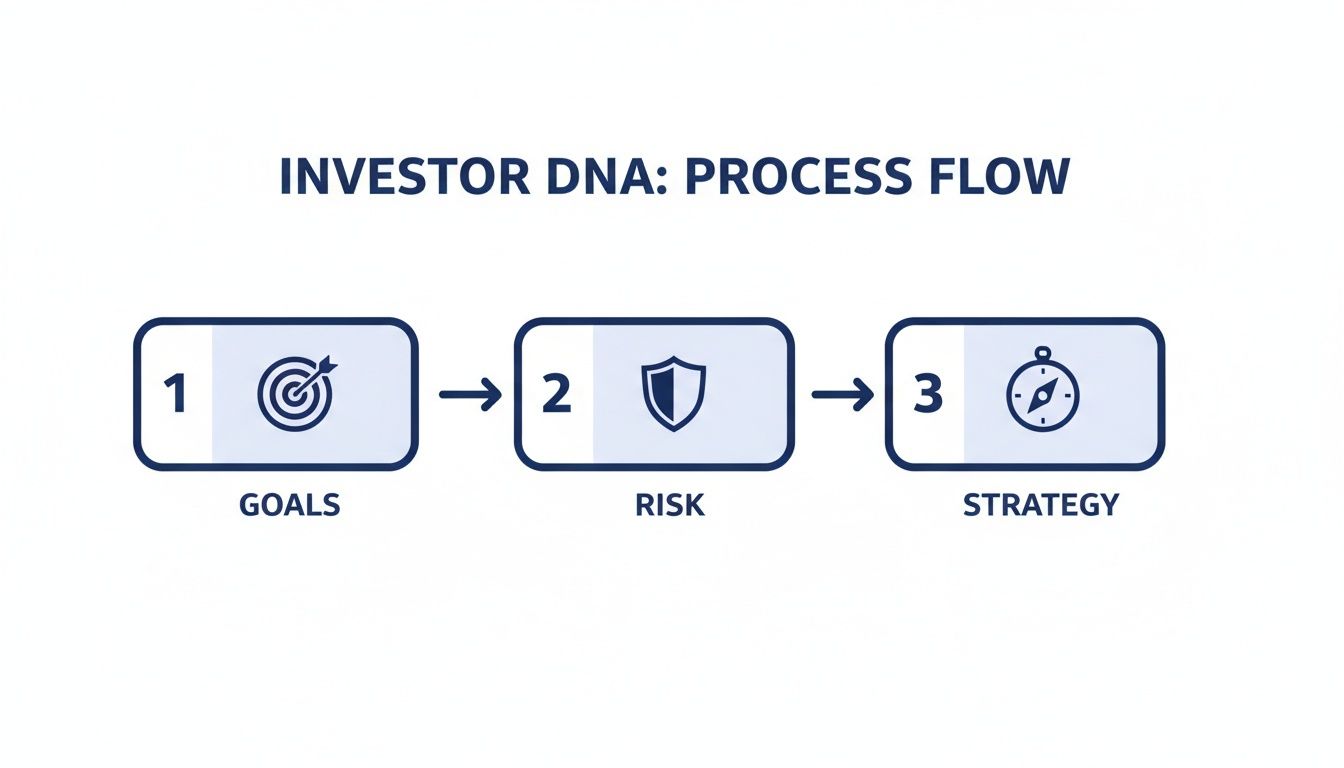
As you can see, locking in your goals, risk tolerance, and strategy is the essential foundation you must build before you ever start looking for a deal.
Identify Your Investor Identity
With your goals in hand, you can start to see which investor archetype fits your personality and resources. Each path requires a different mix of time, money, and stomach for risk.
- The Buy-and-Hold Investor: This is the classic path. You buy properties for long-term rental income and slow, steady appreciation. It's perfect for someone looking for predictable cash flow to replace or supplement their day job. It's generally lower-risk and less hands-on once a property is stabilized.
- The BRRRR Strategist: This stands for Buy, Rehab, Rent, Refinance, Repeat. It’s an active, fast-paced strategy where you force appreciation through renovations, then pull your capital out with a refinance to do it all over again. This is for investors who have the time, skill, and nerve for construction projects and creative financing.
- The House Flipper: Focused entirely on a quick profit, a flipper buys, renovates, and sells in a matter of months. This is less of a passive investment and more of an active business, demanding deep market knowledge and a reliable team of contractors.
Your available time is just as important as your available capital. A high-powered executive with little free time should probably avoid a strategy that requires managing a full-scale renovation from afar.
You have to be brutally honest with yourself here. Do you really have 20 hours a week to hunt for deals and manage projects, or is it closer to two? Do you have a big chunk of cash for a down payment, or do you need to find a strategy with a lower barrier to entry? Your answers will point you in the right direction and stop you from building a portfolio that just burns you out.
Crafting a Portfolio That Can Weather Any Storm
A truly powerful real estate portfolio isn’t just a random assortment of properties you've picked up over the years. It's a carefully assembled machine, built for resilience. Once you’ve figured out what you want to achieve, the real work begins: architecting a portfolio that can handle economic curveballs and even thrive during downturns. This means you need to stop just hunting for "good deals" and start thinking like a strategist, building a balanced mix of assets.

The name of the game is diversification. It's investing 101, but it’s amazing how many people forget it with real estate. You wouldn't dump all your cash into a single stock, so why would you bet everything on one city or one type of property? If a major employer leaves town or regulations change for a specific asset class, your entire investment could be in jeopardy.
By deliberately blending different property types and geographic locations, you create a portfolio that’s both offensive and defensive—ready to pounce on opportunities while being insulated from isolated market shocks.
Getting the Right Mix of Property Types
Every property type has its own personality. They behave differently, offer unique benefits, and come with their own set of headaches. Understanding these nuances is crucial for building a mix that actually fits your goals and your tolerance for risk.
- Single-Family Homes (SFHs): This is the classic entry point for most new investors. SFHs are straightforward, easier to finance, and tend to attract stable, long-term tenants. The big downside? A single vacancy means 100% loss of income for that property until you find a new renter.
- Small Multi-Family (2-4 Units): Duplexes, triplexes, and fourplexes are my favorite sweet spot. You get some economies of scale (one roof, one loan, multiple rent checks), and the vacancy risk is automatically cut in half or more.
- Larger Multi-Family (5+ Units): Now you're in the commercial real estate league. It takes more capital and a sharper management skillset, but these properties are cash flow machines and offer incredible stability because the risk is spread across many tenants.
- Short-Term Rentals (STRs): Think Airbnb or Vrbo. The income potential can blow long-term rentals out of the water, but it's a hands-on business. You're dealing with constant turnover, more management, and your income can be sensitive to travel trends.
A battle-tested strategy for new investors is "house hacking." You start with a duplex, live in one unit to slash your personal housing costs, and rent out the other. The experience—and cash flow—you gain becomes the launchpad for your next deal, whether it’s an SFH or another small multi-family.
Why Where You Invest Matters (A Lot)
The location of your property is just as critical as the property itself. Local job growth, population shifts, and landlord-tenant laws will directly dictate your returns. Spreading your investments across different geographic areas is your best defense against getting wiped out by a single sluggish local economy.
For instance, a savvy investor might build a portfolio by combining properties from two very different kinds of markets. This creates a much more stable, blended return.
| Market Type | Primary Goal | Example City | Role in Portfolio |
|---|---|---|---|
| Cash Flow Market | Consistent monthly income | Cleveland, OH | The workhorse. It provides steady, predictable income to cover all your mortgages and build up your cash reserves. |
| Appreciation Market | Long-term equity growth | Austin, TX | The superstar. It drives serious wealth building as property values climb over time. |
This blend is where the magic happens. The reliable cash flow from your Midwest rental can cover the mortgage on your Texas property during a vacancy. All the while, the powerful appreciation in Texas is building the net worth you'll need to get financing for the next acquisition.
Mixing it up across both property types and geographies is the bedrock of a resilient portfolio. History proves it. Diversified portfolios historically outperformed undiversified ones by 20-25% during the market repricing after 2020 because different assets recovered at different speeds. For example, while industrial properties shot up 15-20% thanks to e-commerce, a smarter strategy might have allocated 40% to residential for that steady income and another 30% to international REITs to insulate against local downturns. You can explore other proven portfolio models and find additional details about real estate investing on amerisave.com.
Mastering Deal Sourcing and Analysis
Once you’ve got your investment thesis nailed down, it’s time to get out of the spreadsheet and into the market. A real estate portfolio is built one deal at a time, and your success really comes down to two things: finding great opportunities and knowing how to vet them like a pro.
This is where the rubber meets the road. It’s easy to get overwhelmed by the flood of listings or, even worse, get paralyzed by the fear of making a bad call. The secret is to build a repeatable system for both finding deals and running the numbers. Without a process, you’re just gambling.
Finding Deals Before Everyone Else Does
Let's be honest, the best investments are rarely the ones that just fall into your lap from a Zillow alert. You have to actively hunt for value where others aren't looking. This means casting a wide net across both on-market and off-market channels.
- On-Market Deals: These are the properties you see listed publicly on the Multiple Listing Service (MLS). Yes, the competition is fierce, but you can get a serious edge by partnering with an investor-focused real estate agent. They're a different breed—they understand cash flow, speak your language, and bring you properties that actually fit your criteria.
- Off-Market Deals: These are the hidden gems. Finding them takes more hustle, but that effort often pays off with better prices and more flexible terms. You can dig these up by networking with local wholesalers, "driving for dollars" to spot distressed-looking properties, or even running direct mail campaigns to absentee owners.
Pro-Tip: A source most investors completely overlook? Local property management companies. They have the inside scoop on which landlords are getting tired and might be ready to sell their portfolios, often long before a "For Sale" sign ever hits the yard.
A truly robust strategy uses a mix of everything. Relying only on public listings means you're fighting the biggest crowds. By building multiple deal-finding channels, you create a consistent pipeline. For a deeper look at this, our guide on improving your real estate deal flow has more strategies.
Analyzing Deals Like a Pro
Finding a potential property is just the start. Knowing how to properly analyze it is what protects your capital and ensures you're actually building wealth. You have to look past the shiny new paint and dig into the numbers that truly define an asset's performance.
There are three metrics that should become second nature to you:
- Net Operating Income (NOI): This is your property's total income minus all operating expenses—before you factor in your mortgage. The NOI tells you how profitable the asset is on its own, regardless of how you finance it.
- Capitalization Rate (Cap Rate): You get this by dividing the NOI by the purchase price. The Cap Rate is the purest way to measure your unleveraged return, making it perfect for comparing the relative value of different properties in the same market.
- Cash-on-Cash (CoC) Return: This is the big one for you, the investor. It’s your annual pre-tax cash flow divided by the total cash you put into the deal (down payment, closing costs, etc.). It directly answers the question: "What return am I getting on the money I pulled out of my pocket?"
Let’s walk through a quick example to see how this all fits together.
Sample Single-Family Rental Deal Analysis
This table breaks down the key financial metrics for a hypothetical investment property to show you how the analysis process works in the real world.
Imagine you've found a single-family home for sale at $250,000. You've done your research and know it can rent for $2,200 per month. You're planning on a conventional loan with 25% down. Here’s how you'd break it down.
| Metric | Calculation/Value | Description |
|---|---|---|
| Purchase Price | $250,000 | The agreed-upon sale price of the property. |
| Gross Annual Income | $26,400 ($2,200 x 12) | Total potential rent collected over one year. |
| Annual Expenses | -$10,560 (40% of Gross) | An estimate covering taxes, insurance, vacancy (5%), repairs (5%), capex (8%), and management (10%). |
| Net Operating Income (NOI) | $15,840 | The property's annual profit before the mortgage. |
| Cap Rate | 6.34% ($15,840 / $250,000) | Your annual return if you paid all cash for the property. |
| Mortgage Payment (P&I) | -$11,436 (30yr @ 6%) | The annual cost of your loan principal and interest. |
| Pre-Tax Cash Flow | $4,404 ($15,840 - $11,436) | The actual profit you put in your pocket each year. |
| Total Cash Invested | $70,000 (25% DP + Closing) | The total out-of-pocket cash to acquire the property. |
| Cash-on-Cash Return | 6.29% ($4,404 / $70,000) | The return on your actual cash investment for the year. |
This systematic analysis tells you the whole story. The property is profitable on its own (a healthy NOI) and delivers a 6.29% return on your invested cash. This is how you make informed decisions. Running every single potential deal through this exact same process is how you stop guessing and start building a portfolio based on solid, reliable numbers.
Securing Smart Financing for Growth
A great deal is only as good as the financing you line up to buy it. Using borrowed money to acquire an asset—what we call leverage—is the secret sauce for scaling a real estate portfolio quickly. It's how you control a valuable property with only a fraction of its total cost coming out of your own pocket.
But think of it like rocket fuel: incredibly powerful, but you have to handle it carefully to avoid a catastrophe.

Understanding your financing options isn't just a box to check off a list. It's a strategic decision that directly impacts your cash flow, your risk, and your overall return. The right loan can put your growth on the fast track, while the wrong one can sink a property before you even cash the first rent check.
Navigating Traditional Loan Options
For most investors just starting out, conventional mortgages are the bread and butter. These are the standard loans you get from a bank or mortgage lender, and the most common options each have their own pros and cons.
- 30-Year Fixed-Rate Mortgage: This is the marathon runner of loans. The payments are stretched over three decades, giving you the lowest possible monthly payment. That's fantastic for maximizing your monthly cash flow, but you’ll end up paying a lot more in interest over the long haul.
- 15-Year Fixed-Rate Mortgage: This one’s the sprinter. Your monthly payments will be significantly higher, which definitely puts a squeeze on your cash flow. The upside? You build equity at lightning speed and pay far less in total interest, freeing up the property's income potential much, much sooner.
The down payment is another critical piece of the puzzle. For investment properties, lenders are typically looking for 20-25% down. Putting down 25% will lower your monthly payment and reduce your risk, but it also ties up more of your cash. That, in turn, brings down your cash-on-cash return. It's the classic tradeoff between playing it safe and moving fast.
The financing you choose directly shapes your returns. A 30-year loan will almost always give you a higher cash-on-cash return in the early years, while a 15-year loan builds your net worth faster.
Exploring Creative Financing Strategies
So, what happens when you find a fantastic deal that just doesn't fit into the neat little box a traditional lender requires? This is where creative financing becomes your best friend. These strategies let you get deals done with less of your own money or on more flexible terms.
Two of my favorite options are:
- Seller Financing: In this setup, the property owner acts as the bank. You make your payments directly to them instead of a lender. This can be a huge win, especially with a motivated seller. You can often negotiate a lower down payment, a better interest rate, and skip a lot of the usual bank fees.
- Partnerships: Teaming up with others is a brilliant way to pool both capital and expertise. Maybe you find someone with cash for the down payment, while you bring the skills to find and manage the deal. Just make sure you have a rock-solid partnership agreement that spells out everyone's roles, responsibilities, and how profits get split.
These methods can open up a whole new world of deals you otherwise couldn't touch. For a deeper dive, our complete guide on how to finance a rental property covers these and other advanced options.
Your Acquisition and Due Diligence Checklist
Getting your financing in order is just one piece of the acquisition puzzle. Once your offer is accepted, the due diligence period starts. This is your last chance to uncover any hidden nightmares before you're legally on the hook. You absolutely need a system.
Here's a practical checklist to get you from offer to closing:
- Make a Compelling Offer: Your offer should be grounded in solid analysis, not emotion. Always include your financing pre-approval letter to show you're a serious buyer.
- Conduct a Professional Inspection: Never skip this. Hire a qualified home inspector to go over the property's structure, roof, HVAC, plumbing, and electrical systems with a fine-tooth comb.
- Review the Appraisal: Your lender will order an appraisal to confirm the property is worth what you're paying. Go through it carefully to make sure it comes in at or above your offer price.
- Complete a Title Search: A title company will dig into the property’s history to ensure there are no surprise liens or ownership disputes. This is how you get a "clear title."
- Final Walk-Through: Just before closing, walk the property one last time. You need to verify it's in the same condition as when you made the offer and that any negotiated repairs are done.
- Close the Deal: At closing, you'll sign a mountain of paperwork, pay your closing costs and down payment, and finally get the keys. Congratulations—you just added a new asset to your portfolio
Building Systems for Property Management
Getting a property under contract is an event. Actually managing it day-in and day-out? That’s a business. I’ve seen far too many investors get so wrapped up in the thrill of the deal that they completely forget about the operational side of things—which is where your returns are actually made.
Without solid systems in place, that shiny new portfolio can quickly devolve from a wealth-building machine into a chaotic, time-sucking nightmare.
The very first operational decision you have to make is how you'll manage the property. Are you going to be the hands-on landlord, or will you hand the keys to a professional property manager? There’s no single right answer here, but your choice will fundamentally define your role as an investor.
Self-Management vs. Professional Management
Going the DIY route gives you ultimate control and, maybe more importantly, saves you the management fee. This fee typically runs between 8-12% of the monthly rent, so keeping that in your pocket can seriously boost your cash flow, especially when you're just starting out.
The trade-off, of course, is your time. You have to be ready for the late-night calls about a leaky faucet, the awkward conversations about late rent, and the headaches of navigating tricky tenant issues.
Hiring a professional property manager, on the other hand, makes your investment far more passive. They handle pretty much everything: marketing the property, screening applicants, collecting rent, and coordinating repairs. This frees you up to focus on higher-value tasks, like finding the next deal. The cost is a direct hit to your monthly profit, but the peace of mind can be priceless.
The decision often comes down to a simple question of scale and distance. Managing one local duplex is manageable for most people. Managing ten properties spread across three different states is a job for a professional.
If you choose to self-manage, your success will depend entirely on building efficient, repeatable processes. To protect your asset and your sanity, you need to become an expert in a few key areas.
- Tenant Screening: This is your first line of defense. Create a standardized process that includes background checks, credit reports, and income verification. I always aim for a gross monthly income of at least 3x the rent. Don't skip calling their previous landlords—it's non-negotiable.
- Ironclad Leases: Don't just download a generic template from the internet. Use a state-specific lease agreement that has been drafted or at least reviewed by a local real estate attorney. It needs to clearly outline all the rules, rent due dates, late fees, and who is responsible for what maintenance.
- Streamlined Operations: Use modern tools to make your life easier. Platforms for online rent collection ensure you get paid on time without chasing checks. A dedicated email or a simple ticketing system for maintenance requests keeps everything organized and well-documented.
Finding the Right Property Management Partner
If you decide to hire a pro, your job shifts from managing tenants to managing your manager. Don't take this lightly; you're entrusting someone with a six-figure asset. I recommend interviewing at least three different companies and approaching it like you're hiring a key employee for your business.
Get right to the point with targeted questions about their operations:
- What does your tenant screening process look like?
- How do you handle late rent payments and, if necessary, evictions?
- What's your average vacancy rate across the properties you manage?
- How are maintenance requests handled, and what are the associated costs and markups?
- Can I see a sample monthly owner's statement so I know what to expect?
A great property manager is a true partner, actively working to maximize your revenue and protect your investment. A bad one can bleed you dry with vacancies, inflated repair bills, and poor tenant placement.
Set Up Your Business Foundation from Day One
Regardless of which management path you choose, you have to treat your portfolio like a real business from the very first property. This means creating a clean separation between your personal and investment finances.
Start with these simple but critical steps:
- Open a Dedicated Business Bank Account: All rental income goes into this account, and all property-related expenses are paid from it. This makes bookkeeping a breeze and is absolutely essential for tax purposes.
- Use Simple Accounting Software: You don't need a complex or expensive system to start. A tool like Stessa (which is designed for landlords) or even a well-organized spreadsheet can track income and expenses, giving you a clear financial picture of your portfolio at a glance.
Putting these basic systems in place from the beginning is what allows you to scale effectively. It gives you the financial clarity needed to make smart decisions and frees up your mental energy to focus on what matters most: building your real estate portfolio.
Common Questions on Building a Real Estate Portfolio

As you start putting all this theory into action, questions are going to pop up. That's a good thing. Building a real estate portfolio is a journey with plenty of forks in the road, and knowing how to navigate them with confidence is what really separates successful investors from those who get stuck.
Let's tackle some of the most common questions I hear from both new and growing investors. The goal here is to give you clear, straightforward answers to keep you moving forward.
How Much Money Do I Need to Start?
This is the big one, and the honest answer is… it completely depends on your strategy. There’s no magic number that unlocks the door to real estate investing.
For a traditional investment loan, you should plan on a down payment of 20-25% of the purchase price. On top of that, you'll need another 3-5% for closing costs and, ideally, at least three months of expense reserves in the bank for those inevitable surprises.
But you can absolutely get started with far less by being creative. Strategies like house hacking with an FHA loan (which only requires 3.5% down) or partnering with someone who has the cash can dramatically lower what you need to bring to the table. The key isn't having a massive pile of cash; it's matching your entry strategy to your current financial reality.
Should I Pay Off One Property Before Buying Another?
This choice really boils down to a classic tug-of-war between security and speed. There's no universally "correct" answer here; it all comes back to your personal goals and how much risk you're comfortable with.
Paying off a mortgage gives you a completely debt-free, cash-flowing asset. That path is incredibly secure and provides a powerful sense of financial stability. The major downside? It massively slows down your portfolio growth by keeping all your capital tied up in a single property.
On the other hand, most investors choose to use leverage to accelerate their growth. They keep the mortgages on their properties and use the accumulated equity and steady cash flow to acquire more assets. This approach builds wealth much faster but also brings more risk into your portfolio. A hybrid approach can be a great balance—maybe you pay down loans more aggressively on your first couple of properties before you start scaling up.
What Are the Biggest Mistakes New Investors Make?
The road to building a portfolio is littered with common, totally avoidable mistakes. Just being aware of them from the start is your best defense.
The most frequent—and costly—errors I see are:
- Underestimating Expenses: New investors get laser-focused on the mortgage payment but forget to budget for the "big four" silent killers: vacancy, maintenance, capital expenditures (like a new roof), and property management. A conservative budget is a profitable budget.
- Shoddy Due Diligence: Skipping a professional home inspection or failing to actually verify the seller's rental income and expense claims is a recipe for disaster. Never let excitement rush you past this critical step.
- Poor Tenant Screening: One bad tenant can cost you thousands in lost rent, legal fees, and property damage. Your screening process has to be rigorous, consistent, and non-negotiable.
The single biggest mistake is treating real estate investing like a hobby instead of a business. Having solid, repeatable systems for your deal analysis, property management, and bookkeeping from day one is the surest way to avoid these expensive lessons.
How Do I Know When It Is Time to Scale My Portfolio?
The urge to grow quickly is strong, but scaling should always be a strategic move, not an emotional one. I've seen investors try to expand before their foundation was solid, and it's one of the fastest ways to get into serious trouble.
You're probably ready to scale when you can check off these boxes:
- Your existing properties are stable, profitable, and running smoothly.
- Your management systems—whether you do it yourself or hire a pro—are efficient and don't require your constant attention.
- You've successfully built your cash reserves back up.
- You have a clear and confirmed path to securing financing for your next purchase.
Scaling is about building on success, not just chasing more properties for the sake of it. When your current portfolio is a well-oiled machine, that's your green light to go find the next deal.
Ready to stop guessing and start making data-driven investment decisions? Property Scout 360 gives you the tools to analyze deals, forecast returns, and build your real estate portfolio with confidence. Eliminate spreadsheets and find your next profitable property in minutes at https://propertyscout360.com.
About the Author
Related Articles
2026 Investor's Guide: Cost of Installing a Sewer Clean Out
Understand the cost of installing a sewer clean out for investment properties in 2026. Get expert advice on prices, ROI, & budgeting for flips. Plan smart!
15 Year vs 30 Year Mortgage: The Investor's Choice
Deciding between a 15 year vs 30 year mortgage for a rental property? Our guide analyzes cash flow, ROI, and equity to help you pick the best loan.
Real Estate Appraisal Software: Features & Limits
Discover what real estate appraisal software is, its core features, and limits. See how it differs from investment tools for profitable deals.
