How to Find Distressed Properties for Your Next Big Investment
Discover how to find distressed properties with our guide. We share proven on-market and off-market strategies to uncover real estate deals others miss.
Finding a great deal on a distressed property often means you're not just buying a house; you're solving a problem for a motivated seller. It's about looking past the peeling paint or overgrown lawn and seeing the hidden potential. You can uncover these undervalued assets long before they ever hit the competitive open market by using proven strategies like driving for dollars, digging into public records for pre-foreclosures, and building a solid network of wholesalers.
Your Guide to Uncovering Hidden Real Estate Deals

When seasoned investors talk about distressed properties, they’re not always picturing a dilapidated building on the verge of collapse. They see a situation—an opportunity where a property can be acquired below market value. The "distress" isn't just physical; it's often financial or circumstantial, like a looming foreclosure, an unpaid tax bill, or a home stuck in probate after an owner's passing.
This guide is your playbook. We'll walk through the exact strategies the pros use to consistently find these deals, from pounding the pavement to building a network that brings opportunities right to your doorstep. It’s all about knowing where to look and how to spot the signs others miss.
What Makes a Property Distressed?
A property’s distress is rarely just about its physical condition. The real key is the owner's urgent need to sell. Understanding what drives this motivation helps you focus your search.
Here are the most common scenarios you'll encounter:
- Financial Duress: The owner has fallen behind on their mortgage payments (pre-foreclosure) or is delinquent on property taxes (tax lien). This is a time-sensitive situation where a quick sale can prevent further financial damage.
- Inheritance: Heirs have been left with a property they either don't want or can't afford to maintain. These probate sales often lead to quick, below-market transactions.
- Neglect: The house shows obvious signs of deferred maintenance—think overgrown yards, peeling paint, or a tarp on the roof. This often points to an owner who is overwhelmed, absentee, or simply can't afford the upkeep.
These opportunities are more common than you might think. In a recent quarter, foreclosure activity in the US jumped 13% year-over-year, impacting over 100,000 properties. This trend, highlighted by data from sources like Amerisave, shows just how powerful digging into public records can be.
The best deals are often found by solving someone's problem. When you learn how to find distressed properties, you're really learning how to identify and assist motivated sellers, creating a win-win scenario.
Later, we'll dive into how modern tools like Property Scout 360 can slash your research time from weeks to minutes, allowing you to make quick, data-driven decisions. Once you master these techniques, you'll have a repeatable system for finding your next profitable deal. For a broader overview, check out our guide on how to find an investment property.
Top Methods for Finding Distressed Properties at a Glance
For those just starting, it helps to see the different paths you can take to find a deal. Some methods require more hustle, while others rely more on data and networking.
Here’s a quick breakdown of the most effective strategies to get you started:
| Method | Primary Source | Effort Level | Best For |
|---|---|---|---|
| Driving for Dollars | Your own observation | High | Finding visibly neglected, off-market properties. |
| Public Records | County clerk, courthouse | Medium | Targeting pre-foreclosures, tax liens, probate. |
| Networking | Wholesalers, attorneys, agents | Medium | Getting a steady flow of pre-vetted deals. |
| Auctions | Online & in-person platforms | Low | Investors comfortable with fast-paced buying. |
Each approach has its own rhythm and rewards. The key is to pick one or two that align with your style and local market, then execute consistently.
Finding Deals Through Public Records and On-Market Listings
While everyone seems to be chasing those elusive, whispered-about off-market deals, a ton of great opportunities are hiding in plain sight. I'm talking about public records and standard on-market listings. These sources are accessible and reliable, but the catch is they often attract more eyeballs.
The secret isn't finding a hidden source nobody knows about; it's learning how to filter through the noise and spot the gems everyone else is scrolling right past.
Mining the MLS for Motivated Sellers
Your first stop for on-market distressed properties is usually the Multiple Listing Service (MLS). Yes, it’s the main playground for traditional real estate, but for a savvy investor, it's also a goldmine. You just need to speak the right language.
Most buyers want a turnkey, move-in-ready home. This is great news for us, because properties needing work get ignored, and that's where we find our advantage. When you or your investor-friendly agent search the MLS, you have to think like a problem solver, not a homebuyer.
Use specific keywords in your search filters to cut through the clutter and zero in on what matters. These terms are basically distress signals from sellers who are ready to make a deal.
- REO (Real Estate Owned): This is industry-speak for a property that's already gone through foreclosure and is now owned by the lender. Banks want these off their books—fast.
- Bank-Owned: Just a more common way of saying REO. It’s a clear sign of a non-emotional, business-minded seller.
- Fixer-Upper: The most direct admission that a property needs serious work. This scares off the competition.
- TLC (Tender Loving Care): A softer, gentler way of saying "this place needs help." It’s often priced to reflect that.
- As-Is: This means the seller won’t be making any repairs. It’s a huge hint that there are known issues you can use as leverage.
When you focus your searches on these listings, you’re skipping all the perfectly staged, overpriced homes and getting straight to the properties where your investment can create real value.
Uncovering Deals in Public Records
If you're willing to roll up your sleeves and do a little old-school digging, public records can give you a direct line to distressed situations, sometimes before they ever hit the open market. These records live at your local county courthouse or recorder's office, and they’re open to anyone.
It might feel a bit old-fashioned, but heading to the courthouse is where the paper trail of distress truly begins. You're hunting for specific documents that signal a homeowner is in a tough financial spot.
The real power of public records is timing. By identifying a property in pre-foreclosure, you have the chance to connect with the owner and create a solution before the bank steps in and the competition intensifies.
Here’s what you should be looking for:
- Lis Pendens: A formal notice that a lawsuit has been filed. In real estate, this is almost always the first public flare in the foreclosure process. It’s a bright red flag that the owner is behind on their mortgage.
- Notice of Default: This document comes after the lis pendens and makes it official: the borrower has defaulted on their loan terms.
- Tax Lien Filings: When a homeowner gets behind on property taxes, the county can place a lien on the property. These owners are often extremely motivated to sell just to clear that debt.
- Probate Court Records: When someone passes away without a clear will, their home can end up in probate. The heirs are usually looking to sell the property quickly to settle the estate and get their inheritance.
Navigating Property Auctions
Auctions are another fantastic public channel for buying distressed properties. They range from chaotic sales on the courthouse steps to sleek online platforms. The pace is fast and you have to be decisive, but the discounts can be massive. Many of these opportunities are listed publicly, and you can get a feel for the landscape by checking out local guides to real estate auctions and other online resources.
It’s absolutely critical to understand the different kinds of auctions you’ll run into.
Types of Real Estate Auctions
| Auction Type | Description | Key Consideration |
|---|---|---|
| Sheriff's Sale | This is the final stage of a foreclosure, where the property is auctioned off, often right on the courthouse steps. | The bidding is fierce, and you almost always need to pay in full with cash on the day of the sale. |
| Online Auctions | Platforms like Auction.com or Hubzu list bank-owned (REO) properties and short sales for online bidding. | The process is more structured. You get clearer rules and usually a bit more time for your due diligence. |
| Tax Lien Sales | Here, you aren't bidding on the property itself, but on the tax lien. If the owner doesn't pay the debt back, you can foreclose. | This is a much more complex strategy and requires a solid understanding of your state's specific laws. |
Whether you're filtering keywords on the MLS or digging through dusty courthouse files, the goal is always the same: find the motivation behind the listing. That's where your real opportunity is hiding.
Mastering the Hunt for Off-Market Properties
Let's be honest: the best deals are almost never sitting on the MLS. The truly profitable finds are discovered through some good, old-fashioned hustle—finding motivated sellers before they ever list their property.
This is where you graduate from just browsing listings to actively creating your own opportunities. It takes more work, absolutely, but going off-market is how you find deals with far less competition and much healthier margins.
Modernizing the "Driving for Dollars" Strategy
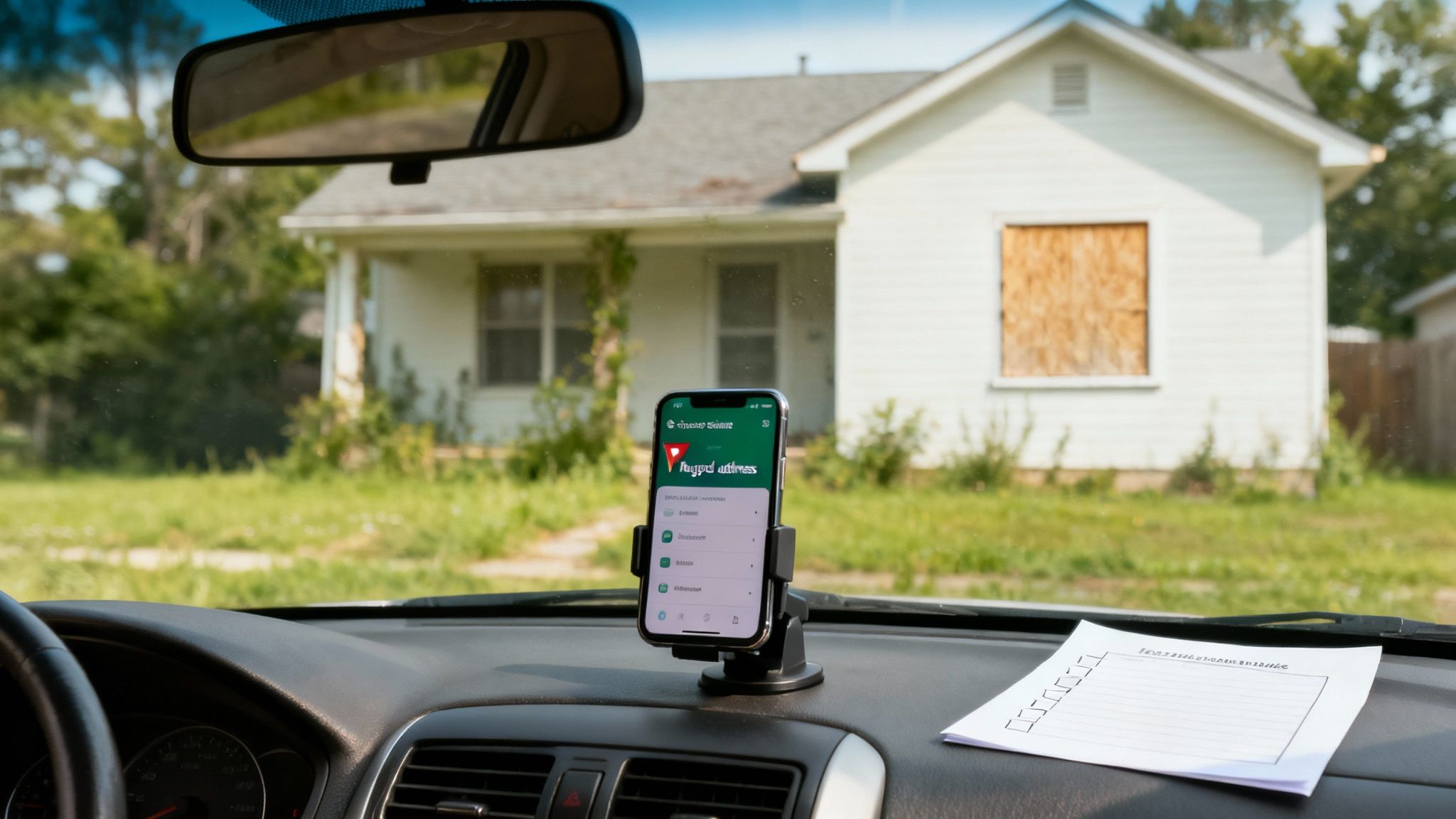
Driving for dollars is a classic for a reason: it flat-out works. The idea is simple. You drive through neighborhoods you're targeting and physically look for properties that scream "neglected." You're essentially a property detective, searching for clues that everyone else drives right past.
Your goal is to spot physical signs of distress that often point to a motivated seller—someone who might be overwhelmed, absent, or just unable to keep up with the property anymore.
So, what are you actually looking for?
- Jungle-like Landscaping: Think weeds swallowing the flowerbeds, grass a foot high, or bushes that haven't seen clippers in years.
- Obvious Exterior Damage: Peeling paint is a big one. Also, look for tarps on the roof, boarded-up windows, or a fence that's falling over.
- Signs of Vacancy: Mail or flyers piled up on the porch is a dead giveaway. No lights on at night over several days is another clue.
- Official Notices: Keep an eye out for code violation stickers from the city or utility shut-off notices taped to a door or window.
Back in the day, this meant scribbling addresses on a notepad and hoping for the best. Today, technology makes this a hundred times more efficient. Apps like DealMachine or PropStream let you pin a property on a map, pull up the owner's information instantly, and even send a postcard right from your phone. A simple drive becomes a high-powered lead-generation session.
Driving for dollars does more than just find you deals; it teaches you the market. You start to learn a neighborhood block by block, giving you an almost unfair advantage when it comes to understanding local property values and trends.
Crafting a Direct Mail Campaign That Actually Gets a Response
Okay, you've got a list of potential properties. Now what? It's time to reach out, and direct mail is still one of the most effective ways to make that first contact. A well-written letter can cut through all the digital noise and land right in a homeowner's hands.
The secret is to sound like a real person, not a faceless corporation. You're an individual offering a potential solution to someone's problem. Your message needs to be simple, direct, and, most importantly, empathetic.
What goes into a letter that works?
- Make It Personal: Always, always use the owner's name and the property address. A generic "Dear Homeowner" letter is headed straight for the trash can.
- Keep It Simple: Get straight to the point. Something like, "I'm a local investor and I'm interested in buying your property at [Property Address]."
- Show Some Empathy: You can acknowledge their situation without being nosy. A simple phrase like, "I know selling a property can be a hassle..." goes a long way.
- Have a Clear Call to Action: Tell them exactly what to do next. "Feel free to call or text me at..." makes it easy for them to respond.
Remember, this is a marathon, not a sprint. Sending one batch of letters and calling it a day won't get you far. The pros treat direct mail like an ongoing campaign, hitting their list every 4-6 weeks. It often takes a few tries before a seller is finally ready to pick up the phone.
A Sample Letter to an Absentee Owner
Here’s a straightforward template you can tweak. The goal here is approachability and clarity, not a hard sales pitch.
[Your Name]
[Your Address]
[Your Phone Number / Email]
[Date]
[Owner's Name]
[Owner's Mailing Address]
Subject: A question about your property at [Property Address]
Dear [Owner's Name],
My name is [Your Name]. I'm a local real estate investor who is looking to buy another property in the area, and I noticed your house at [Property Address] on a recent drive through the neighborhood.
I know that owning a property from a distance can sometimes be a real headache. I'm in a position to buy the property with cash and can close on your schedule. You wouldn't have to worry about making any repairs, and I would handle all the closing costs myself.
If you've ever considered selling, I'd appreciate the chance to chat. You can call or text me anytime.
Thank you for your time.
Sincerely,
[Your Name]
The Strategic Use of Bandit Signs
You’ve definitely seen them at busy intersections—those simple, often handwritten signs that say "We Buy Houses Cash" with a phone number. They're called bandit signs, and while they look low-tech, they can be a surprisingly effective way to get your phone to ring.
The strategy is simple: put the signs where people who need your help will see them. This means high-traffic areas, working-class neighborhoods, or on the main roads leading out of town.
But a word of caution: you can't just slap these up anywhere.
Rules of the Road for Bandit Signs:
- Know the Local Laws: Many cities have strict ordinances about "snipe signs." A quick Google search for your city's sign code can save you a lot of money in fines. Don't skip this step.
- Get a "Burner" Number: Never put your personal cell on a bandit sign. Use a free service like Google Voice to get a dedicated number. This protects your privacy and helps you track which signs are actually working.
- Keep the Message Simple: Less is more. "We Buy Houses," "Sell Your House Fast," and your phone number. That's it. Anything else is just noise.
When used the right way, bandit signs can create a steady drip of inbound leads from homeowners who are actively looking for a fast solution. They are a cheap and effective way to let the world know you're open for business.
Building a Network That Feeds You Deals
While pounding the pavement and digging through public records will absolutely unearth opportunities, the best investors I know all agree: real estate is a team sport. Your personal network can easily become your most powerful—and consistent—deal-finding engine. This doesn't happen by accident, though. It takes a deliberate effort to build genuine relationships where everyone benefits.
Forget the old advice about just handing out business cards at a mixer. You need to connect with the key players who stumble upon distressed properties as a natural part of their work. When you become their go-to person for a quick, reliable sale, a steady stream of high-quality deals will start landing in your inbox.
Forging Relationships with Key Professionals
Certain pros are the gatekeepers to off-market deals. They see the distress long before it ever becomes public knowledge. Your job is to find these people, show them you're a serious buyer, and become the first person they call when an opportunity pops up.
These are the essential contacts you need in your phone right now:
- Real Estate Wholesalers: These are the ground-pounders who specialize in finding undervalued properties, getting them under contract, and then passing that contract to an investor like you for a fee. They're your direct line to pre-vetted deals.
- Probate and Divorce Attorneys: These lawyers handle life's toughest transitions, which often force the sale of a property. They don't want drama; they need reliable buyers who can close fast to help their clients move on.
- Property Managers: Who knows more about burned-out landlords than the people managing their properties? A good property manager will be the first to know when an owner has had enough and is ready to sell their entire portfolio at a discount.
- Contractors and Tradespeople: Plumbers, roofers, and electricians are on the front lines. They’re constantly in homes and can spot major deferred maintenance, giving you a heads-up on a property an overwhelmed owner might be desperate to unload.
How to Approach Your Network
When you reach out, your goal isn't just to ask for deals. It's to show them how you can solve their problems. A wholesaler needs dependable cash buyers. An attorney needs a smooth, hassle-free closing for a stressed-out client.
Position yourself as a problem-solver. When you make a professional's job easier, they will remember you. A simple phrase like, "I can close with cash in 10 days, no inspections," is music to the ears of someone dealing with a complicated probate sale.
Come prepared with a crystal-clear picture of your buying criteria. A vague "send me any deals you have" is useless. Instead, get specific. Tell a wholesaler, "I'm looking for 3-bedroom, 2-bath single-family homes under $200,000 in the Northwood neighborhood that just need cosmetic work." This clarity helps them bring you exactly what you're looking for and is a critical step in optimizing your real estate deal flow.
The Power of Local REIA Meetings
Attending your local Real Estate Investor Association (REIA) meetings is non-negotiable. Seriously. This is the central hub where everyone in the local investing scene gathers—the wholesalers, hard money lenders, contractors, and agents who can help you grow.
Don't just show up and be a wallflower. Your mission at every meeting should be to make two or three meaningful connections. The person sitting next to you could be a seasoned flipper looking to offload a rental or a new wholesaler hunting for their first buyer. Treat every conversation as an opportunity to build a relationship that could feed you deals for years.
How to Analyze Potential Deals and Make Confident Decisions
Finding a promising property is just the first domino. The real skill that separates seasoned investors from rookies is the ability to quickly and accurately analyze a deal. This is where you stop being a hunter and start being a strategist, making data-backed decisions that actually build wealth.
This part of the process, often called underwriting, can feel like a beast, especially when you're starting out. It’s all about running the numbers, estimating costs, and projecting what a property can actually earn you. In the old days, this meant getting lost in a sea of spreadsheets. Thankfully, modern tools have changed the game completely.
Core Metrics Every Investor Must Know
Before you even think about making an offer, you need to have a few key metrics down cold. These are the vital signs of a potential investment; they'll tell you if you've found a goldmine or a money pit. Frankly, mastering them is non-negotiable.
Here are the calculations you'll live and breathe by:
- After Repair Value (ARV): Think of this as your North Star. ARV is what the property will be worth on the open market after you’ve fixed it up and made it shine. It’s the target you’re aiming for.
- The 70% Rule: This is a classic, battle-tested guideline for house flippers. It simply states that you should never pay more than 70% of the ARV, minus the repair costs. This simple formula is your best friend for building in a profit margin and a cushion for those inevitable surprises.
- Cash-on-Cash Return: For buy-and-hold investors, this is king. It measures the annual cash flow you get back compared to the total cash you put into the deal. It's the cleanest way to see how hard your money is actually working for you.
Once you find a property that looks good on the surface, the next step is to accurately estimate renovation costs. Get this number wrong, and you can sink an otherwise fantastic deal before you even start.
Analysis paralysis is real, and it can stop you in your tracks. But if you've done the work and trust your numbers, you can move forward with confidence. A good deal should make perfect sense on paper long before you sign on the dotted line.
A Real-World Analysis Scenario
Let's walk through a real-life example. Say you find a property through your networking—a wholesaler you've been talking to brings you a lead. The asking price is $150,000. You do a walkthrough with your contractor and figure it needs around $30,000 in repairs.
First, you need to nail down the ARV. To do this, you have to run "comps"—finding recently sold, similar homes in the same area that are in the updated condition you're aiming for. This is a critical skill, and you can learn how to pull your own https://propertyscout360.com/blog/free-real-estate-comps to get really good at it.
Let's assume your research shows that renovated homes like this one are selling for $250,000. That's your ARV.
Now, let's plug this into the 70% Rule:
- Calculate 70% of ARV: $250,000 x 0.70 = $175,000
- Subtract Repair Costs: $175,000 - $30,000 (your estimate) = $145,000
This calculation tells you that your Maximum Allowable Offer (MAO) should be $145,000 if you want to protect your profit. The seller is asking $150,000, which is close, but now you have a hard number to anchor your negotiation. You're not just guessing; you're operating from a position of strength.
Using Technology to Accelerate Your Analysis
Manually pulling comps, building spreadsheets, and projecting cash flow for every potential deal is a massive time-suck. It's a surefire way to burn out and miss opportunities. This is exactly where technology gives you a serious competitive edge.
A tool like Property Scout 360 essentially automates the heavy lifting of underwriting. Instead of spending hours or even days staring at a spreadsheet, you can get a full financial breakdown of a property in minutes.
The best deals often come from your network—people on the ground who see opportunities first.
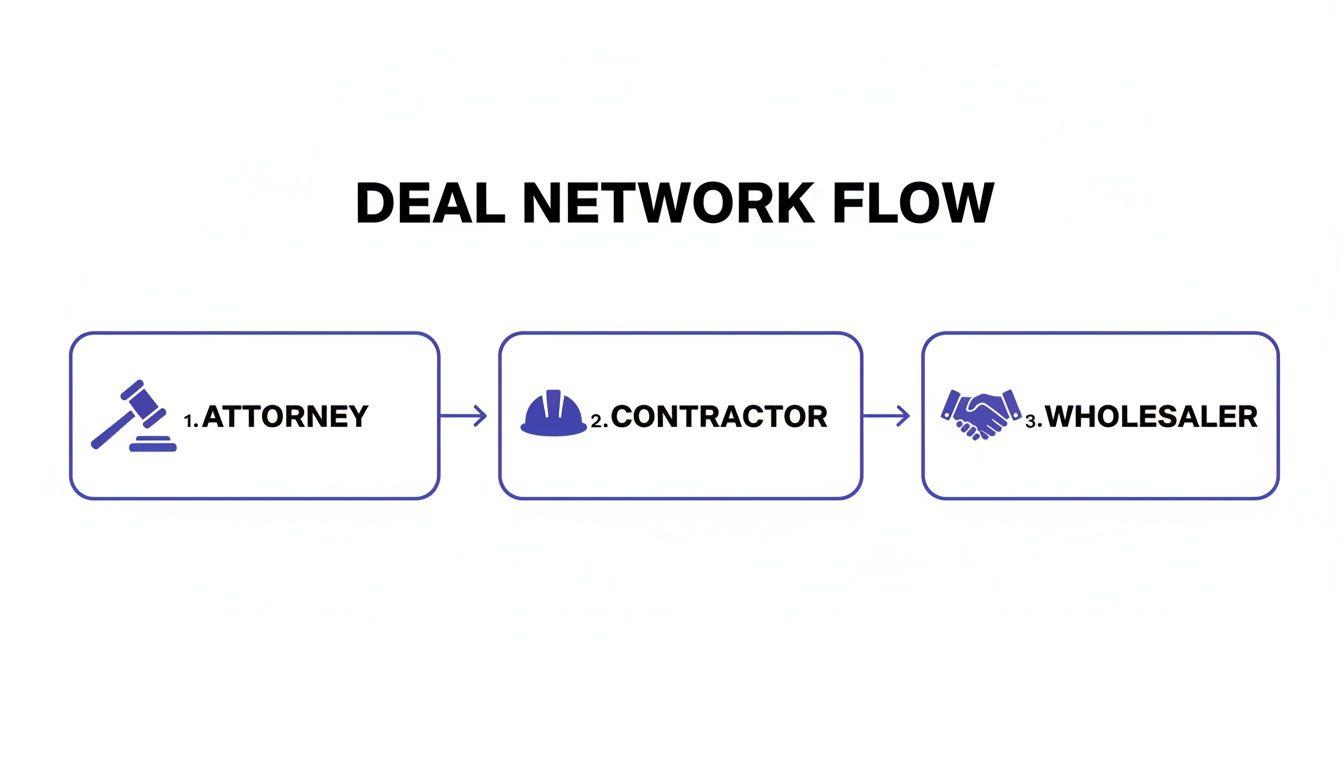
When attorneys, contractors, or wholesalers send you a lead, you need to analyze it fast. That’s where automation comes in.
The table below breaks down just how much time you can save. Manually crunching numbers for one property can take hours, while an automated platform gives you answers almost instantly.
Manual vs. Automated Deal Analysis
| Analysis Task | Manual Method (Time Estimate) | Property Scout 360 (Time Estimate) |
|---|---|---|
| Pulling Comparable Sales (Comps) | 30-60 minutes (searching MLS, Zillow, etc.) | < 1 minute (instant data pull) |
| Calculating ARV | 15-20 minutes (analyzing comps, adjusting for features) | < 1 minute (automated calculation) |
| Estimating ROI & Cash Flow | 45-90 minutes (building/populating a spreadsheet) | < 1 minute (pre-built, instant financial models) |
| Running Financing Scenarios | 30 minutes per scenario (adjusting spreadsheet formulas) | < 1 minute (interactive sliders for rates, DP, etc.) |
| Total Time Per Property | ~2 to 3+ hours | ~5 minutes |
When you're looking at multiple deals a week, that time saving is huge. It's the difference between analyzing two properties and analyzing twenty.
With a tool handling the grunt work, you can instantly:
- Calculate ROI and Cash Flow: See your bottom line without ever opening a calculator.
- Run Financing Scenarios: Toggle between different loan types, rates, and down payments to see how they impact your returns.
- Get 30-Year Projections: Look beyond the flip and understand the long-term wealth potential of a rental.
- Estimate Expenses: Automatically factor in property taxes, insurance, maintenance, and vacancy for a realistic picture.
By automating the underwriting, you can analyze more deals, make offers faster, and beat the competition to the best properties. It’s how you shift from asking "how do I find distressed properties?" to "which one of these great deals should I close on?"
Your Questions on Finding Distressed Properties, Answered
Even with the best strategies in hand, you're bound to have some questions. That’s perfectly normal. Diving into the world of distressed properties isn't like typical real estate—it has its own quirks and challenges.
Let's clear up some of the most common questions that pop up for investors, whether they're just starting out or have a few deals under their belt. My goal is to give you direct, practical answers for the real-world situations you'll likely run into.
What's the Single Best Way for a Beginner to Find Their First Distressed Property?
If you're just getting started, the best approach is to tackle it from two angles at once. First, get on the MLS with a real estate agent who actually understands investor needs. At the same time, start "Driving for Dollars" in your own backyard.
This two-pronged strategy gives you a fantastic balance. The MLS is a structured sandbox where you can learn the ropes. You'll get familiar with keywords like "REO," "short sale," and "fixer-upper" while having an agent to guide you through the process.
Driving for Dollars, on the other hand, is all about old-fashioned detective work. It teaches you to spot the visual cues of a property in trouble—overgrown lawns, boarded-up windows, overflowing mailboxes. This method costs you nothing but time and fuel, and it can unearth incredible off-market deals before anyone else even knows they exist. It’s the perfect mix of online data and on-the-ground reality.
A huge mistake I see beginners make is trying to do everything at once. Don't. Just focus on these two methods first. You'll learn both the numbers side and the street-smart side of investing, which is exactly the foundation you need.
How Much of a Discount Can I Realistically Expect?
The discount you can get on a distressed property is all over the map. It really boils down to the property's condition, how motivated the seller is, and how hot your local market is. That said, it's not unheard of to snag properties for 20-30% below their current market value, especially if you find them off-market or at an auction.
But here's the critical part: the purchase price is only half the equation. A massive discount can disappear in a flash if you're hit with unexpected, five-figure repair costs. Your goal isn't just to buy cheap; it's to create a profitable deal after every single expense is accounted for.
To keep yourself grounded, always run the numbers using a trusted formula like the 70% Rule. This rule of thumb says your maximum offer should be 70% of the After Repair Value (ARV), minus your estimated rehab costs. It's a simple gut-check that forces you to make sure the deal actually works on paper before you get emotionally invested.
Are There Legal or Ethical Issues to Be Aware of When Contacting Distressed Homeowners?
Absolutely, and you need to take this part very seriously. When you're reaching out to homeowners facing pre-foreclosure or other hardships, your approach has to be rooted in empathy and transparency.
Never, ever misrepresent who you are or what your intentions are. Be direct: you're a real estate investor who can potentially offer a solution to their problem by purchasing their property. This isn't the time for high-pressure sales pitches or making grand promises you can't keep. Think of yourself as a problem-solver, not a predator.
On top of that, you have to know the law. Many states have specific rules governing how and when you can contact homeowners in foreclosure. Breaking these rules can land you in serious trouble.
Before you send a single letter or make a single call, do yourself a favor and consult with a real estate attorney. It’s a small investment that protects you, the homeowner, and the integrity of the deal.
Ready to stop spending weeks analyzing deals and start making confident offers in minutes? Property Scout 360 gives you the instant ROI projections, cash flow analysis, and market data you need to find and fund your next great investment. Try Property Scout 360 for free and see how much faster you can build your portfolio.
About the Author
Related Articles
2026 Investor's Guide: Cost of Installing a Sewer Clean Out
Understand the cost of installing a sewer clean out for investment properties in 2026. Get expert advice on prices, ROI, & budgeting for flips. Plan smart!
15 Year vs 30 Year Mortgage: The Investor's Choice
Deciding between a 15 year vs 30 year mortgage for a rental property? Our guide analyzes cash flow, ROI, and equity to help you pick the best loan.
Real Estate Appraisal Software: Features & Limits
Discover what real estate appraisal software is, its core features, and limits. See how it differs from investment tools for profitable deals.
